
Imagine you’re shopping for a CRM (that’s short for Customer Relationship Management software) and you quickly realize there are dozens of options out there. It can feel overwhelming, right? But here’s the thing: a small group of big players actually controls most of the market. Understanding the CRM share landscape can save you a ton of time and help you make a smarter choice for your business.
In this post, we’re breaking it all down in plain, simple terms. No jargon, no confusing charts you need a business degree to understand. Just a clear, honest look at which companies are winning the CRM race, how much of the market they actually own, and why it matters to you as someone exploring your options.
Whether you’re a small business owner trying to pick your first CRM or just someone curious about how the software world works, you’re in the right place. By the time you finish reading, you’ll have a solid grasp of who the major players are and what their dominance in CRM share really means for everyday users like you.
What Is CRM Market Share and Why Should You Care?
Let’s start with the basics. CRM stands for Customer Relationship Management, and at its core, it’s software that helps you keep track of your customers, manage your sales pipeline, and automate the follow-up tasks that would otherwise fall through the cracks. Think of it as a smart digital Rolodex that also reminds you to send that proposal, logs every conversation you’ve had with a client, and tells you which leads are most likely to close. Whether you run a solo freelance business or manage a team of hundreds, a CRM is designed to make selling and relationship-building less chaotic.
Now, market share in this context simply means which software companies are capturing the biggest slice of total global CRM spending. The global CRM market is projected to hit around $126 billion in 2026, and different vendors are competing fiercely for that pie. When you hear that one platform holds 20% market share, it means roughly one in five dollars spent on CRM software worldwide flows to that company.
Here is why that number actually matters to you as a small business owner or first-time buyer. Platforms with larger market share tend to have more third-party integrations, bigger support communities, and more stable long-term product roadmaps. According to CRM statistics for 2026, 91% of companies with ten or more employees already use CRM software, which means the ecosystem around popular platforms is enormous. More users means more tutorials, more freelance consultants who know the tool, and more confidence that the platform will still be thriving five years from now.
The honest truth is that most CRM market share articles are written for enterprise IT procurement teams, not for someone trying to pick their first tool on a tight budget. This piece is different. Understanding the competitive landscape helps you ask smarter questions, spot platforms that may be overpriced for your needs, and avoid betting on a vendor whose growth is stalling or whose community is shrinking.
The Big Picture: A Market Worth Over $112 Billion
If you’ve ever wondered whether CRM software is just a passing trend or a genuine business transformation, the numbers tell a very clear story. The global CRM market surpassed $80 billion in 2023, climbed to an estimated $112 billion in 2025, and is projected to hit a staggering $262 billion by 2032, according to analyst estimates tracked by key CRM statistics for 2026. That kind of growth doesn’t happen by accident. It reflects millions of businesses around the world waking up to the same realization: managing customer relationships with spreadsheets and sticky notes simply doesn’t cut it anymore.
The cloud-based segment is leading the charge here, and it’s easy to see why. 87% of all CRM systems today are cloud-based, meaning teams can log in from a laptop in a coffee shop, a phone on a sales call, or a tablet in a warehouse. On-premise software requires expensive servers, IT maintenance, and physical location access. Cloud CRM eliminates all of that friction, making it a natural fit for today’s distributed, remote-friendly workforces. Scalability is the other big win; you can start small and grow your plan as your business expands, without rebuilding your entire system.
Pricing has also changed the game for smaller businesses. Freemium and subscription-based models have brought professional CRM tools within reach of budgets that would have been locked out entirely a decade ago. A small retail shop or a solo consultant can now access the same core capabilities that enterprise teams rely on, often for free or just a few dollars per month per user.
The competitive pressure driving all of this adoption is real. Gartner research has consistently highlighted that 80% of companies expect customer experience to be their primary competitive battleground, meaning businesses are investing in CRM not just to organize data, but to genuinely win customers and keep them coming back. When you combine that urgency with cloud accessibility and affordable pricing, the explosive growth of this market starts to make complete sense.
Who Is Winning: A Vendor-by-Vendor Breakdown
Now that we’ve seen the overall market picture, let’s zoom in on who’s actually holding the biggest pieces of that pie. The CRM landscape is not an even playing field, and understanding who dominates, who is climbing fast, and who punches above their weight will help you make a much smarter software decision.
Salesforce: The Giant That Keeps Growing
Salesforce is the undisputed heavyweight of the CRM world, holding roughly 20 to 21% of the global CRM market and serving over 327,000 customers worldwide. To put that in perspective, its market share is larger than its next four competitors combined. The company closed its most recent fiscal year with $41.5 billion in total revenue, and its CRM-specific earnings alone outpace what several major tech rivals earn across their entire software divisions. Salesforce has also been ranked the number one CRM vendor by IDC for 13 consecutive years, which is a record no competitor has come close to matching. Its massive ecosystem of third-party integrations, partner apps, and industry-specific solutions makes it especially powerful for large enterprises with complex needs. If your organization needs deep customization and has the budget to match, Salesforce is almost always in the conversation. You can explore a detailed CRM market share breakdown for 2026 to see how these figures compare across vendors.
Microsoft Dynamics 365: The Smart Choice for Microsoft Shops
Microsoft Dynamics 365 holds around 4 to 5% of global CRM market share, and its biggest selling point is not really the CRM itself. It is the ecosystem around it. If your organization already runs on Office 365, Teams, and Azure, Dynamics 365 slots in naturally without requiring your team to learn an entirely new toolset. Its native connections to familiar Microsoft products reduce friction and speed up user adoption significantly. Recent revenue growth figures in the double digits reflect strong demand from enterprise customers who prefer to consolidate their software stack under one vendor. For Microsoft-native organizations, this platform often wins simply by being the path of least resistance.
HubSpot: The Fastest Climber in the Room
HubSpot has emerged as the fastest-growing major CRM vendor, with an estimated 5 to 6% global market share and nearly 300,000 paying customers as of early 2026, growing at roughly 23% year over year. Its freemium model lets small businesses get started at zero cost, which has made it incredibly popular with startups, solo operators, and marketing-led teams. The interface is clean, intuitive, and genuinely beginner-friendly in a way that enterprise platforms often are not. If you are a small or mid-sized business trying to align your marketing and sales teams around a single platform, HubSpot is consistently one of the top recommendations.
Zoho CRM: The Underdog Worth Taking Seriously
Zoho CRM serves over 250,000 businesses worldwide and is one of the most underestimated names in this market. Because Zoho is a private company and does not publish revenue figures, it tends to get undercounted in revenue-based market share analyses, but its real-world adoption tells a different story. It is particularly dominant among budget-conscious SMBs and businesses in price-sensitive international markets across Asia-Pacific, Latin America, and the Middle East. Zoho offers a remarkably broad feature set, covering everything from pipeline management to automation and analytics, at a fraction of what enterprise platforms charge. For teams that want robust capabilities without the enterprise price tag, Zoho consistently delivers strong value.
Quick-Reference Buyer Guide
Not sure which platform fits your situation? Here is a simple starting point:
- Salesforce works best for large enterprises needing deep customization and complex integrations
- HubSpot is ideal for marketing-driven SMBs and teams that value ease of use
- Microsoft Dynamics 365 is the natural fit for organizations already built on the Microsoft ecosystem
- Zoho CRM is perfect for budget-conscious teams that still want a powerful, full-featured platform
Salesforce: How One Company Captured a Fifth of the Entire Market
Salesforce didn’t become the king of CRM by accident. Founded in 1999, the company made an early and bold bet on cloud delivery at a time when most competitors were still selling bulky on-premises software. That head start compounded over two decades of aggressive product investment, growing from a simple sales tool into a massive platform covering sales, service, marketing, and commerce. Add in the AppExchange marketplace, which now hosts nearly 6,000 apps from over 3,600 developers, and you have an ecosystem that is incredibly hard to leave once you’re inside it. According to IDC’s market share rankings, Salesforce has held the number one CRM position for 13 consecutive years.
The market share numbers are genuinely striking. Salesforce commands roughly 21% of the global CRM market, and here’s the part that really puts it in perspective: the next four largest vendors combined still don’t reach that level. That means Salesforce has more CRM market influence than SAP, Oracle, and Microsoft Dynamics 365 put together. You can explore a detailed breakdown of those Salesforce statistics and trends to see just how wide that gap really is.
That said, Salesforce isn’t the right fit for everyone. Smaller businesses often find the platform overwhelming and expensive. Entry-level plans can feel like you’re paying for a rocket ship when you just need a bicycle. The learning curve is steep, and many small teams end up needing a dedicated admin or outside consultant just to keep things running smoothly.
On the innovation front, Salesforce has embedded Einstein AI deeply into its product. Einstein automates lead scoring, predicts which deals are most likely to close, and serves up next-best-action recommendations directly to sales reps in their workflow, making it a genuinely powerful tool for larger teams ready to use it.
Why HubSpot and Zoho Are Winning Over Small Businesses
If Salesforce owns the enterprise world, HubSpot and Zoho have quietly built an empire among the businesses that make up the backbone of the global economy: small and medium-sized companies.
HubSpot’s secret weapon is its free tier. Small businesses can sign up, import their contacts, and start tracking deals without spending a single dollar. That might sound simple, but it fundamentally changed the CRM landscape. Historically, the cost of CRM software was enough to make most small business owners walk away before they even started. HubSpot removed that barrier entirely, and the results speak for themselves. As of Q1 2026, HubSpot has surpassed 299,458 paying customers with annual recurring revenue hitting $3.45 billion, growing at roughly 23% year over year. The freemium model works because businesses start free, see the value, and naturally upgrade as they grow. You can explore HubSpot’s free CRM platform to see exactly what’s included at no cost.
Zoho CRM takes a different but equally effective approach. Rather than leading with a free product, Zoho competes on price and sheer feature depth. It serves over 250,000 businesses worldwide and holds an estimated 3 to 4% global CRM market share, growing at approximately 12 to 15% annually. For businesses that want robust sales automation, workflow management, and reporting without paying enterprise-level prices, Zoho delivers a compelling package. This makes it especially popular in international markets across Asia, the Middle East, and Latin America, where budget sensitivity runs high but appetite for capable software remains strong.
Both platforms have also made ease of use a genuine priority rather than just a marketing claim. HubSpot in particular earns consistently strong reviews for its onboarding experience and clean dashboard design, making it approachable even for business owners who have never used CRM software before. According to HubSpot’s own research data, businesses are increasingly prioritizing tools that their teams will actually adopt and use daily, and intuitive design is a core part of that equation.
The broader trend here is undeniable. The small business CRM market was valued at approximately $16.8 billion in 2024 and is projected to reach $42.5 billion by 2033. Freemium and low-cost platforms are the primary engine pulling micro-businesses and first-time CRM buyers into the ecosystem, and that momentum shows no signs of slowing down through 2026 and well beyond.
What Is Fueling This Explosive Growth?
So what’s actually driving all this growth? It’s not just one thing. Five powerful forces are converging at the same time, and together they’re reshaping what CRM software is and what it can do for a business.
AI and machine learning are the biggest game-changers right now. Every major CRM platform has moved well beyond storing names and phone numbers. Today’s systems embed predictive analytics, automated lead scoring, and AI-driven customer insights directly into the workflow. Think about what that means practically: instead of a sales rep manually reviewing 50 leads and guessing which ones are worth calling first, the system automatically ranks them by likelihood to buy. The AI-powered CRM segment is growing at a CAGR of 13.3%, which is even faster than the overall market, and it’s easy to see why. CRM has fundamentally shifted from a passive contact database into an active revenue intelligence engine that tells you which deals will close and when.
Mobile optimization is pushing that transformation even further. Sales teams are no longer sitting at desks to manage their pipelines. Reps in the field are updating deal stages, logging calls, and pulling up customer history from their phones between meetings. This everyday reality is pushing vendors to build genuinely powerful mobile-first features rather than watered-down versions of their desktop tools. The result is that mobile CRM is now a fast-growing market segment in its own right, with dedicated investment from major vendors.
Social CRM is changing how businesses understand customers. Platforms are now pulling social media data directly into customer profiles, giving sales and support teams a 360-degree picture of how someone interacts with a brand across every channel. This matters because 70% of customers expect a representative to already know their purchase and issue history when they reach out. Meeting that expectation requires unified data, and social CRM integration is how forward-thinking vendors are delivering it.
Data security has quietly become a serious buying criterion. In 2026, businesses are asking harder questions before signing CRM contracts, specifically where their customer data is stored, who can access it, and how it is protected. Privacy concerns are now listed as a named factor influencing vendor selection decisions, and companies that store sensitive customer information are paying close attention to compliance capabilities before they commit.
Finally, the shift from contact management to revenue intelligence may be the most significant structural change of all. Modern CRM platforms now automate repetitive tasks like follow-up emails and meeting scheduling, surface real-time pipeline health metrics, and generate AI-powered forecasts that would have required a full analyst team just five years ago. Research shows companies using the right combination of these tools report 28% higher win rates and 26% larger deal sizes. That kind of measurable output explains exactly why businesses keep increasing their CRM investment year after year.
What Does CRM ROI Actually Look Like in Real Life?
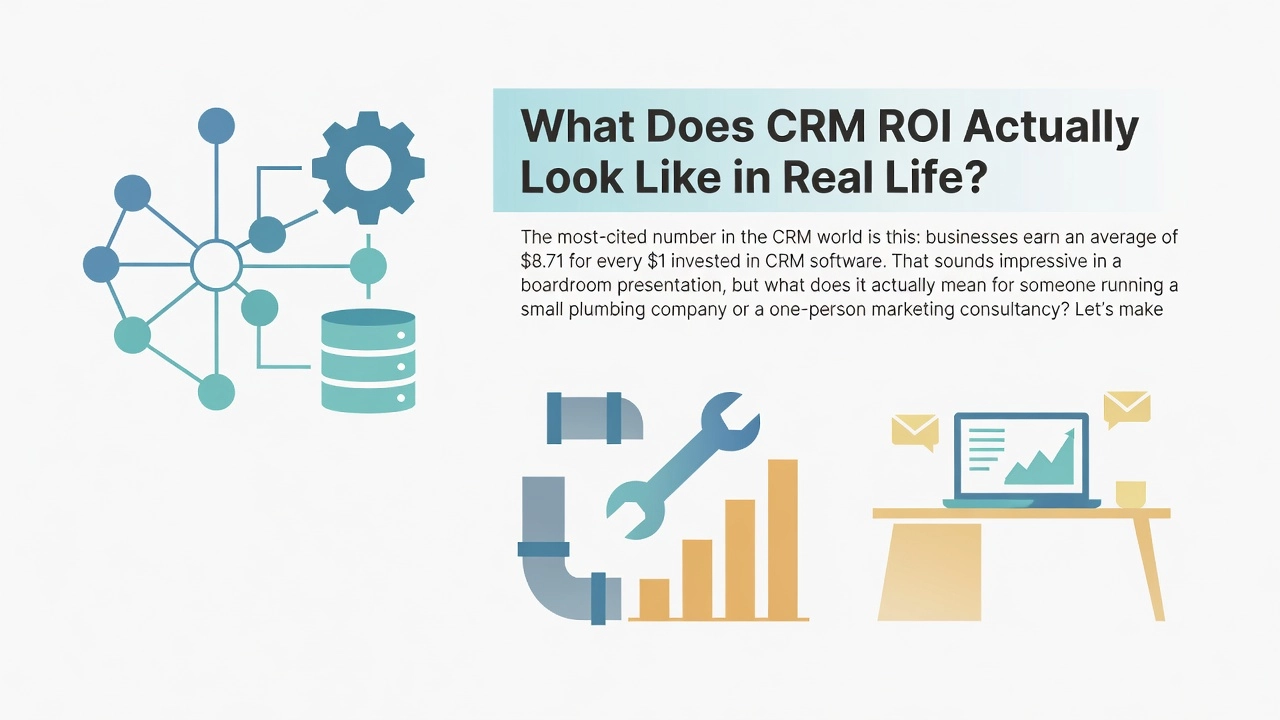
The most-cited number in the CRM world is this: businesses earn an average of $8.71 for every $1 invested in CRM software. That sounds impressive in a boardroom presentation, but what does it actually mean for someone running a small plumbing company or a one-person marketing consultancy? Let’s make it concrete. If you’re spending $50 a month on a CRM subscription, that’s $600 a year. Apply the $8.71 return model and you’re looking at roughly $5,226 in generated value, whether that comes from won deals, retained clients, or hours saved on admin tasks you’d otherwise handle manually. That’s not a rounding error. That’s a real business outcome.
The lead conversion story is where things get especially interesting for local service businesses. A plumber, boutique retailer, or marketing consultant relying on spreadsheets or memory to track follow-ups will inevitably let hot leads go cold. Life gets busy, notes get lost, and a prospect who was ready to buy last Tuesday hears nothing by Friday. Businesses using CRM to systematize their follow-up process can convert up to 300% more leads than those operating without one. That number isn’t magic; it’s just consistency. CRM removes the human forgetting problem from your sales process entirely.
Speed matters too. CRM tools consistently reduce sales cycle time by 8 to 14%, which sounds modest until you do the math. For a business closing 50 deals a year, shaving even a few days off each cycle compounds into weeks of freed-up capacity and meaningfully faster cash flow. Deals close sooner, invoices go out earlier, and your pipeline stays cleaner.
Beyond individual wins, CRM builds what you might call institutional memory. Every customer interaction, every note, every follow-up sits in one place. If a team member leaves or a client calls with a question, nobody has to scramble. This alone reduces costly duplicate outreach and embarrassing context gaps that quietly erode customer trust.
The best part for beginners? The barrier to entry is essentially zero. Free-tier options deliver real, measurable ROI gains over manual processes. You can explore ROI of HubSpot’s Customer Platform to see exactly how those gains stack up. The only genuine cost upfront is setup time, and that investment pays itself back faster than most people expect.
CRM for WordPress Users: Connecting Your Website to Your Sales Pipeline
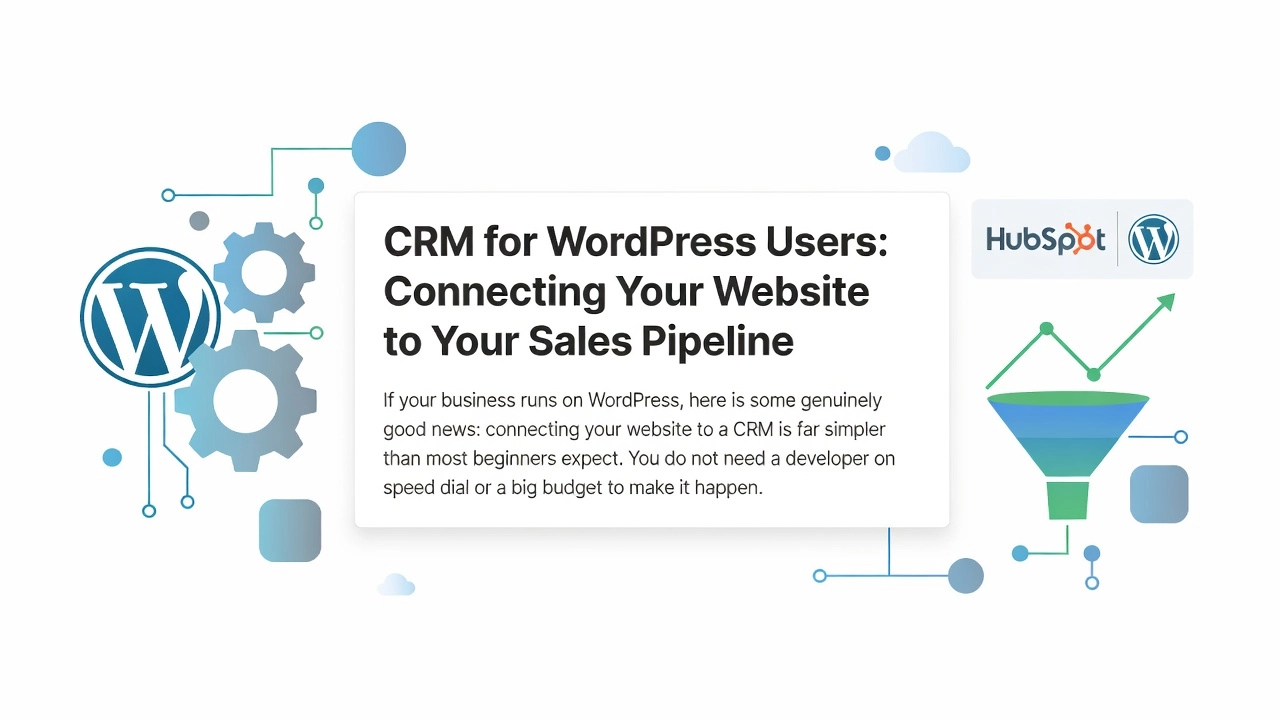
If your business runs on WordPress, here is some genuinely good news: connecting your website to a CRM is far simpler than most beginners expect. You do not need a developer on speed dial or a big budget to make it happen.
HubSpot offers a dedicated free WordPress plugin that takes just minutes to install. Once active, it automatically syncs your contact forms, live chat conversations, and email activity directly into your HubSpot CRM dashboard. Every time a visitor fills out a form on your site, that contact appears in your pipeline in real time, with no manual data entry required. For a beginner, this is one of the fastest ways to go from zero to a functioning sales pipeline.
Zoho CRM also plays nicely with WordPress. Through third-party connectors like Bit Integrations, form submissions and even e-commerce activity from your store can flow directly into customer records without writing a single line of code. This means a small business selling products through WordPress can track exactly which customers bought what, and follow up through an organized CRM pipeline rather than scattered spreadsheets.
Here is why this matters in practical terms: without integration, your WordPress analytics and your CRM live in completely separate silos. You might know a blog post got 500 views, but you have no idea how many of those readers became actual leads. Connecting the two systems closes that loop for good, giving you clear visibility into which content is actually driving revenue.
One important thing to plan for early: building your WordPress site with CRM integration in mind from day one avoids costly technical rework down the road. This means using compatible form plugins, structuring your data fields correctly, and ensuring your site architecture supports webhooks and third-party connections. This is exactly the kind of foundational work that dailynewsorbit.com’s WordPress development services are designed to help businesses get right before they scale.
Your recommended first step is straightforward: install HubSpot’s free WordPress plugin, connect it to a free HubSpot CRM account, and within about 30 minutes you will have real-time visibility into which visitors are converting into contacts.
Bottom Line: What the CRM Market Tells Us About Picking the Right Tool
The data we’ve covered throughout this post paints a clear picture: CRM is no longer optional for businesses that want to grow. The market is already worth over $80 billion and climbing fast, fueled by AI, cloud adoption, and a fundamental shift in how companies compete. As Gartner found, 80% of businesses now expect customer experience to be their primary competitive battleground, and CRM is the tool that makes winning that battle possible.
Here is what the market share data actually tells you as a buyer. Salesforce at roughly 21% dominance makes sense for large, complex operations that need deep customization. But for most small businesses and first-time CRM users, HubSpot and Zoho are the smarter starting points, offering free tiers, gentle learning curves, and real integrations that work without a dedicated IT team.
The $8.71 ROI per dollar invested is not reserved for big companies with big budgets. Even free-tier users report better lead tracking, faster follow-ups, and improved conversion rates. If you run a WordPress site, plugging in a CRM today is one of the highest-leverage moves you can make to turn passive blog traffic into an actual sales pipeline.
Your action plan is simple: start with a free HubSpot or Zoho account, connect it to your website, and set one clear goal for your first 90 days, targeting that 8 to 14% reduction in your sales cycle as your benchmark for success.
Conclusion
The CRM market may feel crowded, but now you know the truth: a handful of powerful players control the lion’s share, and that knowledge is your advantage. Here are the key takeaways to carry with you:
- A few dominant brands own most of the market
- Market share reflects real-world trust, investment, and reliability
- Smaller players can still be the right fit, depending on your needs
- Knowing the landscape helps you ask better questions before buying
Now it is your turn to act. Use this breakdown as your starting point, not your finish line. Dig into the options that align with your budget, team size, and goals. Request demos, read user reviews, and compare pricing. The right CRM is out there waiting for you. Go find it with confidence.