
Remember when asking your phone for directions felt like science fiction? Well, buckle up, because AI tech is moving so fast that what seemed impossible just a few years ago is now part of our everyday lives, and things are only getting more exciting.
Whether you’re someone who loves keeping up with the latest gadgets or you simply want to understand what all the buzz is about, this post is for you. AI-tech is no longer just a topic for engineers and tech insiders. It’s reshaping how we work, shop, communicate, and even how we take care of our health.
In this listicle, we’re breaking down the 10 biggest AI tech trends that are set to define 2026. We’ll explain each one in plain, simple language so you don’t need a computer science degree to follow along. By the end, you’ll have a clear picture of what these changes actually mean for your day-to-day life and how you can stay ahead of the curve. Let’s dive in!
Trend 1: Agentic AI Is Here and It Works Without You
Imagine waking up to find your AI assistant has already compared flight prices, booked your hotel, and added the confirmation to your calendar, all while you were sleeping. That is exactly what agentic AI makes possible. Unlike the chatbots you may already be familiar with, agentic AI does not wait for you to ask it something new at every step. Instead, it takes a goal, breaks it down into tasks, and works through them on its own, from start to finish.
According to Info-Tech Research Group’s AI Trends 2026 report, agentic AI is set to grow in adoption even faster than generative AI did, which means this technology is not a distant future concept. It is rolling out right now, and most everyday users have no idea it is already being embedded into the tools they use daily.
Real-world examples are already here. AI shopping assistants are now capable of comparing prices and completing purchases autonomously, without you clicking a single button. AI email tools can draft replies, send follow-ups, and manage your inbox independently. Retail apps, browsers, and productivity platforms are all quietly gaining these capabilities through background updates.
Here is the important part for you: because agentic AI needs access to your accounts and personal data to act on your behalf, the permissions you grant these systems carry real weight. Take a few minutes to review which apps have access to your email, calendar, or payment information. Enable two-factor authentication on key accounts, and stay aware of what you are agreeing to when you enable new AI features. Staying informed now puts you in control before the technology moves even faster.
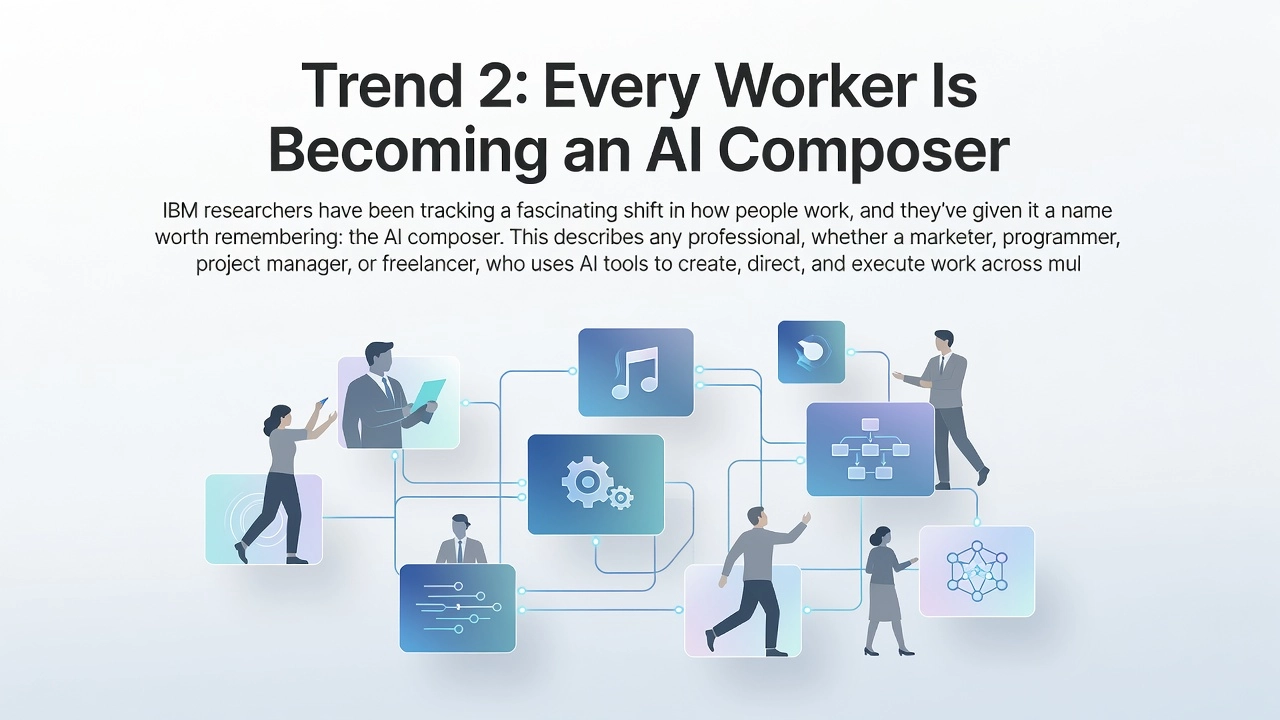
Trend 2: Every Worker Is Becoming an AI Composer
IBM researchers have been tracking a fascinating shift in how people work, and they’ve given it a name worth remembering: the AI composer. This describes any professional, whether a marketer, programmer, project manager, or freelancer, who uses AI tools to create, direct, and execute work across multiple disciplines. Think of it less like using a single app and more like conducting an orchestra where the instruments are AI tools responding to your direction.
Here is the reassuring part: this is not about AI replacing your job. It is about your job changing shape. A great comparison is what happened when spreadsheets arrived. Accountants did not disappear; they just stopped doing calculations by hand and started focusing on analysis and strategy. The same logic applies now, and IBM’s research on AI and the future of work backs this up, with studies showing that 87% of executives believe employees are more likely to be augmented by AI than replaced by it.
The practical difference this makes is huge. Picture a small business owner who, instead of hiring a copywriter, a social media manager, and a legal consultant separately, uses AI to write product descriptions, schedule posts, analyze customer reviews, and draft basic disclaimers all in one morning.
According to new IBM research on how AI is changing work, around 40% of the global workforce will need to reskill within the next three years as AI reshapes daily tasks. That sounds daunting, but the starting point is simpler than most people expect. Free and low-cost tools like browser-based writing assistants, AI scheduling helpers, and research tools are already available to anyone with an internet connection. Getting comfortable with even one or two of these tools in your current role is quickly becoming as essential as knowing how to send an email.
Trend 3: AI-Powered Cyberattacks Are Surging 56 Percent
Not all of the changes AI is driving are positive ones. According to IBM’s Cost of a Data Breach Report 2026, AI-driven cyberattacks jumped a staggering 56 percent compared to the prior year, making this the fastest-growing category of digital threat right now. In fact, one in four malicious breaches is now AI-enabled, costing companies an average of $6 million per incident. IBM is calling this moment “the AI tipping point” in cybersecurity, and the implications reach far beyond corporate IT departments.
What makes AI-powered attacks so much more dangerous than traditional ones is how personal they feel. Older phishing emails were easy to spot because they were generic and full of typos. Today, attackers can scrape your name, your employer, your recent LinkedIn activity, and even your writing style from public sources, then use AI to craft a message that sounds exactly like it came from your actual bank or your actual boss.
The threats showing up in everyday life include AI-generated voice calls that convincingly mimic a family member asking for urgent help, hyper-realistic deepfake videos used in scam campaigns, and phishing texts written to match your own communication patterns. These are not rare edge cases; they are increasingly common.
The old advice of simply checking a sender’s email address no longer cuts it. Your baseline defenses today should include using a password manager, turning on two-factor authentication, and always verifying unexpected or urgent requests through a separate channel like a direct phone call.
It is also worth remembering that these breaches affect any company holding your personal data. When businesses get hit, your information is often what gets exposed, so the security practices of the services you use matter more than ever.
Trend 4: Vibe Coding Is Changing Who Can Build Software
Have you ever had a brilliant idea for an app but immediately talked yourself out of it because you assumed you needed to know how to code? That barrier is crumbling fast, thanks to a trend called vibe coding.
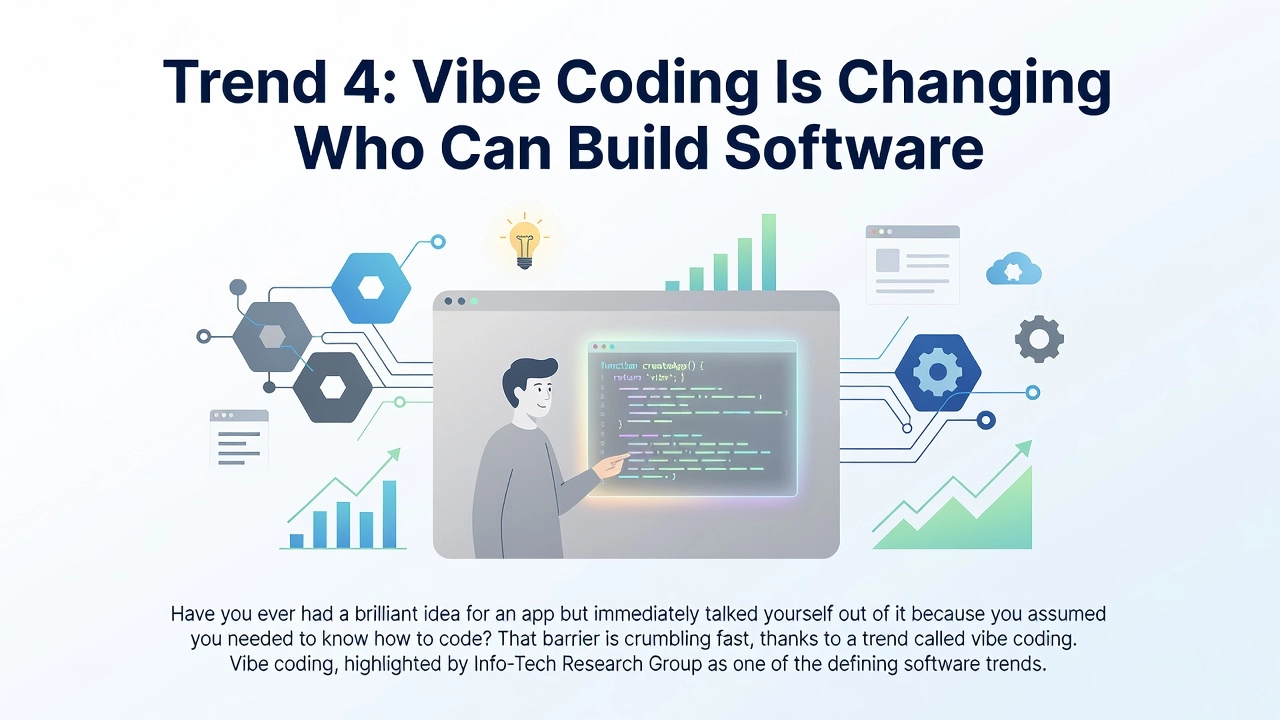
Vibe coding, highlighted by Info-Tech Research Group as one of the defining software trends of 2026, is exactly what it sounds like. Instead of writing syntax, you describe what you want in plain English, and AI generates the working code for you. Think of it as having a conversation with a really talented developer who never sleeps. According to vibe coding adoption data for 2026, a remarkable 63% of active vibe coding users are non-developers, including founders, product managers, and small business owners.
The real-world impact of this shift is already showing up for everyday consumers. Faster development cycles mean more apps are reaching the market, more of them targeting niche audiences with specific needs, and at lower price points because development overhead has dropped significantly. As explained in this breakdown of vibe coding tools for non-programmers, entrepreneurs can now prototype a full application in days rather than months.
For anyone looking to build or strengthen their web presence in 2026, this is genuinely exciting news. Platforms like WordPress, combined with AI-assisted development support, make launching a professional, functional website more accessible and affordable than ever before. The threshold has never been lower, and the tools have never been more beginner-friendly.
Trend 5: Open-Source AI Models Are Shaking Up Big Tech
Here is another massive shift that directly benefits your wallet. Open-source AI models are sophisticated reasoning systems that anyone can freely download, modify, and deploy without paying licensing fees to large technology companies. Models like DeepSeek-R1 operate under an MIT license, meaning small businesses and individual developers can use them for commercial projects at no cost. As IBM Think explains in their DeepSeek breakdown, DeepSeek-R1 is roughly 96% cheaper to use than comparable proprietary models, and IBM researcher Abraham Daniels noted that this kind of model “could really accelerate AI democratization.”
That price pressure is already trickling down to you. When companies compete to keep users, they improve free tiers and lower subscription prices. The practical result is that writing assistants, image generators, and AI-powered productivity tools available to everyday users in 2026 are dramatically more capable than anything accessible at low cost just 18 months ago.
Small business owners and content creators benefit most directly from this shift. AI-powered features that once required expensive enterprise software contracts are now baked into affordable tools. A freelance designer or a local shop owner can access the same quality of AI assistance that large corporations were paying premium prices for just a year ago. That gap will only keep widening as open-source models continue improving.
Trend 6: The Chip Shortage Is Still Affecting Your Devices
Here is something that does not get talked about enough: the chip shortage never really went away. It just changed shape. According to IDC’s global memory shortage analysis, 2026 represents an “unprecedented inflection point” where demand is materially outpacing supply, and this time the cause is structural rather than temporary.
The core problem is straightforward. AI data centers are consuming a massive share of global chip output, particularly high-bandwidth memory chips that power machine learning workloads. As TechCrunch summarizes, “AI data center demand is fueling a multi-year chip shortage, pushing up component costs and retail device prices.” A staggering 70% of all high-end memory in 2026 is projected to flow into data centers, leaving manufacturers of laptops, gaming PCs, and smartphones competing for a shrinking slice of supply.
For everyday shoppers, this translates directly into higher prices and thinner availability. Memory prices surged 40 to 50% in early 2026 alone, with the PC market potentially contracting by up to 9% as a result.
What should you do? If you are eyeing a new AI-capable laptop or gaming rig right now, understand that prices are elevated partly because of forces beyond any retailer’s control. Newer chiplet-based device generations currently in development may offer better value once they arrive in 2027 or 2028. Waiting even one product cycle could save you meaningful money.
Trend 7: Governments Are Racing to Regulate AI, But Not Together
Here is another trend that might not make headlines the same way robots and chatbots do, but it will absolutely affect your day-to-day digital life. AI sovereignty is the term Info-Tech Research Group uses to describe what happens when individual governments each write their own rulebook for how AI can be built, sold, and used within their borders. The catch? Those rulebooks often contradict each other, creating a messy global patchwork instead of one consistent standard.
For everyday consumers, this fragmentation shows up in surprisingly practical ways. The AI features inside your favorite apps may work differently depending on where you live. Tech companies regularly disable or water down capabilities to stay compliant with local laws, meaning a user in Europe might get a different chatbot experience than someone using the same app in the US or Southeast Asia. You have already seen this pattern before: when GDPR rolled out across Europe, cookie consent pop-ups suddenly appeared everywhere overnight. AI regulation is shaping up to deliver a similar ripple effect, just on a much larger scale.
The good news is that organizations are not waiting around for governments to sort this out. According to Info-Tech Research Group, 58% of organizations now have AI embedded in their enterprise-wide strategies, up from just 26% in 2025. Companies are building internal governance frameworks proactively, which means the AI tools you use daily are becoming more consistently accountable, regardless of where you live or which regulations apply locally.
Trend 8: Brain-Machine Interfaces and Green Tech Are Closing In
Two of the most talked-about technology shifts heading into 2026 and beyond are brain-machine interfaces (BMIs) and green technology, and both are moving faster than most people realize.
BMIs allow direct communication between the human brain and digital devices. Right now, they are not something you will find at a consumer electronics store, and full societal adoption is still roughly a decade away. But the early results from medical trials are genuinely remarkable. People living with ALS are communicating through real-time brain signal decoding, and individuals with tetraplegia are regaining the ability to walk and climb stairs. These are not science fiction headlines; they are active research outcomes happening today.
Green tech is a different story entirely because it is already affecting products you buy right now. Global clean energy investment has surpassed $2 trillion annually, and over 70% of medium-sized businesses in North America and Europe plan to adopt some form of eco-friendly technology by the end of 2026. AI is powering smart grids that balance energy supply and demand in real time, and solid-state battery innovations are directly driving improvements in EVs and smart home devices.
Consumer curiosity about both trends is enormous and growing well beyond tech circles. Fashion, food, and retail brands are increasingly weaving green certifications and AI-driven supply chain sustainability into their products. When you see an “eco-certified” label on a purchase, green tech is working quietly behind the scenes to back that claim up.
Trend 9: AI Is Personalizing Shopping, Food, and Entertainment
AI has quietly become the engine running behind almost every digital experience you have as a consumer. According to recent data, 49% of Americans used AI in some form of shopping during 2025, and 64% plan to use AI chatbots for shopping in 2026. On Black Friday 2025 alone, AI influenced over $14 billion in online sales. These numbers make one thing clear: this is not a future trend. It is already your present reality.
Shopping and fashion retail are two of the most visible arenas. AI personalization engines track your browsing behavior, past purchases, and even how long you linger on a product page to serve up recommendations that feel almost eerily accurate. In fashion, virtual try-on tools powered by AI are predicting your sizing before you ever touch a fitting room, and retailers are adjusting their inventory in real time based on what customers are actually clicking on, reducing waste and keeping popular items in stock longer.
Food and entertainment are equally transformed. Grocery and meal delivery platforms now suggest recipes and meal plans based on your dietary history, what ingredients are available locally, and current seasonal pricing. Meanwhile, streaming services use AI to keep you engaged between content drops, and gaming platforms are deploying dynamic difficulty systems and AI companions that adapt to your individual play style rather than following a fixed script.
The convenience here is real. AI shoppers saved an average of 6.2 shopping hours in 2025 and 94% reported satisfaction with their purchases. But every recommendation is built on behavioral data your platforms are collecting continuously, so staying aware of your privacy settings is genuinely worthwhile.
Trend 10: AI Tools Are Leveling the Playing Field for Small Businesses
Here is something genuinely exciting to end on: the gap between a Fortune 500 company and a three-person startup has never been smaller. Enterprise-grade AI tools covering marketing automation, customer service chatbots, and analytics dashboards are now available through affordable or even free entry-level plans. Capabilities that once cost six figures annually are now accessible for a few hundred dollars a month, or nothing at all at the freemium tier. According to recent SME data, 58% of small businesses already use at least one AI-powered tool regularly, and 67% of owners say implementation was easier than they expected.
AI-assisted website builders, automated SEO optimization tools, and AI-generated product descriptions are no longer premium extras. They are standard features baked into platforms small teams are already using. This means you can build a polished, search-optimized online presence without hiring a developer, a copywriter, or an SEO specialist on day one.
The enterprise world is also pushing things forward on your behalf. As large organizations chase measurable ROI from AI investments, software makers are competing hard to build practical, plug-and-play tools that require zero IT expertise. That competition directly benefits small business owners.
If you are planning to launch or grow a business in 2026, the timing is genuinely in your favor. WordPress remains the most widely supported CMS platform available, and pairing it with AI-driven content tools and development support can compress what used to be a months-long website buildout into just a few focused weeks.
The Bottom Line on AI Tech in 2026
All ten trends covered in this list share one clear theme: AI is no longer hiding in the background. It is actively shaping how you shop, work, stay safe online, and experience the digital world every single day.
Here are a few practical steps worth taking right now. Review the permissions you have granted to AI-powered apps on your phone and browser. Update your cybersecurity habits with the 56% surge in AI-driven attacks in mind, starting with stronger passwords and two-factor authentication. And try at least one AI productivity tool that fits your work or daily routine.
The good news is that staying informed does not require a tech degree. Simply approach each new AI feature in your apps with curiosity, and keep a basic awareness of the trade-offs involved, especially around your data and privacy.
Whether you are a curious consumer, a small business owner, or planning a tech purchase soon, these trends give you a confident starting point for navigating what comes next.
Conclusion
The AI revolution is not some distant future event. It is happening right now, and it is reshaping every corner of your daily life. From agentic AI handling your tasks automatically, to personalized health tools that know your body better than ever, these 10 trends share one common thread: they put more power, convenience, and opportunity directly in your hands.
The key takeaways are simple. AI is becoming invisible, working quietly behind the scenes. Personalization is reaching new depths across health, work, and entertainment. And the people who thrive will be those who stay curious and adapt early.
So here is your call to action: pick one trend from this list that excites you most and explore it this week. Read, experiment, and ask questions. The future belongs to those who engage with it. Start today, and you will already be ahead.