


30 Day Beginner Calisthenics Workout Routines That Deliver Real Results
Core Benefits of a 30 Day Beginner Calisthenics Workout
Committing to a 30 day beginner calisthenics workout delivers rapid physical adaptations and builds a lasting foundation for lifelong physical health. Because bodyweight resistance forces you to stabilize your own joints through natural human movement patterns, it activates deep core and stabilizer muscles that gym machines often isolate and ignore. Training without external weights teaches your central nervous system to coordinate multi-joint movements efficiently, enhancing agility, balance, and spatial awareness.
The physical improvements over a single month are well-documented across multiple fitness metrics:
- Push-Up Capacity: Most beginners experience a 50-100% improvement in total push-up reps by Day 30 through steady neurological adaptation and cumulative volume.
- Plank Endurance: Midsection stability increases dramatically, with typical plank hold times improving by 2-3x as the transverse abdominis strengthens.
- Posture and Fat Loss: Peer-reviewed studies show that an 8-week calisthenics intervention significantly increases total body strength, reduces fat mass, and corrects posture alignment by strengthening posterior chain muscles.
- Hypertrophy Efficiency: Standard push-ups have been shown to build upper body muscle size and strength comparable to a barbell bench press loaded at 40% of a lifter’s one-rep max (1RM).
- Connective Tissue Resilience: Calisthenics movements strengthen tendons and ligaments at a natural pace, drastically reducing the risk of overuse injuries compared to heavy weightlifting.
Beyond the physical metrics, starting with bodyweight exercises removes common barriers like expensive memberships, crowded facilities, or equipment friction. Learning why a beginner 30-day workout challenge is the best way to start exercising highlights how a fixed timeline builds mental discipline, accountability, and long-term habit formation.
Essential Exercises and Progressions for Beginner Calisthenics
Mastering bodyweight training requires prioritizing strict execution and form over sheer movement volume. Progressing through leverage angles allows anyone to scale movements safely regardless of current strength levels. If an exercise feels too demanding, changing your body’s incline angle or leverage reduces total gravitational load without sacrificing key muscle activation.
Reviewing good workout plans for men and women reveals that balanced routines combine pushing, pulling, leg strength, and core stabilization to build symmetric athletic capability.
Essential Upper Body and Core Movements
- Incline & Wall Push-Ups: Placing your hands on a wall, high counter, or raised table reduces gravity’s load, letting you build pushing strength in your chest, shoulders, and triceps while establishing solid scapular stability.
- Knee Push-Ups: Lowering your knees to the floor bridges the gap between incline variations and full standard push-ups, maintaining core alignment from knees to head.
- Doorframe & Inverted Rows: Gripping a sturdy doorframe or pulling yourself upward under a sturdy kitchen table targets the upper back, rear deltoids, and biceps, building crucial pulling strength that counters desk posture.
- Hollow Body Holds & Dead Bugs: Pressing your lower back flat into the floor while holding extended legs engages deep abdominal walls, strengthens the anterior core, and teaches integrated scapular control.
Essential Lower Body and Mobility Drills
- Air Squats: Keeping your chest high, heels planted firmly on the ground, and pushing knees outward builds quadriceps and glute strength while promoting healthy hip movement patterns.
- Walking Lunges: Builds single-leg stability, balance, coordination, and ankle flexibility while strengthening the hamstrings and hip flexors.
- Glute Bridges: Lying flat on your back and driving through your heels activates the posterior chain, strengthens gluteal muscles, and protects the lower spine during daily activities.
- Hip & Ankle Mobility: Dynamic leg swings and ankle openers improve squat depth, prevent knee valgus collapse, and support overall leg alignment throughout every movement.
How to Structure Your 30 Day Calisthenics Workout Calendar

Structuring a successful calendar requires balancing effective training stimulus with adequate physiological recovery. Beginners adapt best when workouts are spread across non-consecutive days, leaving 24 to 48 hours between intense sessions for muscular repair, central nervous system recovery, and glycogen replenishment.
When picking your calendar structure, compare your lifestyle and schedule against these two common beginner frameworks:
| Feature | 3-Day Full Body Split | 5-Day Block Split (10-Day Cycles) |
|---|---|---|
| Weekly Schedule | Mon / Wed / Fri (4 Rest Days) | 5 Days On / 1 Active Rest (Rotates) |
| Focus Area | Full body compounds every session | Push, Pull, Legs, Core, Plyometrics split |
| Rest Intervals | 90 seconds between sets | 60–90 seconds between sets |
| Best For | Absolute beginners, busy schedules | Trainees seeking daily movement habits |
Following a structured daily program ensures steady adaptation without sudden spikes in physical fatigue.
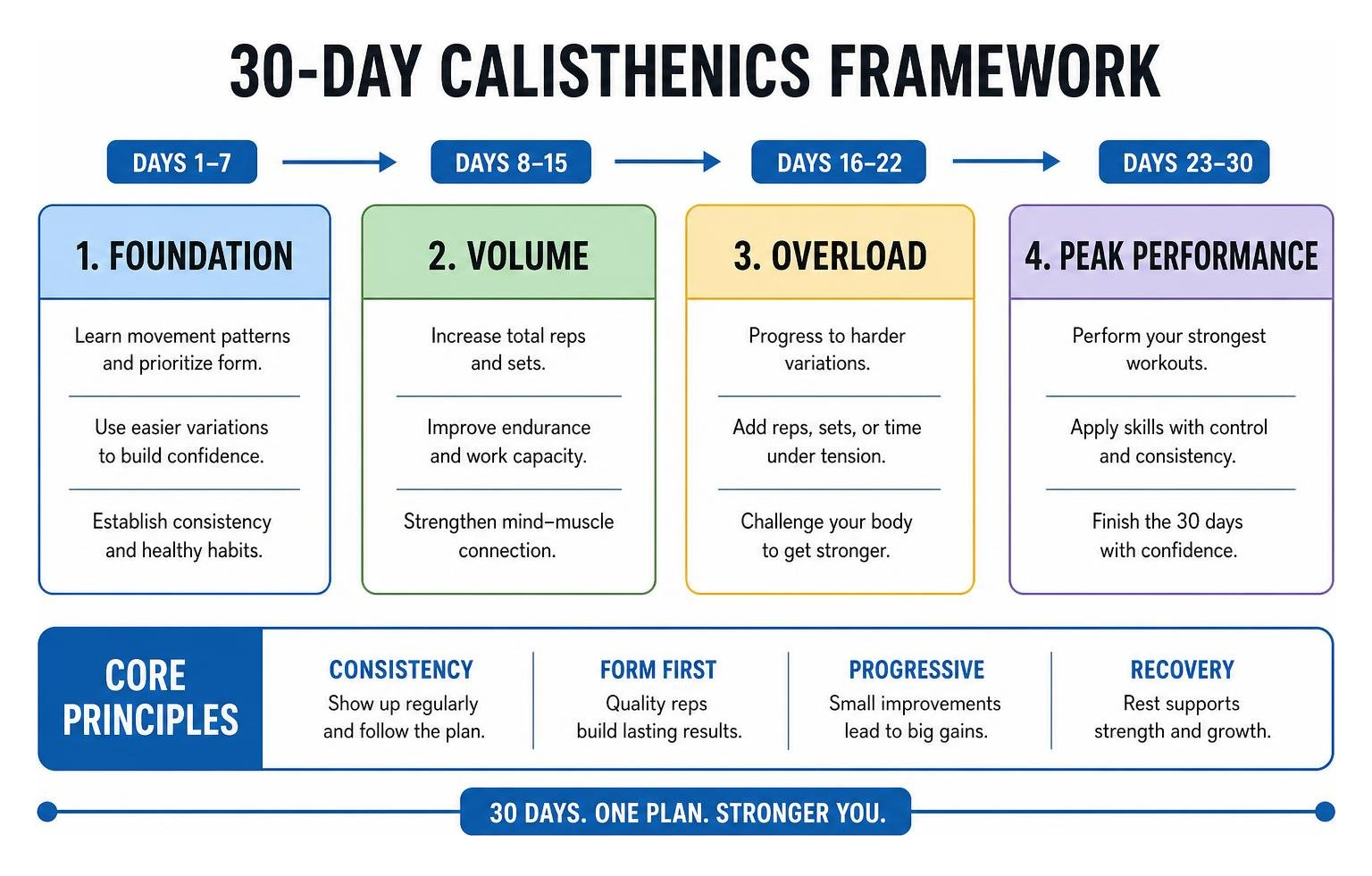
Week-by-Week Breakdown of the 30 Day Beginner Calisthenics Workout
- Week 1 (Foundation & Neurological Adaptation): Focus entirely on mastering basic technique and “greasing the groove” mentally. Keep reps moderate (e.g., 3 sets of 8–10 reps) and rest 90 seconds to build pristine movement mechanics without inducing severe exhaustion.
- Week 2 (Volume & Tempo Control): Increase total volume by adding an extra set or a couple of reps, and apply a deliberate 2-second eccentric (lowering) tempo to build muscle control under tension.
- Week 3 (Progressive Overload & Splits): Challenge your functional limits by shortening rest intervals down to 60 seconds, introducing harder leverage variations, or increasing total set counts across workout days.
- Week 4 (Circuit Integration & Peak Testing): Combine exercises into full-body circuits to boost metabolic conditioning. On Day 30, run a strength benchmark test to measure max push-ups, squats, and plank holds against your Day 1 baseline.
Scaling and Adapting Your 30 Day Beginner Calisthenics Workout
Listen to your body by monitoring your Rate of Perceived Exertion (RPE) on a 1-to-10 scale. Aim to keep most working sets between RPE 7 and 8 (meaning you could execute 2 to 3 more reps with good technique before failure).
If joints feel tender or muscles are overly fatigued, scale exercises immediately—swap standard push-ups for incline reps or replace pull-ups with doorframe rows. You can also stop making excuses and start quick bodyweight workouts on days when time is tight to maintain your training momentum without risking overtraining or injury.
Warm-Up, Nutrition, and Recovery Protocols for Beginners
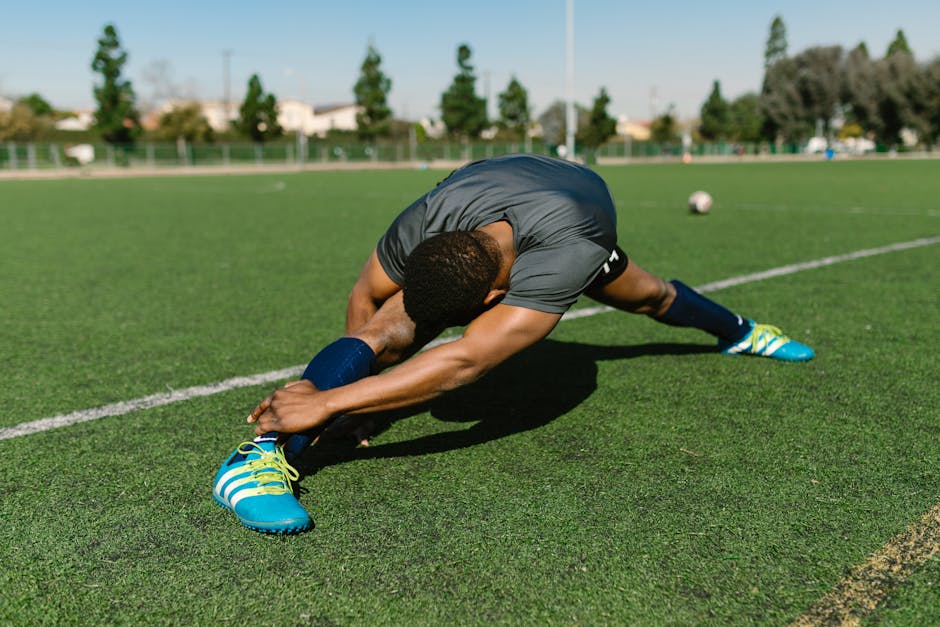
A comprehensive bodyweight routine requires proper warm-up, nutrition, and recovery strategies to maximize adaptations and keep your energy elevated. Exploring broader fitness resources can help you build comprehensive healthy habits that extend far beyond your first 30 days of training.
Dynamic Warm-Up and Cool-Down Routines
Never skip your 5-to-10-minute dynamic warm-up. Moving your joints through their full active range of motion preps joint stabilizers, increases synovial fluid lubricity, and elevates core heart rate before loading muscles:
- Wrist Rotations: 10 circles in each direction to prep wrists and elbows for plank and push-up pressure.
- Cat-Cow Stretches: 10 slow reps to mobilize the thoracic spine and promote dynamic scapular health.
- Arm Circles & Scapular Pulls: 15 reps forward and backward to activate shoulder blades, rotator cuffs, and upper back tissue.
Post-workout, perform 5 to 10 minutes of static stretching (holding positions like child’s pose, shoulder cross-body stretches, or cobra stretch for 20–30 seconds) to lower heart rate and ease residual muscle tension.
Nutrition and Recovery Strategies
- Protein Target: Consume 1.6 to 2.2 grams of protein per kilogram of body weight daily (around 0.8–1.0g per pound) to support optimal muscle tissue repair and lean tissue growth.
- Hydration Baseline: Drink 2 to 3 liters of water daily. Muscle tissue is composed largely of water, so remaining properly hydrated dramatically reduces muscle cramping and delayed soreness.
- Sleep Hygiene: Growth hormone release peaks during deep sleep cycles. Aim for 7 to 9 hours of quality uninterrupted sleep nightly in a cool, quiet room (65–68°F / 18–20°C).
- DOMS Management: Delayed Onset Muscle Soreness is normal during Week 1 as your tissue adapts. Light active recovery, such as 30-minute brisk walks or gentle mobility work, increases blood flow and relieves stiffness far better than remaining sedentary on rest days.
Frequently Asked Questions About Beginner Calisthenics
What common mistakes should beginners avoid when starting calisthenics?
The five most common mistakes include:
- Sacrificing proper execution and technique to chase higher rep counts.
- Skipping pre-workout dynamic warm-ups and post-workout cooling routines.
- Training every single day without built-in rest periods for muscle recovery.
- Ignoring sharp joint pain or pushing through structural discomfort and fatigue.
- Failing to log weekly workout sets, reps, and hold times to track progressive overload accurately.
How can I track progress during a 30-day bodyweight challenge?
Keep a digital notebook or paper workout log to record sets, reps, leverage modifications, and rest periods for every single session. Test your maximum push-up count, bodyweight squat reps, and plank hold duration on Day 1, Day 15, and Day 30 under identical conditions. Taking weekly progress photos and tracking overall energy levels and sleep quality also provides strong motivation beyond standard bathroom scale numbers.
What should I do after completing the 30-day plan?
Once you complete your initial 30 days, avoid stopping your momentum! You can repeat the 30-day cycle using harder exercise variations (such as archer push-ups, single-leg squats, or decline planks), progress to intermediate push/pull/legs splits, begin dedicated skill training for handstands or L-sits, or introduce a light weighted vest to your foundational movements.
Conclusion
At Daily News Orbit, we believe that building a strong, lean, and athletic body doesn’t require complex gym gear or expensive monthly memberships. A structured 30 day beginner calisthenics workout gives you everything needed to unlock functional strength, improve posture alignment, and establish a lasting exercise routine right from home.
By focusing on movement quality, staying consistent day after day, and respecting your physiological recovery needs, your initial 30 days will serve as the strong foundation for a lifetime of movement mastery.
Ready to continue building your functional bodyweight baseline? Take the next step in your progression by exploring our workout guides to take your home training to the next level today!