


Good Workout Plans for Men: A Practical Roadmap to Strength
Good Workout Plans for Men Start With the Right Fit
Good workout plans for men are not one-size-fits-all. The best plan fits your goal, your available time, and your current training experience – and it is simple enough to follow week after week.
| If your main goal is… | A strong starting plan is… | Typical weekly schedule |
|---|---|---|
| Build muscle and strength | Upper/lower split | 4 days |
| Get started and learn form | Full-body training | 2-3 days |
| Lose fat while keeping muscle | Full body or upper/lower plus walking/cardio | 3-4 days |
| Focus on major lifts | Exercise-focused routine | 3-4 days |
| Maximize training volume | Push/pull/legs split | 5-6 days |
For most people, 3 to 4 strength workouts per week is the practical sweet spot. Train the major muscle groups regularly, add reps or weight over time, and allow enough recovery to come back stronger.
The plan matters, but consistency matters more. A routine you can complete around work, family, and real life will beat a perfect-looking plan you quit after two weeks.
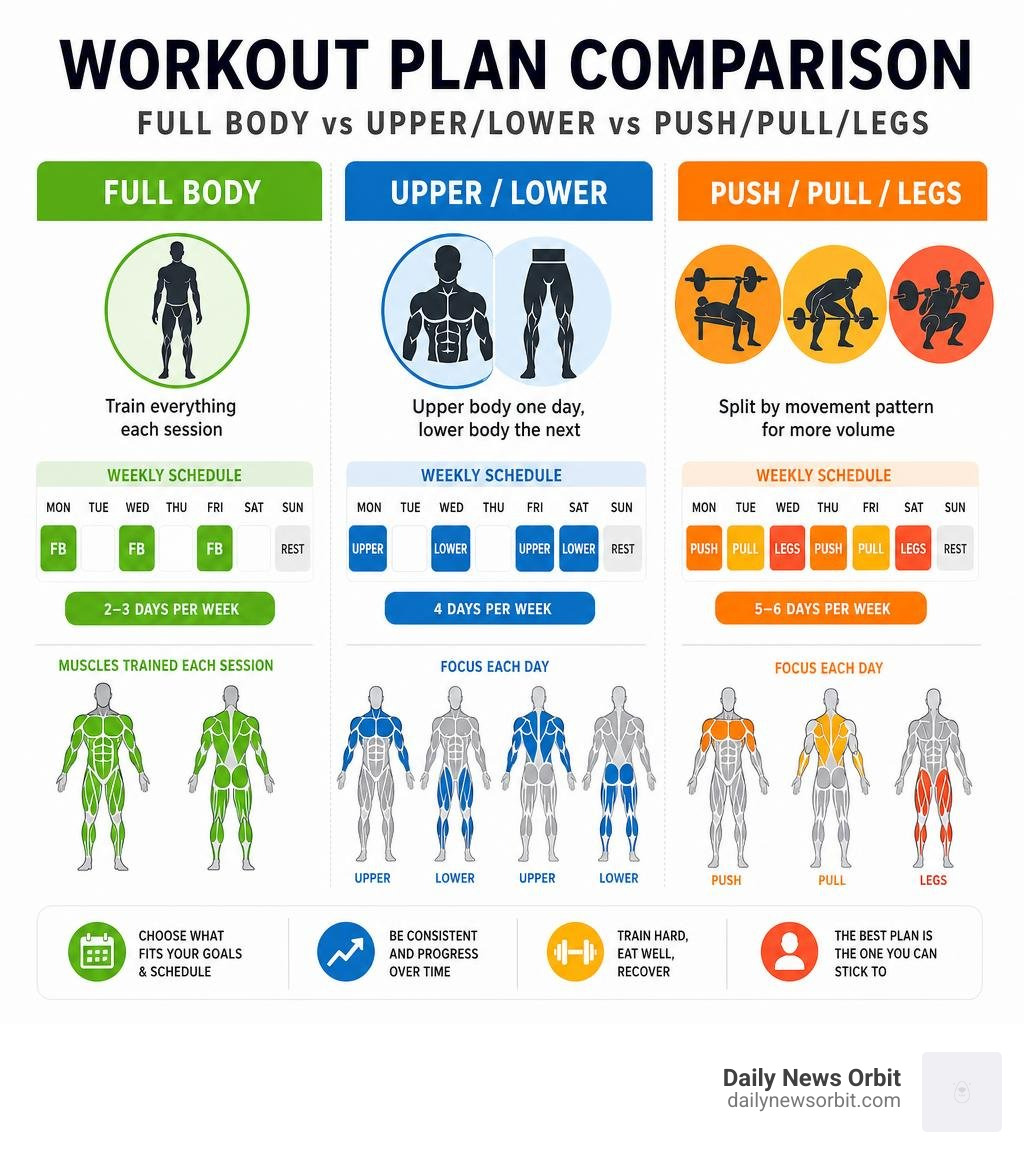
How to Choose Good Workout Plans for Men Based on Your Goals
Finding an effective workout plan starts with honest self-assessment. We often see lifters jump into high-volume professional athlete routines, only to burn out within two weeks because the schedule does not match their real life.
Matching Training Days to Personal Schedule
When selecting a routine, your available time dictates your strategy. Training 2 to 4 days per week is ideal for most men balancing busy careers and family lives.
- 2 Days per Week: Requires full-body sessions to hit every major muscle group twice weekly.
- 3 Days per Week: Allows for a classic Monday-Wednesday-Friday full-body split with built-in rest days.
- 4 Days per Week: Unlocks the gold-standard upper/lower body split, offering a perfect blend of volume and recovery.
If you are brand new to structuring your routine, reading about why a beginner 30-day workout challenge is the best way to start exercising can help you build initial momentum before stepping into heavy lifting.
Aligning Workouts with Muscle Building and Fat Loss Goals
Whether your goal is adding size or leaning out, resistance training remains the primary engine of body recomposition. For fat loss, pair 3 to 4 days of weight training with a modest caloric deficit (250–500 calories below your Total Daily Energy Expenditure) to force your body to burn stored fat while holding onto lean muscle mass.
If your primary objective is a complete physical overhaul, checking out a detailed guide like the 12 Week Weight Loss Workout Plan Male: Top 2026 Transformation gives you a clear vision of how structured resistance training and cardio work together over time.
Primary Workout Plan Styles: Full-Body, Split, and Exercise-Focused

Every successful training blueprint falls into one of three primary organization styles.
Full-Body Workouts
Full-body workouts hit all major muscle groups in a single session. They are ideal for men who can only hit the gym 2 to 3 times per week. Because you train your entire body each visit, missing a session will not throw off your entire week.
Body Part Splits
Body part splits separate muscle groups across different days. Popular variations include Upper/Lower splits (4 days per week) and Push/Pull/Legs splits (3 to 6 days per week). If you want to dive deeper into multi-day programming, explore how you can build muscle faster using a weekly 5-day training split to isolate specific target areas with dedicated training sessions.
Exercise-Focused Workouts
Exercise-focused routines build each training session around a heavy foundational compound movement—such as the barbell bench press, back squat, overhead press, or deadlift. A classic example is the “Big 5” routine, which relies on 5 sets of 5 reps across main compound lifts to build raw power and thick structural muscle.
Breakdown of Workout Routines by Experience Level
Your training age—how long you have consistently lifted weights—determines how much training volume you can handle and recover from.
Good Workout Plans for Men at the Beginner Level
Beginners are men with less than 1 year of consistent lifting experience. At this stage, your body responds rapidly to almost any progressive stimulus.
- Frequency: 3 days per week (e.g., Mon/Wed/Fri).
- Focus: Mastering movement mechanics and establishing dynamic neuromuscular connections.
- Structure: 3 full-body workouts utilizing fundamental barbell, dumbbell, and bodyweight exercises. Dumbbell-only variations work brilliantly here for home lifters.
Intermediate Male Routine: 4-Day Upper Lower Split
Intermediate lifters (1 to 2 years of consistent lifting) require structured volume and progressive overload management to keep gaining size.
- Frequency: 4 days per week (e.g., Mon/Tue/Thu/Fri).
- Structure: Upper Body Strength, Lower Body Strength, Rest, Upper Body Hypertrophy, Lower Body Hypertrophy.
A popular intermediate strategy is the Power Hypertrophy Upper Lower (P.H.U.L.) approach. For a practical example of high-intensity superset programming that balances strength and fat loss, check out Build and Burn with This Full-Body Workout From Our New ‘Build Muscle, Burn Fat’ Plan.
Good Workout Plans for Men Tailored for Advanced Lifters
Advanced lifters (2+ years of continuous hard training) need higher volume, specific exercise variations, and intense focus to stimulate stubborn muscle tissue.
- Frequency: 5 to 6 days per week using a rotating Push/Pull/Legs split.
- Techniques: Supersets, drop sets, controlled eccentrics, and periodic max-output conditioning tests to challenge biological limits.
Top Fundamental Exercises Every Male Routine Needs

Regardless of your split, good workout plans for men center around compound exercises—movements that cross multiple joints and recruit large muscle mass simultaneously.
The Essential 10 Exercises for Men
- Trap Bar Deadlift: Builds posterior chain strength with less lower back strain than traditional conventional deadlifts.
- Front Squat: Emphasizes quad development while forcing an upright torso and deep core engagement.
- Barbell Glute Bridge: Isolates and strengthens the powerful gluteal muscles for athletic drive.
- Bulgarian Split Squat: Corrects side-to-side leg strength imbalances while building mobility.
- Military Press: Overhead pressing builds broader shoulders and upper chest mass.
- Pull-Up: The ultimate bodyweight test for upper back width and lat expansion.
- Barbell Row: Develops mid-back thickness and postural stability.
- Barbell Bench Press: The classic horizontal push for chest, front delt, and tricep power.
- Farmer’s Walk: Builds crushing grip strength, forearm density, and core stability.
- Dip: An exceptional bodyweight movement for lower chest and tricep hypertrophy.
Training Frequency, Nutrition, and Recovery Principles
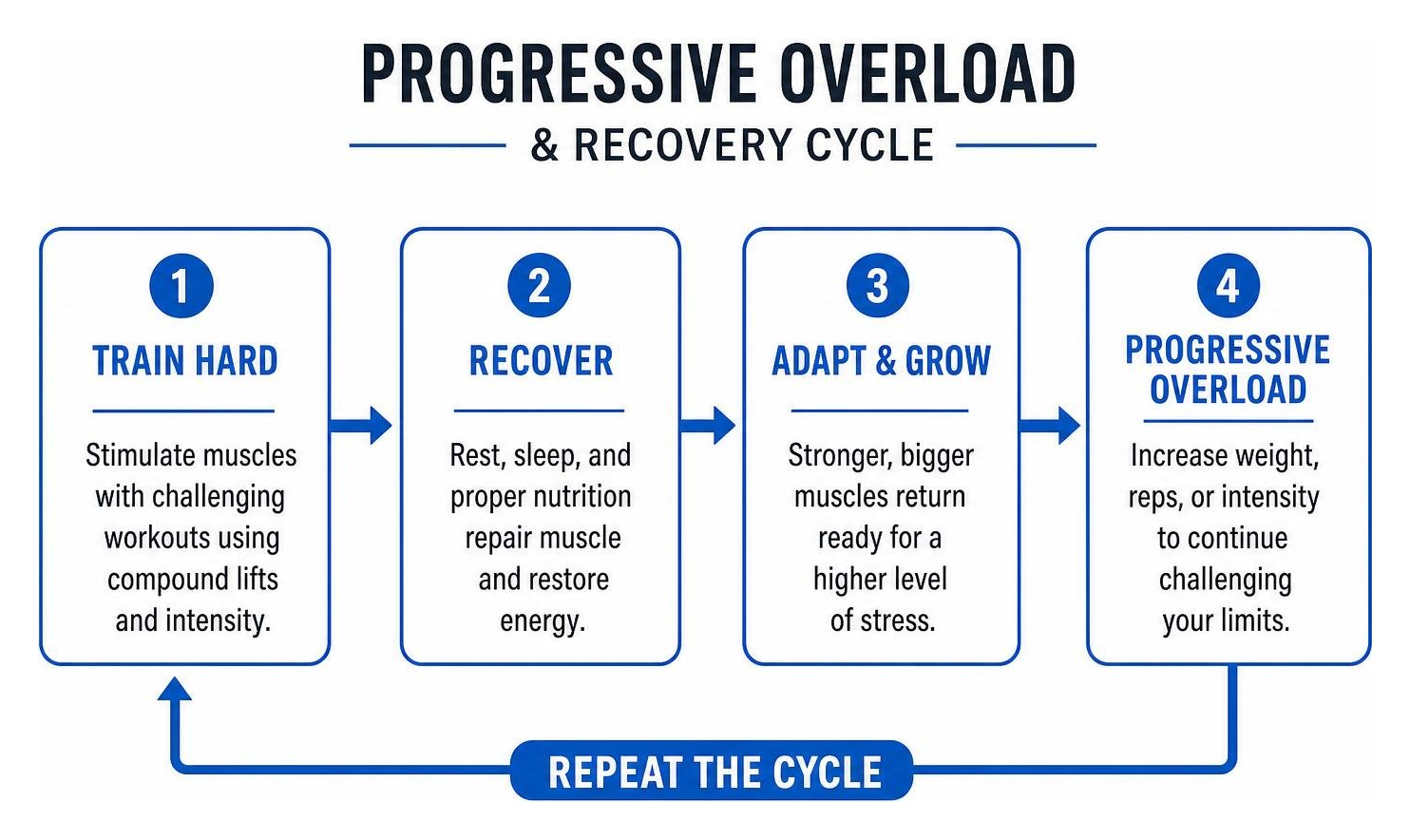
Lifting heavy weights provides the spark, but nutrition and rest supply the fuel to build actual muscle mass.
How Many Days a Week Should Men Train?
Research shows natural muscle building flourishes when you hit each muscle group 2 to 3 times per week.
- 3 to 4 days per week is the ideal standard for maximum progress and natural recovery.
- Leaving 1 to 2 Reps in Reserve (RIR) on major compound lifts prevents central nervous system burnout.
If you are pressed for time on busy workdays, learning to stop making excuses and start these 15-minute workouts today can help maintain your baseline conditioning when getting to the gym isn’t an option.
Fueling Muscle Mass with Nutrition
To support hypertrophy during a lean bulk, aim for a minor calorie surplus of 250 to 500 calories above your maintenance needs. Keep your protein intake between 0.7 and 1.0 gram per pound of body weight daily. If you are looking for structured dietary guidance, reviewing a 7-Day Bulking Meal Plan for Men: 3,000 Calories provides a realistic template for whole-food meal planning.
Training Considerations and Modifications for Men Over 40
As men reach age 40 and beyond, natural muscle mass and bone density begin a gradual decline. Resistance training actively halts this process, but joint integrity and recovery time require smarter exercise choices.
Joint-Friendly Exercise Substitutions
- Goblet Squats instead of Heavy Barbell Back Squats: Reduces axial spine loading while keeping your torso upright.
- Cable Triceps Pushdowns instead of Dips: Protects vulnerable shoulder joints from extreme extension under bodyweight load.
- Reverse Lunges instead of Forward Lunges: Decreases shearing forces across the knee patellar tendon.
- Dumbbell Neutral-Grip Presses instead of Wide Barbell Presses: Alleviates shoulder impingement risks.
Allow up to 48 to 72 hours of recovery between intense sessions targeting the same muscle groups, and prioritize 7 to 9 hours of continuous sleep each night.
Frequently Asked Questions About Male Workout Plans
What is the best workout plan for men to build muscle?
The best workout plan is a 4-day upper/lower split or 3-day full-body routine that allows you to hit each muscle group 2 to 3 times per week while maintaining progressive overload over 8 to 12 weeks.
How many days a week should a man workout?
Most men achieve optimal strength and body composition results working out 3 to 4 days per week with weights, combined with light walking or mobility work on rest days.
Can you gain 10 pounds of pure muscle in a month naturally?
No. Gaining 10 pounds of pure muscle naturally in 30 days is physically impossible. Rapid early weight jumps on the scale are almost entirely glycogen storage, cellular water retention, and minor fat accumulation.
Conclusion
Building a stronger, healthier body comes down to choosing a sustainable routine, trusting the process, and executing progressive overload session after session. Check out The Ultimate Gym Workout Routines for Men for Beginners to kickstart your journey with a complete step-by-step roadmap today!