

Build Foundational Core Strength, Not Just a Six-Pack
A beginner core workout routine for men should build a stable, strong trunk for lifting, sports, better posture, and everyday movement – not just chase visible abs.
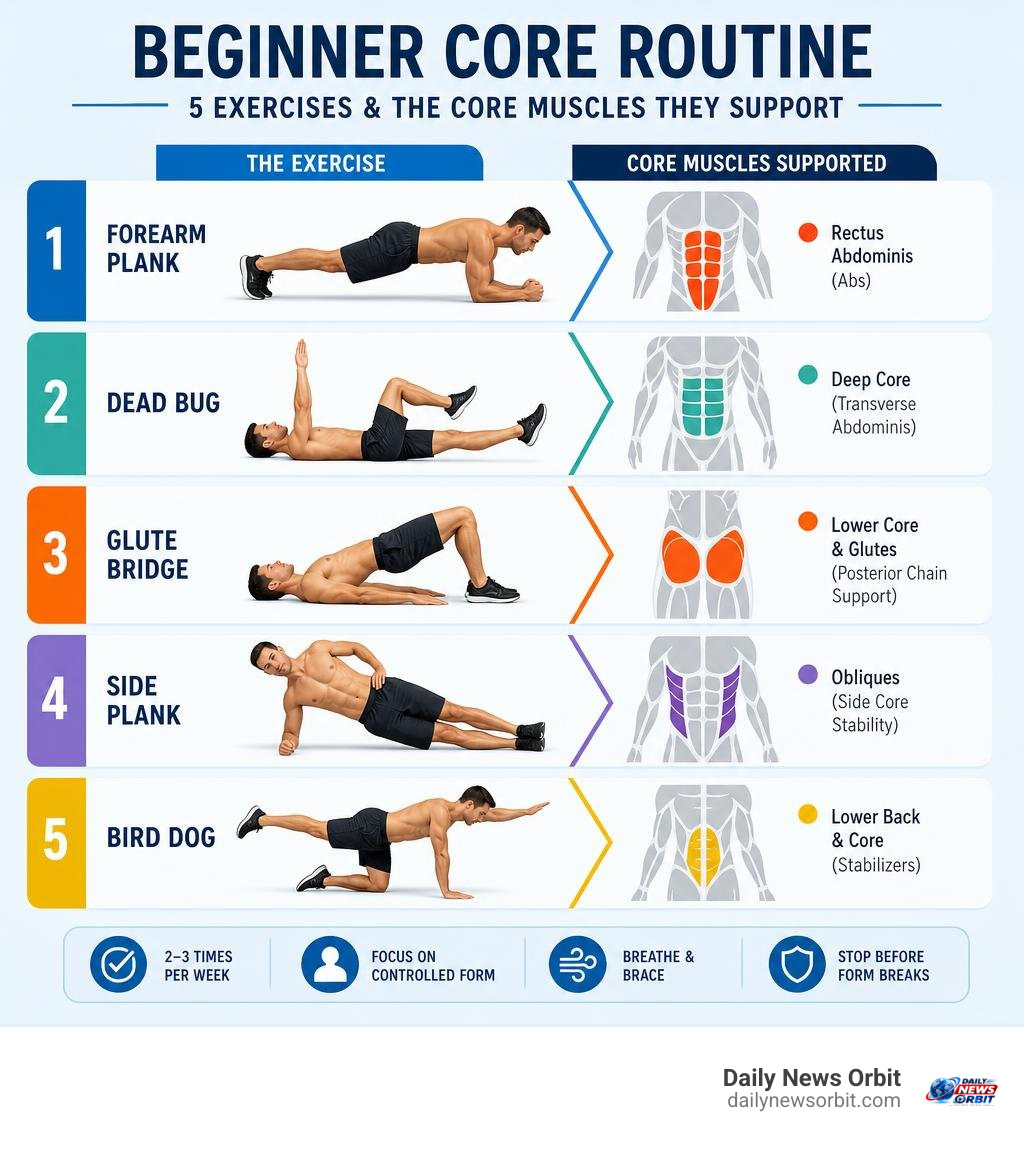
Quick answer: Start with five no-equipment movements that train your core from several angles: the forearm plank, dead bug, glute bridge, side plank, and bird dog. Do them 2-3 times per week, focus on controlled form, and stop each set before your lower back starts to arch or twist.
Your core is more than the muscles at the front of your stomach. It includes the obliques, deep abdominal muscles, lower-back stabilizers, glutes, diaphragm, and pelvic floor. Together, these muscles act like a 360-degree support system around your spine.
That matters whether you are carrying groceries, sitting at a desk, running, or learning to squat and deadlift. Endless crunches can make your abs tired, but they do not fully teach your body to resist unwanted bending, twisting, and side-to-side movement.
The goal here is simple: learn to brace, breathe, and control your trunk before making exercises harder.
Beginner core workout routine for men helpful reading:
Understanding the Male Core: Anatomy, Posture, and Proper Bracing

When most men think of core training, they picture the rectus abdominis—the classic “six-pack” muscle running down the front of the abdomen. However, true trunk strength functions like an internal weight belt that wraps 360 degrees around your midsection.
To build a resilient midsection, we must target every key muscle group:
- Transverse Abdominis (TVA): The deepest abdominal layer that compresses your internal organs and stabilizes the spine.
- Internal and External Obliques: Located along the flanks, these control and resist rotational and lateral forces.
- Erector Spinae and Multifidus: Deep back muscles running along your vertebrae that keep your spine tall and protected.
- Gluteal Complex and Pelvic Floor: The base of your core cylinder, vital for locking the pelvis in place and driving hip extension.
Many men who work desk jobs suffer from anterior pelvic tilt—a posture where the pelvis dumps forward, overextending the lumbar spine and causing the lower belly to protrude. If you want to start effective ab workouts at home today, mastering your pelvic alignment and learning proper intra-abdominal pressure is step one. For further guidance on foundational trunk stabilization, you can explore the Trumeta beginner core workout guide.
Bracing vs. Sucking In Your Stomach
A common misconception is that “engaging your core” means sucking your belly button toward your spine (the abdominal hollowing maneuver). Sucking in actually destabilizes the lumbar spine, compresses the neck, and restricts your breathing.
Proper core engagement is abdominal bracing. Imagine preparing your midsection to absorb a light punch to the stomach. Your ribcage stacks directly over your pelvis, your abdominal wall expands laterally in 360 degrees, and your deep stabilizers lock down. You must learn to breathe smoothly behind this shield rather than holding your breath.

The Functional Roles of the Core
The real purpose of your core is not movement creation—it is movement prevention. In strength training, your trunk acts as a rigid bridge transferring force between your lower and upper body during squats, presses, and daily tasks:
- Anti-Extension: Resisting the arching of the lower back (e.g., Forearm Planks, Dead Bugs).
- Anti-Rotation: Resisting twisting forces through the lumbar spine (e.g., Bird Dogs).
- Anti-Lateral Flexion: Resisting side-bending under offset loads (e.g., Side Planks).
5 Essential Core Exercises That Actually Work for Beginners
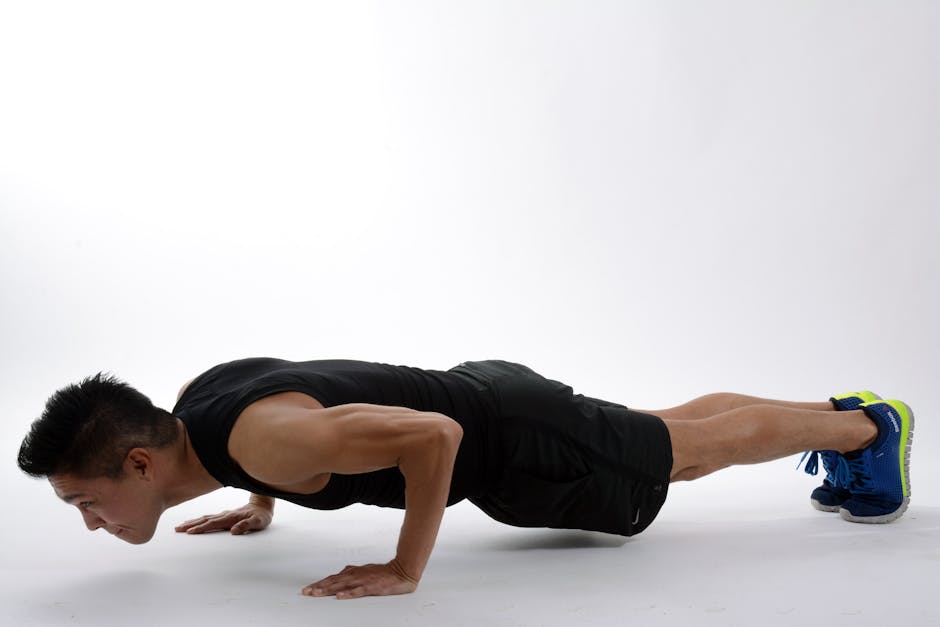
These five bodyweight movements require no equipment and focus strictly on movement quality, joint alignment, and tension control. For a structured regimen, our ab workout routine for beginners tested for form and effectiveness breaks down these movement patterns even further.
1. The Forearm Plank
The forearm plank is the gold standard for anti-extension strength, teaching your trunk to resist spinal sagging.
- How to do it: Place your elbows directly beneath your shoulders on the floor. Extend your legs straight back, resting on your toes. Tuck your pelvis slightly under (posterior pelvic tilt), squeeze your glutes hard, and draw your abdominal wall tight.
- Form cue: Gaze at the floor a few inches ahead of your hands to keep your neck neutral. Imagine pulling your elbows toward your toes to generate maximum tension.
- Target: 2–3 sets of 20–30 second holds.
2. The Dead Bug
The dead bug trains your deep transverse abdominis to stabilize your lumbar spine while your limbs move independently.
- How to do it: Lie flat on your back with your arms pointing toward the ceiling and your knees bent at 90 degrees directly over your hips. Press your lower back completely flush against the floor. Slowly lower your right arm behind your head while extending your left leg straight out until both are hovering just above the ground. Return to the start and alternate sides.
- Form cue: If your lower back arches off the mat at any point, stop and reset. Only extend your leg as far as your spine remains glued to the floor.
- Target: 2–3 sets of 8–10 controlled reps per side.
3. The Glute Bridge
Your glutes are the powerful anchor of your posterior core. Weak glutes force the hamstrings and lower back to overcompensate during daily movement. Adding targeted glutes workouts at home ensures total pelvic stability.
- How to do it: Lie on your back with your knees bent and feet flat on the floor, hip-width apart. Drive firmly through your heels to raise your hips until your body forms a straight diagonal line from your shoulders to your knees. Squeeze your glutes forcefully at the top for a two-second pause before lowering under control.
- Form cue: Avoid hyperextending your lower back at the top; the lift should come purely from hip extension.
- Target: 3 sets of 12–15 reps.
4. The Side Plank
The side plank targets your obliques and the quadratus lumborum (QL), developing lateral stability to protect your lower back from asymmetrical loads.
- How to do it: Lie on your side with your elbow directly underneath your shoulder and your legs extended with your feet stacked. Lift your hips off the floor until your body forms a straight line from your head to your heels.
- Regression: If a full side plank is too difficult, bend your knees to 90 degrees and support your weight from your knees to your elbow.
- Target: 2–3 sets of 15–30 seconds per side.
5. The Bird Dog
The bird dog builds cross-body stability by engaging the multifidus, erector spinae, and glutes across the sagittal plane without placing stress on the lumbar discs.
- How to do it: Start on all fours with your hands directly under your shoulders and your knees under your hips. Keeping your spine neutral and hips square to the ground, slowly reach your right arm straight forward while kicking your left leg straight back. Pause for a second at full extension, then return to the starting position and repeat on the opposite side.
- Form cue: Imagine balancing a cup of water on your lower back—do not let your hips twist or tilt.
- Target: 2–3 sets of 8–10 reps per side.
Designing Your Beginner Core Workout Routine for Men
To see real strength gains, you need a repeatable structure. If you are also following an Athleex beginner gym workout plan guide or doing a quick 15 min beginner ab workout for rapid core strength at home, you can place this core routine either at the beginning of your session when your nervous system is fresh, or as a standalone home circuit.
| Exercise | Primary Focus | Sets | Reps / Duration | Rest Between Sets |
|---|---|---|---|---|
| Forearm Plank | Anti-Extension | 2–3 | 20–30 sec hold | 45–60 sec |
| Dead Bug | Deep Core & Limb Control | 2–3 | 8–10 reps / side | 45–60 sec |
| Glute Bridge | Posterior Core & Hips | 3 | 12–15 reps | 45–60 sec |
| Side Plank | Anti-Lateral Flexion | 2–3 | 15–20 sec / side | 45 sec |
| Bird Dog | Anti-Rotation & Balance | 2–3 | 8–10 reps / side | 45 sec |
Structuring a Weekly Beginner Core Workout Routine for Men
Perform this beginner core workout routine for men 2 to 3 non-consecutive days per week (for example: Monday, Wednesday, and Friday). This schedule provides a necessary 48-to-72-hour recovery window between sessions.
Keep your rest periods between 45 and 60 seconds to maintain high training density. A complete routine should take only 12 to 15 minutes to complete.
Progression Roadmap for a Beginner Core Workout Routine for Men
Once you can complete the baseline reps and hold times with perfect technique, apply progressive overload:
- Increase Time Under Tension (Weeks 1–3): Build your plank holds up by 5 seconds per week until you reach 45–60 seconds cleanly.
- Adjust Lever Lengths (Weeks 4–6): Move from standard movements to longer lever variations, such as extending your arms further on planks or straightening your legs during dead bugs.
- Add Resistance (Weeks 7+): Introduce light resistance bands around your thighs for glute bridges, or hold a light dumbbell across your hips.
Frequently Asked Questions About Beginner Core Training
Can I do core exercises every day or do I need rest days?
We do not recommend daily high-intensity core training for beginners. Your abdominal and trunk muscles are composed of skeletal muscle fibers that require rest to repair micro-tears and adapt. Training 2 to 3 times per week with adequate rest days yields faster strength gains and prevents overuse fatigue in the lower back.
How does diet and body fat affect visible abs?
You can build exceptionally strong core stabilizers without ever seeing a defined six-pack. Abdominal muscle visibility is dictated by overall body fat percentage (typically below 12–14% for most men). While direct core training thickens the muscle bellies, revealing them requires maintaining a slight caloric deficit and consuming sufficient dietary protein (roughly 1.6–2.0 grams per kilogram of body weight) to preserve lean tissue while shedding fat.
What are the most common beginner core mistakes to avoid?
The most frequent mistakes include yanking on the back of the neck during floor movements, allowing the lower back to arch and sag during planks, rushing through repetitions using momentum instead of muscular control, and holding your breath during isometric holds. Always prioritize form quality over total repetition counts.
Conclusion
Building a powerful midsection is about functional midline stability, enhanced lifting mechanics, and everyday injury resilience. By sticking to these five essential movements and applying consistent progressive overload, you will establish an unbreakable foundation. When you are ready to expand your strength training further, check out our comprehensive guide on the ultimate gym workout routines for men for beginners to take your functional fitness to the next level.