
Compare Ab Workouts at Home Before You Start
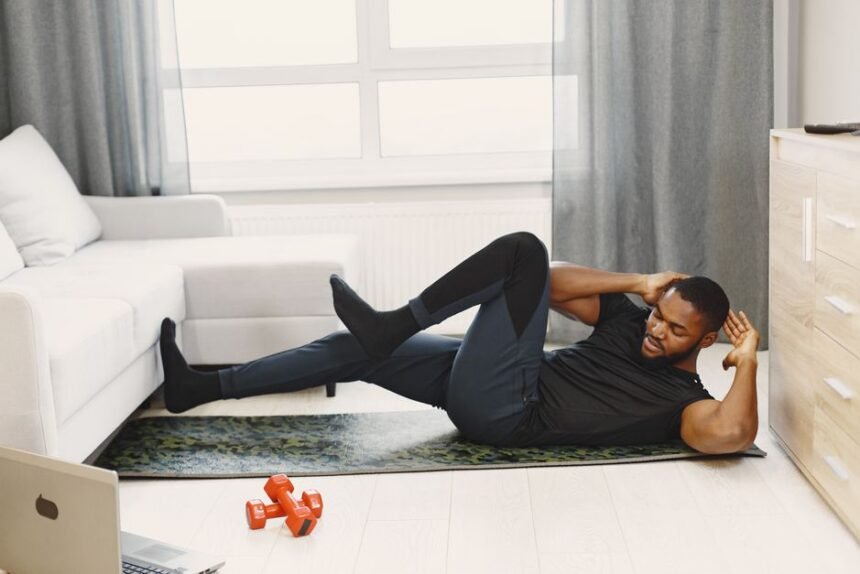
Ab workouts at home can build a stronger, more stable core with no equipment beyond a clear patch of floor and, ideally, a mat. The best routine depends on your current fitness level, available time, and whether your goal is core strength, muscle endurance, or a more defined midsection.
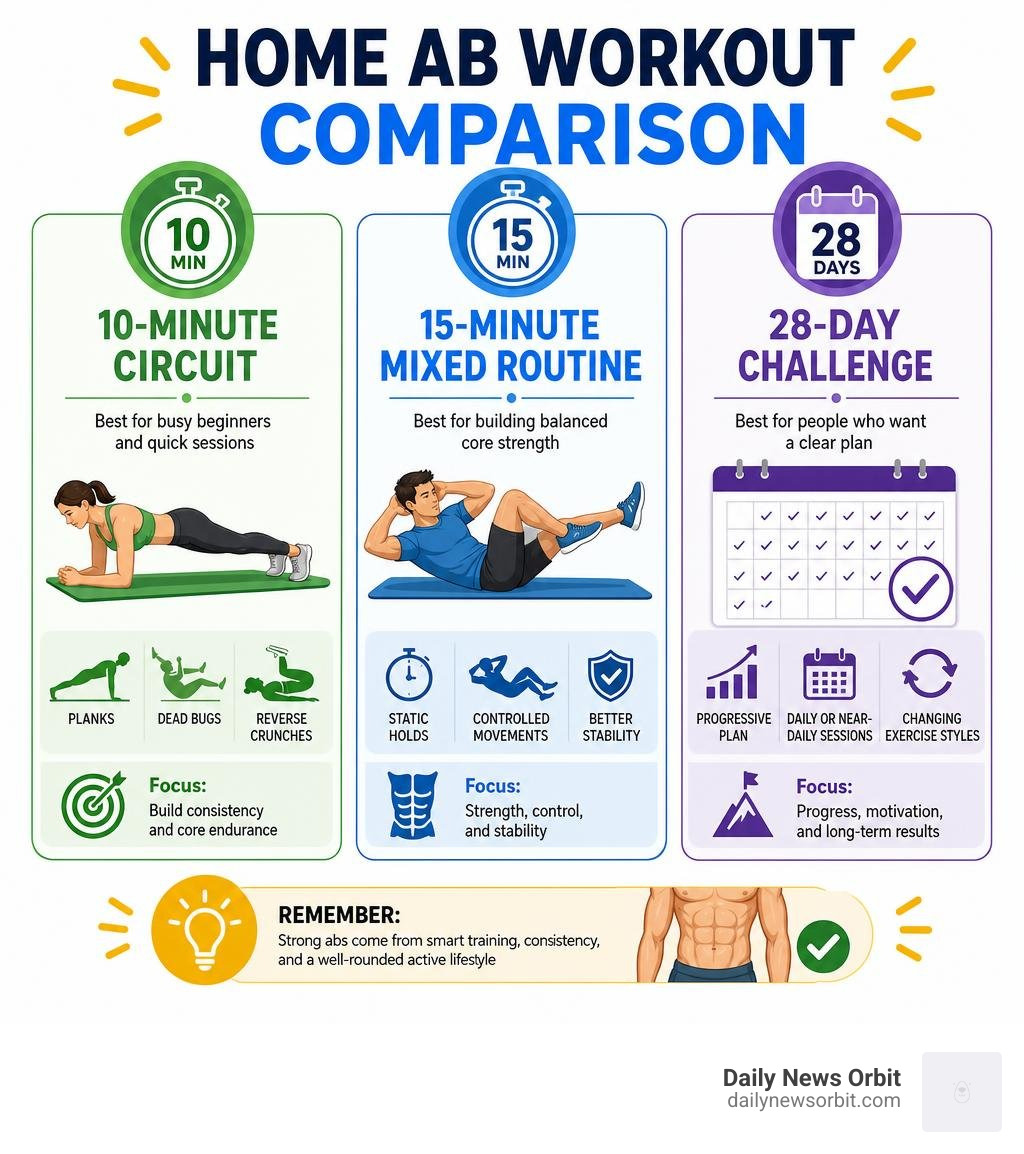
| Routine type | Best for | Typical format |
|---|---|---|
| 10-minute circuit | Busy beginners and quick sessions | Timed bodyweight moves, such as planks, dead bugs, and reverse crunches |
| 15-minute mixed routine | Building balanced core strength | Combines static holds with controlled moving exercises |
| 28-day challenge | People who want a clear plan | Progressive daily or near-daily sessions with changing exercise styles |
A smart home routine trains more than visible “six-pack” muscles. It also includes the deep core, obliques, hips, and lower back stabilizers that help support posture and everyday movement.
Short workouts can work well when form is controlled and the plan is repeatable. For overall health, the CDC recommends at least 150 minutes of moderate activity weekly plus muscle-strengthening work on two days per week. Ab training fits best as one part of that larger routine, not as a shortcut for losing belly fat.
Terms related to ab workouts at home:
Deep Core vs Surface Abs: Why Muscle Isolation Matters
When we think about abdominal training, most of us picture the visible six-pack muscles. However, true core strength relies on a balanced relationship between surface muscles and the deep core stabilizers beneath them.
The surface layer is dominated by the rectus abdominis, which runs vertically down the front of the stomach and handles spinal flexion (like when you perform a crunch). External obliques sit on the sides to assist with rotation and lateral bending.
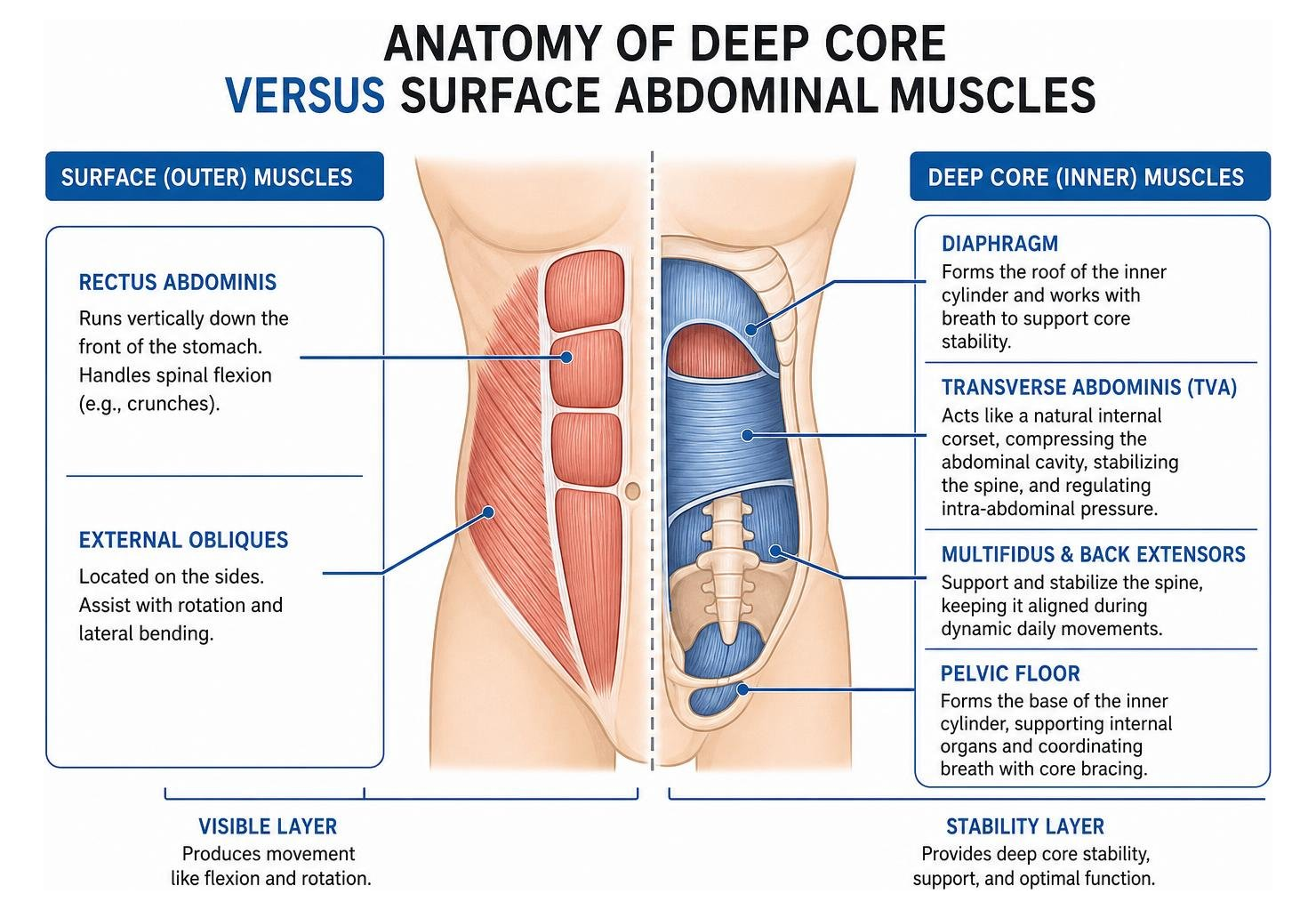
Beneath these lies the deep core framework:
- Transverse Abdominis (TVA): Acts like a natural internal corset, compressing the abdominal cavity, stabilizing the spine, and regulating intra-abdominal pressure.
- Pelvic Floor & Diaphragm: Form the base and roof of the inner cylinder, supporting internal organs and coordinating breath with core bracing.
- Multifidus & Back Extensors: Keep the spine aligned during dynamic daily movements.
Focusing strictly on surface flexion through endless crunches neglects spinal stability and can even worsen posture. Deep core training strengthens intra-abdominal pressure regulation, assisting with balance, back pain relief, and athletic output. In fact, engaging in comprehensive core practices like Pilates—which drew almost 12 million US participants in 2023—highlights the massive shift toward functional deep-core health. If you are starting fresh, exploring Why a Beginner 30-Day Workout Challenge Is the Best Way to Start Exercising can help you build this baseline stability safely.
Comparing Top Ab Workouts at Home
Choosing the right structure for ab workouts at home comes down to balancing training volume, available time, and your baseline fitness. Research shows that adherence rates double (rising from 13% up to 78%) when workout routines are kept to a concise 12 to 15 minutes, making short sessions far easier to stick with long-term.
| Routine Structure | Duration | Work/Rest Interval | Core Focus | Experience Level |
|---|---|---|---|---|
| 10-Minute High-Density Circuit | 10 mins | 45s work / 15s rest (or 40/20) | Lower abs, obliques, upper abs | Beginner to Intermediate |
| 15-Minute Isometric & Isotonic | 15 mins | 30s work / continuous | Dynamic flexion + static holds | Intermediate |
| 28-Day Bodyweight Challenge | 15 mins | EMOM / HIIT / Tabata cycles | Full core endurance & hypertrophy | Intermediate to Advanced |

Routine 1: The 10-Minute High-Density Core Circuit
This format uses a 40-second work to 20-second rest interval (or 45/15) repeated across two 5-exercise rounds. By ordering the exercises strategically, we fatigue the heaviest levers first while your core is fresh.
- Crescent Tucks or Leg Drops (Lower Abs): Focus on placing lower leg leverage first because moving the weight of the legs causes faster fatigue.
- Controlled Mountain Climbers: Performed slowly to emphasize deep core bracing over cardio speed.
- Low Plank Hold: Focus on dragging elbows toward toes to engage the transverse abdominis.
- Side Cycles or Russian Twists (Obliques): Rotational control without pulling on the neck.
- Corpse Crunch or Toe Reaches (Upper Abs): Squeezing at peak contraction to finish the circuit.
For an expert breakdown of interval-based core training, review the 10 Minute Ab Workout | 8 Abs Exercises | ATHLEAN-X guide. Working against the clock allows you to focus on maintaining a steady pace throughout the set rather than rushing to hit rep counts. Keeping sessions uncomplicated ensures maximum consistency.
Routine 2: The 15-Minute Isometric and Isotonic Routine
This continuous 15-minute routine pairs static isometric holds (planks, hollow body holds) with dynamic isotonic movements (reverse crunches, leg drops). Isometric holds train your muscles to resist unwanted movement, while isotonic movements take the abdominals through a full range of motion.
- Minute 0–5: Isotonic phase (Reverse crunches, dynamic side plank dips, leg drops).
- Minute 5–10: Isometric phase (Hollow body hold, elbow plank hold, side plank holds).
- Minute 10–15: Unilateral phase (Spiderman press-ups, kneeling side rotations).
Combining static holds with controlled breathing has also been shown to help manage blood pressure while challenging muscular endurance. Continuous bodyweight protocols offer an effective way to train without extra equipment. If you frequently struggle to fit training into a chaotic schedule, explore our guide to Stop Making Excuses and Start These 15-Minute Workouts Today.
Routine 3: The 28-Day Equipment-Free Ab Challenge
For those who thrive on structured variety, a 28-day challenge cycles through distinct thematic formats each day of the week:
- Day 1: Every Minute On the Minute (EMOM) abdominal sets.
- Day 2: Standard high-rep sets.
- Day 3: High-Intensity Interval Training (HIIT) core work.
- Day 4: Isometric holds.
- Day 5: Oblique isolation.
- Day 6: Crunch challenges.
- Day 7: Plank endurance tests.
This method keeps ab workouts at home fresh across more than 50 bodyweight variations. Following a structured challenge helps intermediate lifters manage training volume and implement effective scaling strategies over time.
How to Target Lower Abs, Upper Abs, and Obliques
Essential Exercises for Lower Ab Workouts at Home
The lower region of the rectus abdominis is often harder to target because the hip flexors tend to take over during leg-raising movements.
To isolate the lower abs safely, try these key exercises:
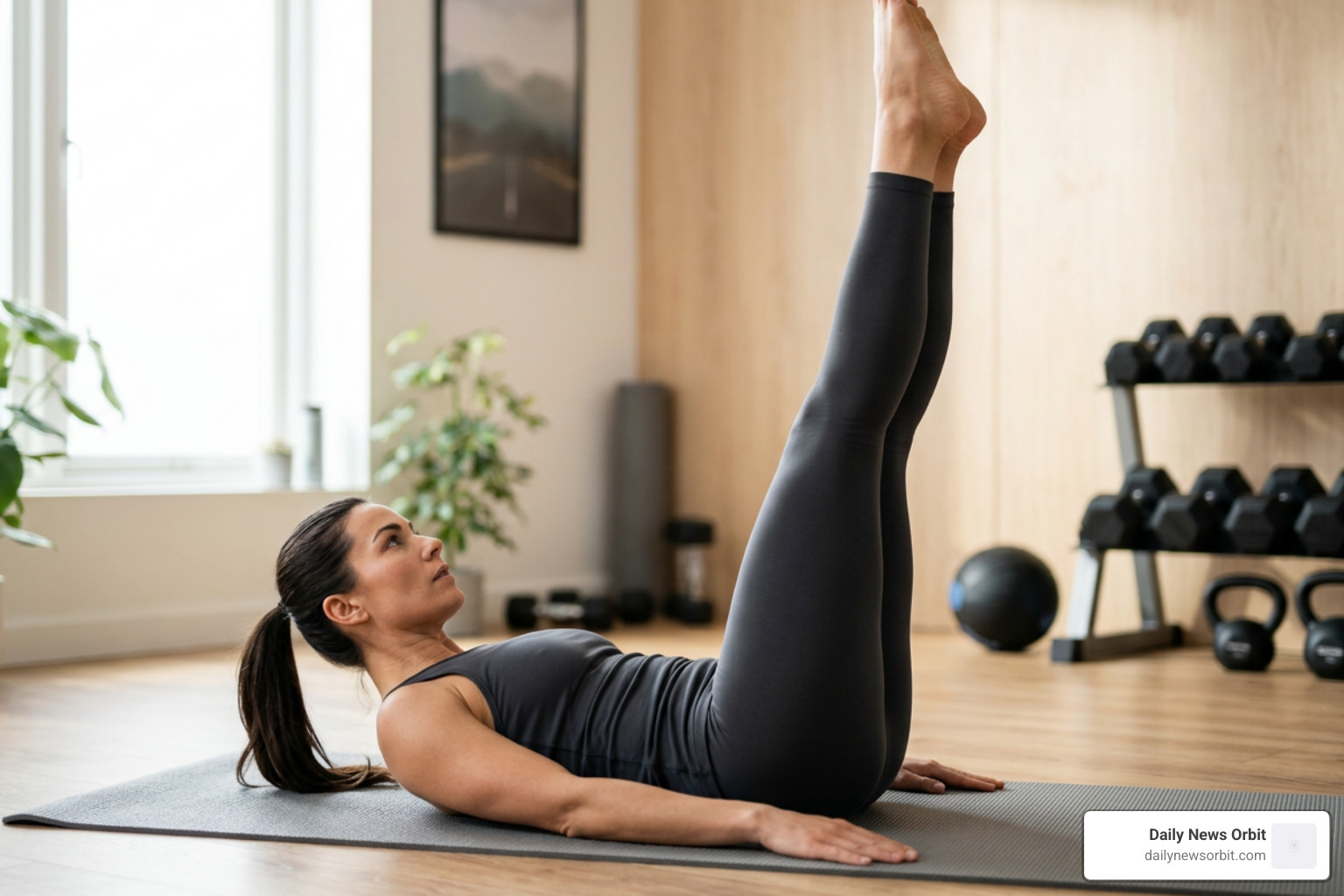
- Lying Floor Leg Drops: Lie flat on your back, extend your legs toward the ceiling, and lower them slowly under control. Only lower as far as you can maintain a flat lower back against the floor.
- Reverse Crunches: Curl your pelvis upward toward your ribs rather than just swinging your legs.
- Flutter Kicks: Lift your heels approximately 6 inches off the floor and execute rapid, scissor-like kicks while keeping your navel pulled inward.
To protect your lumbar spine during leg drops and flutter kicks, form a pelvic tilt support by placing your hands in a shallow triangle shape directly beneath your tailbone. If you want to integrate these movements into a complete strength blueprint, check out Good Workout Plans for Men: A Practical Roadmap to Strength.
Dynamic Movements for Upper Abs and Obliques
The upper abs respond exceptionally well to controlled spinal flexion, while the internal and external obliques require rotational resistance and lateral stabilization.
- Bicycle Crunches: Drive elbow to opposite knee smoothly, pausing for 1 second at peak contraction.
- Russian Twists: Lean back at a 45-degree angle, lift your feet for an added challenge, and rotate your torso side-to-side without using arm momentum.
- Spiderman Press-ups: Bringing your knee forward toward your elbow reduces your points of contact to three, forcing your obliques and core stabilizers to work twice as hard.
- Side Plank Hip Dips: Engage the lateral core and serratus anterior—the finger-like muscles along your upper ribs that assist with shoulder stability and core aesthetics.
For a deeper look into science-based exercise selection, see the Best Ab Workout for Women (10-Minute Science-Based Plan) guide.
Key Safety Tips, Form Guidelines, and Progressive Overload
Form Cues to Protect Your Lower Back
Prioritizing strict mechanics over repetition counts is vital for preventing low back pain and neck strain during home training.
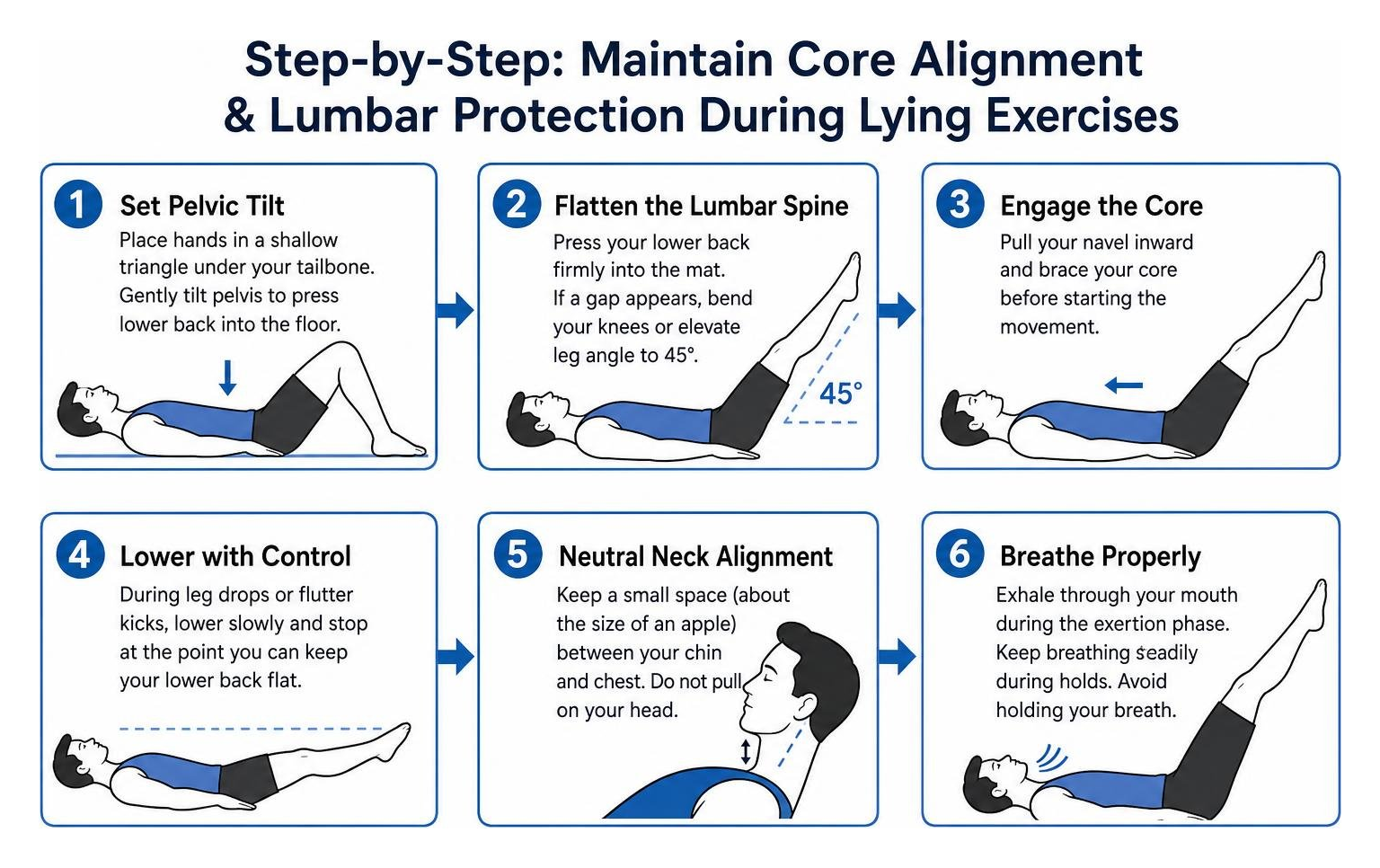
- Flatten the Lumbar Spine: When lying on your back, press your lower back firmly into the mat. If a gap appears, bend your knees or elevate your leg angle to 45 degrees.
- Neutral Neck Alignment: Never pull or tug on your head during crunches. Maintain a small space (about the size of an apple) between your chin and chest, letting your abdominals do the lifting.
- Breathing During Holds: Exhale through your mouth during the exertion phase (the contraction) and maintain continuous diaphragmatic breathing during static plank holds. Avoid holding your breath, which creates unsafe blood pressure spikes.
Progressive Overload Strategies for Ab Workouts at Home
Abdominal muscles require progressive overload to grow and strengthen just like your chest, legs, or back. You cannot simply perform 100 fast crunches every day and expect continuous growth.
To progress ab workouts at home without adding weights:
- Increase Time Under Tension: Slow down your tempo (e.g., 3 seconds on the eccentric/lowering phase, 1 second hold at peak contraction).
- Modify Exercise Levers: Transition from knee planks to full toe planks, or extend your arms overhead during hollow body holds to lengthen the lever arm.
- Decrease Rest Periods: Reduce rest intervals between sets from 30 seconds down to 15 seconds.
- Track Performance: Log your exact reps and hold times, increasing volume steadily week over week.
To learn more about structuring progressive overload across a full weekly routine, read our guides on how to Build Muscle Faster Using a Weekly 5-Day Training Split and how to Upgrade Your Pull Day with Cable Back Workouts.
Frequently Asked Questions About Ab Workouts at Home
Can ab workouts alone get rid of belly fat and reveal a six-pack?
No. Performing ab workouts at home will build and thicken the abdominal muscles underneath, but it will not spot-reduce belly fat. Revealing visible abs requires a sustained calorie deficit through diet and physical activity to lower overall body fat percentage (typically below 15% for men and below 22% for women).
How often should you do ab workouts at home each week?
Training your core 2 to 4 times per week is ideal. Abdominal muscles are recovery-resilient, but they still require 24 to 48 hours of rest to repair and rebuild. Avoid daily high-intensity ab workouts over long periods.
What is the difference between deep core exercises and traditional crunches?
Traditional crunches focus primarily on surface spinal flexion (the rectus abdominis). Deep core exercises (like dead bugs, planks, and vacuum holds) focus on spinal stabilization, posture, and regulating intra-abdominal pressure via the transverse abdominis and pelvic floor.
Conclusion
At Daily News Orbit, we believe building a stronger midsection doesn’t require expensive equipment or hours at the gym. By mastering proper form, pairing surface flexion with deep core stabilization, and applying progressive overload, ab workouts at home deliver remarkable strength, posture, and stability benefits.
Ready to take your overall training routine to the next level? Explore The Ultimate Gym Workout Routines for Men for Beginners for a comprehensive strength plan!