
Remember when AI felt like something out of a sci-fi movie, reserved for robots and supercomputers? Well, those days are long gone. By 2026, artificial intelligence has quietly slipped into nearly every corner of our daily routines, and honestly, most of us barely noticed it happening.
Whether you’re asking your phone for directions, getting a Netflix recommendation, or having an email drafted for you in seconds, AI is already working behind the scenes. But things are moving fast, and the changes coming in 2026 are bigger and more personal than ever before.
If you’ve ever felt confused or even a little overwhelmed by all the AI buzz, don’t worry. You’re in the right place. This post is written for everyday people, not tech experts. We’re breaking down the real, practical ways AI is changing life as we know it, from your morning routine to how you shop, work, and even visit the doctor. By the end of this list, you’ll have a clear and friendly picture of what AI actually means for you right now.
AI Agents Are Doing Tasks for You Now
Think about the last time you asked a virtual assistant something. You typed a question, it gave you an answer, and then you had to go do something with that answer yourself. That’s the old model. Agentic AI flips this completely. Instead of answering your questions, it goes out and handles the whole task for you, start to finish, without you needing to do anything else.
So what does that actually look like in real life? Imagine you want to fly home for the holidays but prices are too high right now. Instead of checking flight prices every day, an AI agent watches the fare for you, and the moment it drops to your target price, it books the ticket automatically using your saved payment details. Or picture running low on laundry detergent. An AI agent notices your purchase history, sees you’re due for a restock, and places the order before you even realize you needed it. These are not far-off sci-fi scenarios. They are the kinds of tasks agentic AI is being built to handle right now.
This is a genuinely big deal because it marks a fundamental shift in how AI works. Earlier tools like basic voice assistants or simple chatbots were reactive; you had to keep prompting them at every step. Agentic AI is proactive. You give it a goal once, and it figures out all the steps, makes decisions along the way, and takes real-world actions like sending emails, making bookings, or comparing prices across dozens of sites, all on its own.
The technical foundation that made this possible is something called the Model Context Protocol (MCP), a framework that lets AI agents connect to and control external tools, from your calendar to an airline’s booking system. According to IBM’s dedicated guide to AI agents, this infrastructure took root in 2025 and has since become the backbone of agentic systems. IBM has identified agentic AI as the defining computing shift of 2026, and they are not alone. Microsoft’s 7 AI trends for 2026 flag the exact same development, meaning this is genuine industry consensus, not marketing hype. According to Insentra Group’s 2026 analysis, Gartner predicts that 40% of enterprise applications will feature task-specific AI agents by the end of 2026, up from less than 5% in 2025. When IBM and Microsoft agree on something, it is worth paying attention.
Your Phone, TV, and Smart Home Are Getting a Lot Smarter
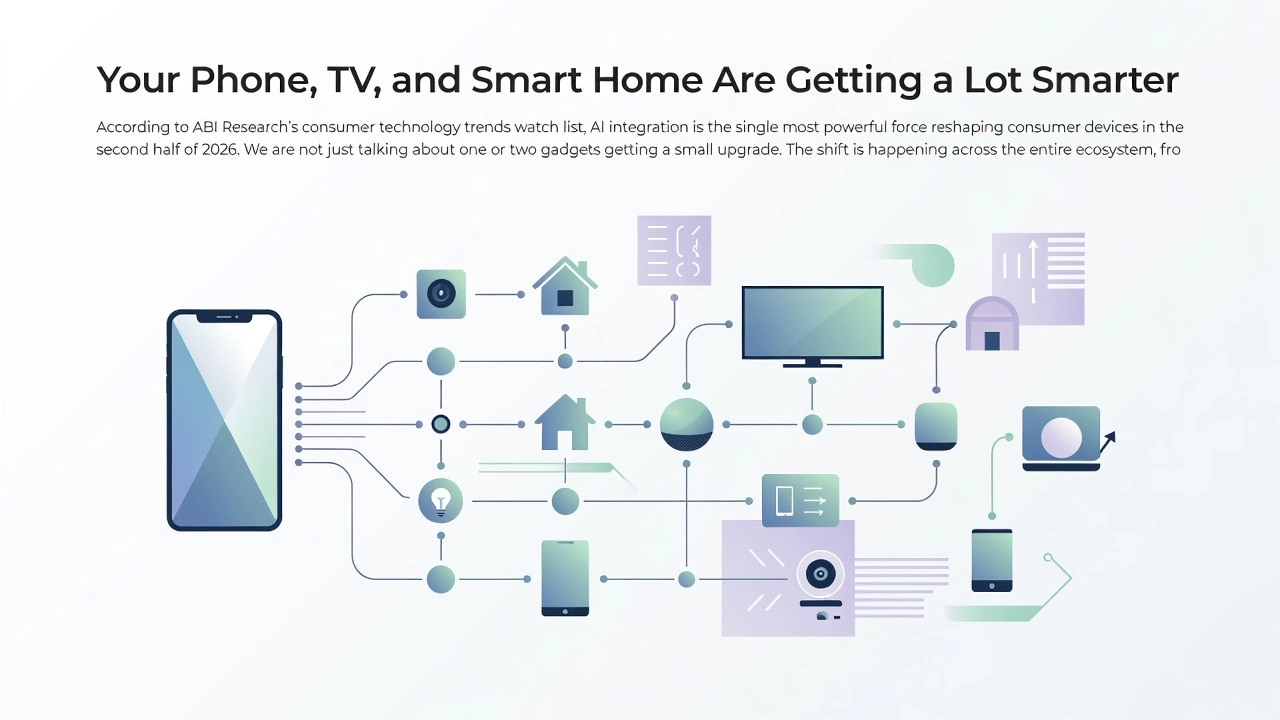
According to ABI Research’s consumer technology trends watch list, AI integration is the single most powerful force reshaping consumer devices in the second half of 2026. We are not just talking about one or two gadgets getting a small upgrade. The shift is happening across the entire ecosystem, from the smartphone in your pocket to the speaker on your kitchen counter to the television in your living room.
One of the biggest changes you will actually notice day-to-day is on-device AI processing. Rather than sending your voice commands or photos to a remote server and waiting for a response, newer devices handle those requests right on the device itself. This means faster responses and, importantly, your personal data stays local. It never leaves your phone or speaker. For anyone who has ever wondered what happens to the things they say around smart devices, this is a meaningful step forward.
Your smartphone camera is also a great example of how practical these upgrades have become. AI can now identify objects in your photos, recognize faces, and automatically sort your library into albums without you lifting a finger. It can even suggest edits based on what is in the shot, like brightening a dark portrait or straightening a crooked horizon. You get better photos with far less effort, which is something most people can genuinely appreciate.
Smart TVs have gotten a serious upgrade too. AI recommendation engines now learn your viewing habits well enough to surface content you actually want to watch, not just what is trending. On top of that, many new TVs use AI to upscale older video content in real time, making a DVD-quality clip look noticeably sharper on a 4K screen.
And your smart home assistant is no longer just waiting for a command. As covered in guides to the best smart home devices of 2026, today’s systems learn your daily routines and start anticipating what you need before you ask, whether that means adjusting the thermostat before you wake up or dimming the lights when you usually wind down for the night.
How AI Is Transforming Shopping and Fashion in 2026
Shopping has never been more personal, and AI is the reason why. Whether you’re browsing for a new outfit, redecorating your living room, or just trying to figure out which pair of jeans will actually fit, AI-powered tools are making the entire experience smarter, faster, and a lot less frustrating.
Virtual Try-On: See It Before You Buy It
One of the most exciting changes in retail right now is AI-powered virtual try-on technology. Instead of guessing how a jacket looks on your body type or whether that sofa works in your living room, you can upload a single photo and let AI do the work. The technology uses computer vision and deep learning to map garments realistically onto your body, accounting for fabric drape, body shape, and proportion. It is not just a filter slapped over a camera feed; it actually reconstructs how clothing would physically sit on you. According to CNBC’s April 2026 coverage, retailers are calling returns “silent killers” for their margins, and virtual try-on is one of the most promising tools to fight back.
Smarter Recommendations and Better Sizing
Beyond try-on, AI recommendation engines have leveled up significantly. Instead of generic “you might also like” prompts, today’s tools build a full style profile around you. They factor in your body type, past purchases, seasonal trends, and even your browsing behavior to suggest items that genuinely match your taste. This means less endless scrolling and more relevant results every time you open an app or website.
Sizing is another area where AI is making a real difference. Online apparel returns average 30 to 40%, and poor fit is the number one reason. AI sizing tools now analyze your measurements against brand-specific sizing data to predict your best fit before you check out, cutting down on those disappointing “it looked great online” moments.
Trend Forecasting and the Bigger Picture
Fashion brands across every price point are investing in AI-generated trend forecasting to reduce overstock and match production more closely to what consumers actually want. Both luxury houses and fast-fashion retailers are using AI to analyze social signals, search data, and purchase patterns, helping them produce less waste and more of what sells. The AI in fashion market is projected to grow from roughly $5.9 billion in 2025 to over $35 billion by 2035, which tells you everything about how seriously the industry is taking this shift.
For everyday shoppers, all of this adds up to one thing: a retail experience that feels built for you, whether you’re shopping online at midnight or walking into a physical store.
AI in Gaming: What Developers and Xbox Are Actually Building
Gaming is one of the most exciting places to watch AI grow up in real time. The changes happening right now are not just technical upgrades. They are reshaping how games are made, how they feel to play, and what it even means to be a game developer.
NPCs that actually surprise you. For years, talking to a non-player character in a game meant picking from a menu of pre-written responses while the character repeated the same three lines. AI is changing that fast. Modern AI-driven NPCs can now respond to what you actually did in the game, adapting their tone, attitude, and even their storyline based on your choices. Companies like Inworld AI have been partnering with studios to build characters that feel genuinely reactive rather than scripted. The result is gameplay that feels less like following a railroad track and more like living inside a story.
Microsoft’s Muse tool and the push for smaller studios. Microsoft Research developed a model called Muse, described as a “World and Human Action Model” that can generate game visuals, controller actions, and environment concepts to help developers brainstorm and build faster. The idea is that a small indie studio with a tight budget can use AI tools to produce assets and environments that would have previously required a much larger team. That said, internal adoption has been uneven. Some studios under Microsoft’s umbrella have pushed back, describing themselves as “craft oriented” and preferring traditional creative workflows.
Difficulty that adjusts to you. AI-powered adaptive difficulty is quietly becoming one of the most player-friendly innovations in gaming. These systems monitor how you play in real time, whether you are breezing through levels or hitting the same wall repeatedly, and adjust the challenge accordingly. You stay engaged without feeling cheated or crushed.
Better visuals on everyday hardware. Technologies similar to NVIDIA DLSS 4 and AMD FSR 4 use AI to upscale images and generate frames, delivering sharper visuals even on mid-range GPUs. This matters enormously for players who cannot afford top-tier hardware.
The concerns are real too. According to AI and Games, over 4,000 games on Steam carried AI content disclosures in 2025, and predictions suggest one in three Steam games will include such disclosures by the end of 2026. Developers are asking hard questions about creative ownership and whether AI tools will eventually replace the artists and writers who make games worth playing in the first place.
AI Is Now Your Sous Chef and Meal Planner
If you have ever stared into your fridge at 6pm with absolutely no idea what to make for dinner, AI has officially entered the chat. A new wave of smart meal planning apps can now look at what you already have on hand and build an entire dinner plan around it, no cooking experience required.
From fridge photo to dinner plate is no longer just a fun concept. Apps like Samsung Food (formerly known as Whisk) use ingredient recognition to scan your fridge and pantry contents, then suggest meals built around what you already own. Tools like MenuMagic let you import recipes directly from Instagram, TikTok, or YouTube, turning your social media food scroll into an actual weekly menu. The practical benefit here is real: when your meal plan is built around existing ingredients, you waste far less food and spend less time wandering grocery aisles without a plan.
Nutrition personalization is another area where these tools genuinely shine. Mealime, which has more than 5 million users, lets you filter meals by diet type, including keto, paleo, vegan, and low-carb, while also excluding up to 119 individual ingredients you dislike or cannot eat. Apps like Eat This Much go even further, auto-generating plans around specific calorie and macro targets. For anyone managing food allergies or chasing a fitness goal, this level of customization used to require a personal nutritionist.
Once your meals are planned, the grocery list practically writes itself. Apps like eMeals push your shopping list directly to major grocery retailers for delivery, often in under ten minutes. According to rankings from leading meal planning review sites, tools like Ollie for Meals have been highlighted by major publications for genuinely simplifying weeknight cooking for busy families.
The biggest win for beginners is that none of this requires you to know how to cook. Mealime explicitly markets step-by-step instructions designed for people who have never cooked before, with most recipes clocking in at 30 minutes or less. AI has quietly made home cooking something anyone can actually do.
AI Scams and Cyberattacks Are Surging: How to Protect Yourself
AI is not just making life more convenient. It is also making fraud more convincing, more targeted, and more dangerous than ever before. According to IBM’s Cost of a Data Breach Report 2026, AI-driven cyberattacks have surged by 56%, and while that number is largely driven by enterprise-level incidents, the same tools and tactics reach everyday consumers faster than most people realize. Think of it like a new scam playbook getting written at the top and copied at the bottom within months.
The Threats You Actually Need to Know About
The three most common AI-powered attacks hitting regular people right now are worth understanding clearly.
Deepfake voice scams are the scariest evolution of the old “grandparent scam.” Criminals can clone someone’s voice using as little as three seconds of audio pulled from a voicemail, a TikTok, or a social media video. That cloned voice then calls a family member pretending to be in trouble and asking for money urgently. These calls sound real because they essentially are, and AI deepfake scams have been called the worst scam of 2026 by consumer safety journalists reaching hundreds of thousands of viewers.
Hyper-personalized phishing emails have replaced the obvious spam of the past. AI can now scrape your LinkedIn, social profiles, and leaked data to write an email referencing your actual employer, a recent purchase, or a colleague’s name. According to KnowBe4, 86% of phishing attacks are now AI-generated, which means the grammar mistakes that used to give scammers away are largely gone.
Fake AI customer service agents are also on the rise, with agentic AI being used to impersonate real company representatives at scale, guiding victims toward handing over credentials or payment details.
5 Practical Ways to Protect Yourself
- Set up a family code word. Agree on a secret phrase with close family members. If someone calls claiming to be them in an emergency, ask for the word. Scammers cannot know it.
- Enable multi-factor authentication everywhere. With credential phishing growing by 700% in just the second half of 2024 alone, a second verification step is non-negotiable.
- Slow down on urgent requests. AI scams are engineered to panic you into acting fast. Any unexpected financial request through any digital channel deserves a pause and a callback on a verified number.
- Use AI-powered defenses. Your email provider, antivirus software, and bank are all using behavioral AI to flag suspicious activity. Keep software updated so those tools stay current.
- Report what you see. Use FTC’s ReportFraud.ftc.gov or IC3.gov to flag scam attempts, which helps protect others too.
On the defensive side, AI-powered fraud detection systems are fighting back in real time, scanning networks and flagging anomalies before damage occurs. The deepfake detection market alone is projected to hit $15.7 billion by 2026. The arms race is real, but staying informed and using a few simple habits keeps you far ahead of most targets.
AI Tools Every Small Business Owner and Website Builder Should Know
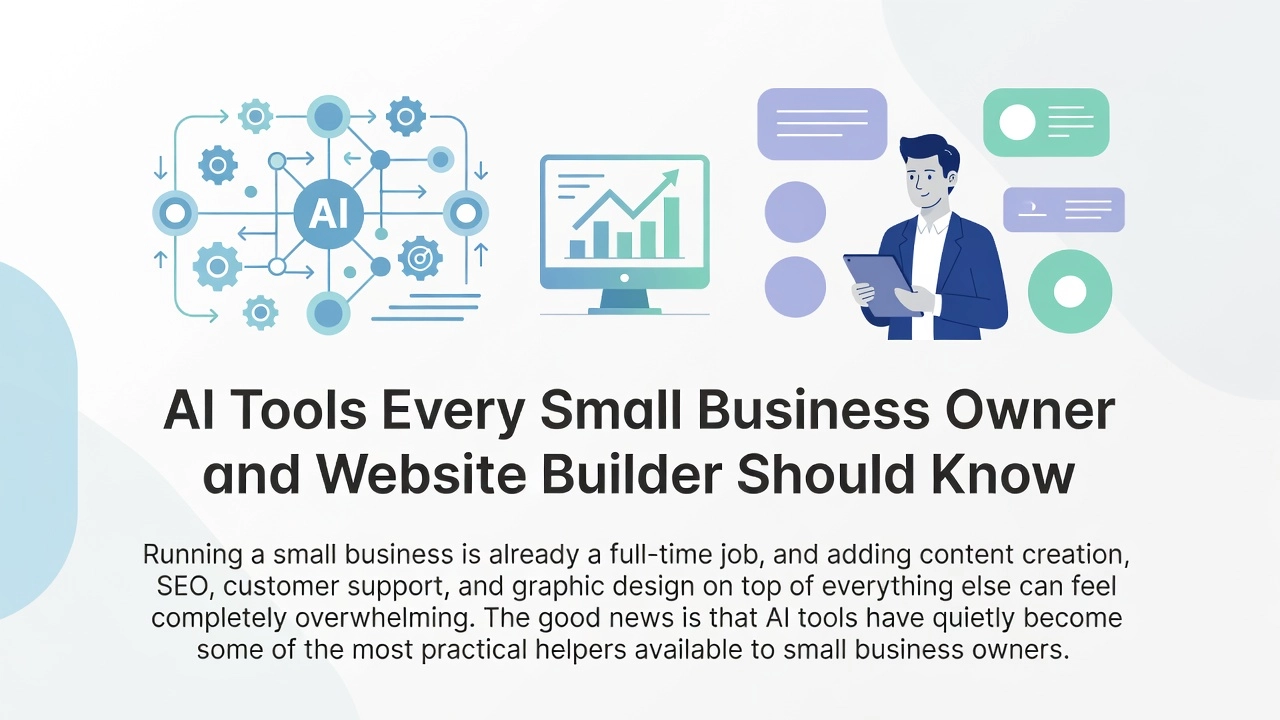
Running a small business is already a full-time job, and adding content creation, SEO, customer support, and graphic design on top of everything else can feel completely overwhelming. The good news is that AI tools have quietly become some of the most practical helpers available to small business owners and website builders right now. Here are the key categories worth knowing about.
1. AI Writing Tools for Content Creation
If keeping up with blog posts, product descriptions, and landing page copy feels impossible, AI writing tools built directly into platforms like WordPress can change that. Builders like Elementor AI, Divi AI, and SeedProd now generate draft copy right inside the editor, so you are not bouncing between apps. According to a 2026 buyer’s guide from KlashTech, these tools “can genuinely replace hours of manual work each week,” which is often the difference between publishing consistently and letting your blog go quiet. You will still want to review and tweak the output for your brand’s voice, but the heavy lifting gets done fast.
2. AI-Powered SEO Tools
Getting found on Google is non-negotiable for small businesses, and AI-powered SEO plugins can help even non-technical owners compete. Tools like Rank Math AI and similar WordPress plugins automatically scan your pages, flag missing meta descriptions, suggest keyword opportunities, and even analyze what is working in competing content. Instead of guessing, you get a clear checklist of fixes and improvements surfaced automatically.
3. AI Chatbots for 24/7 Customer Support
Solo operators cannot be available around the clock, but an AI chatbot can. Embedding a chatbot on your site means customer questions about shipping, pricing, or bookings get answered instantly, even at midnight. This is especially valuable for e-commerce, real estate, and service-based businesses where delayed responses cost sales.
4. AI Image Generation and Editing
Need social media visuals or product photos but cannot afford a designer? AI image tools now generate and resize professional-quality graphics in minutes, making polished visuals accessible to any budget.
5. AI Throughout Your WordPress Journey
From choosing a layout to publishing your first post, AI is embedded at every stage of building a WordPress site today. What used to cost thousands of dollars and weeks of development is now something many business owners can achieve with the right tools and a free afternoon.
Key AI Statistics Translated for Regular People
Sometimes numbers tell a story better than anything else, and the AI statistics coming out of 2026 are genuinely worth paying attention to, even if you have never worked in tech a day in your life.
Start with this: Microsoft identified 7 headline AI trends for 2026, and that report sits alongside dedicated AI outlook pieces from IBM, Capgemini, MIT Sloan, and CapTech, all published within the same calendar year. When institutions that size all commit resources to documenting the same shift at the same time, that is not hype. That is a signal that something structural is changing, the same way banks and governments started publishing annual internet reports in the late 1990s. AI is not a passing wave you can wait out.
IBM’s research adds a layer that hits closer to home. Their work describes a future where every worker becomes an “AI composer,” meaning someone who actively directs and uses AI tools rather than just watching from the sidelines. That includes nurses drafting shift notes, teachers building lesson plans, office managers summarising meeting transcripts, and retail workers handling scheduling. The point is that jobs far removed from anything labeled “technology” are already being reshaped by AI tools for writing, research, and daily organisation.
The volume of data backing all this up is staggering. Forbes Advisor compiled 22 key AI statistics for 2026, while National University aggregated 137 separate data points on AI’s economic and social impact. A few years ago, researchers were making projections. Now they are measuring what already happened. That shift from forecasting to tracking is itself meaningful.
Finally, Capgemini, CapTech, and MIT Sloan all describe 2026 as the year AI moves from experimental pilot projects to embedded infrastructure, meaning it is being built directly into the tools, platforms, and workflows people use every day, whether they realise it or not.
The takeaway is simple. These numbers are not written for data scientists. They confirm something practical for everyone: learning to use AI tools is no longer optional career preparation. It is a basic life skill, like learning to use email was twenty years ago.
What AI Means for Your Job and Career in 2026
IBM has a phrase for what workers are becoming in 2026, and it is a good one: AI composers. The idea is that instead of being replaced by AI, workers are becoming the people who direct it, edit its output, and collaborate with it to get things done. Think of it like being a film director rather than the camera operator. You are not doing every task yourself; you are shaping the final result. That framing matters because it shifts the conversation from fear to strategy.
The practical day-to-day shift is already visible. Workers are using AI to generate first drafts, summarize long reports, pull together research, and handle scheduling logistics. According to PwC’s 2026 AI Jobs Barometer, new tasks added to AI-exposed roles are 2.5 times more likely to require empathy, judgement, and creativity than tasks AI is absorbing. In plain terms, when AI handles the repetitive groundwork, your job becomes more about the human stuff: making calls, reading a room, building relationships, and making decisions that actually carry weight.
Now for the honest part. Some roles are genuinely shrinking. Data entry, basic content production, and routine customer service positions are all seeing reduced demand as AI handles more of that volume. At the same time, new roles are growing around AI oversight, quality review, and prompt engineering. The World Economic Forum estimates that while 85 million jobs could be displaced globally, new technology could create 97 million new roles over the same period. The labor market is not disappearing; it is sorting itself into a new shape.
Here is why timing matters right now. IBM describes 2026 as the year enterprises stop experimenting with AI and start proving its measurable business value. Employer adoption is accelerating fast, and workers who build AI fluency early are walking into that shift with a real edge.
You do not need a corporate IT budget to start. Try these tools on your own:
- ChatGPT (free tier) for writing drafts, brainstorming, and summarizing
- Otter.ai for AI-powered meeting notes and transcripts
- Reclaim.ai for AI-assisted calendar and task scheduling
- Notion AI for organizing notes and generating content outlines
Starting small is completely fine. Even using one of these tools regularly builds the AI literacy that employers are increasingly looking for.
Open-Source AI Is Growing Fast and That Benefits You
Open-source AI might sound like a technical term, but the concept is actually pretty simple. When an AI model is open-source, its underlying code is made publicly available so that any developer, anywhere in the world, can download it, modify it, and build products with it. Nobody has to pay licensing fees to a big tech company just to get started. Think of it like a recipe that anyone can use and remix versus a secret formula locked behind a corporate wall.
The biggest open-source story of 2025 was DeepSeek-R1, a model released by a Chinese AI startup that genuinely rattled the industry. DeepSeek-R1 matched the performance of much more expensive proprietary models and did it at a fraction of the cost, with some analyses showing it running up to 99% cheaper for comparable results. The disruption was significant enough that U.S. tech stocks took a major hit when the news broke, simply because investors realized expensive AI was no longer the only option.
Here is why that matters for you personally. More competition in the AI market means lower prices, more variety in the apps being built, and less dependence on just one or two dominant platforms. By mid-2025, roughly 80% of AI startups seeking funding from major venture capital firms were building on open-source models because the cost savings were impossible to ignore. That pressure flows downstream, giving everyday consumers access to cheaper, better tools.
The trade-off is worth acknowledging honestly. Open access also means fewer guardrails, and bad actors can use these same models to build scam tools or generate misinformation at scale. This is exactly why the security awareness and AI literacy covered earlier in this article are not optional extras; they are essential skills now.
The bigger picture is actually encouraging though. Unlike social media, which consolidated around just a handful of gatekeepers, the AI market is staying remarkably competitive and open. That is genuinely good news for small businesses and everyday consumers alike.
The Bottom Line on AI in 2026
Here is where everything covered in this list comes together. AI in 2026 is not something happening in a lab somewhere or arriving in a few years. It is already inside your phone, your shopping apps, your workplace tools, and unfortunately, your security threats too.
Three things are worth walking away with. First, pick one AI tool that connects to your job or a hobby you actually enjoy and spend some real time with it. Workers who use AI regularly are already pulling ahead of those who do not. Second, turn on multi-factor authentication and tighten up your account security today, because AI-powered scams are faster and more convincing than ever. Third, stay curious rather than dismissive. The people who understand what AI is doing and why will always be better positioned to benefit from it.
If any section of this list caught your attention, DailyNewsOrbit has deeper dives waiting for you on AI in gaming, AI-powered shopping tools, and smart lifestyle apps worth trying. The readers who lean in now will not be caught off guard later. They will be the ones taking advantage.
Conclusion
AI in 2026 is not a distant, intimidating concept; it is already woven into the fabric of your daily life. From smarter morning routines and personalized shopping experiences to faster healthcare and more efficient workdays, these changes are designed to make your life easier, not harder.
Here are the key takeaways to remember: AI is already working for you in ways you may not notice, the changes ahead are personal and practical, and staying informed is your greatest advantage.
The best thing you can do right now is stay curious. Start paying attention to the AI tools you already use, explore one new feature this week, and share what you learn with someone else.
You do not need to be a tech expert to thrive in an AI-powered world. You just need to stay open, stay informed, and take it one step at a time.