


A 3 Day Gym Schedule That Fits Real Life
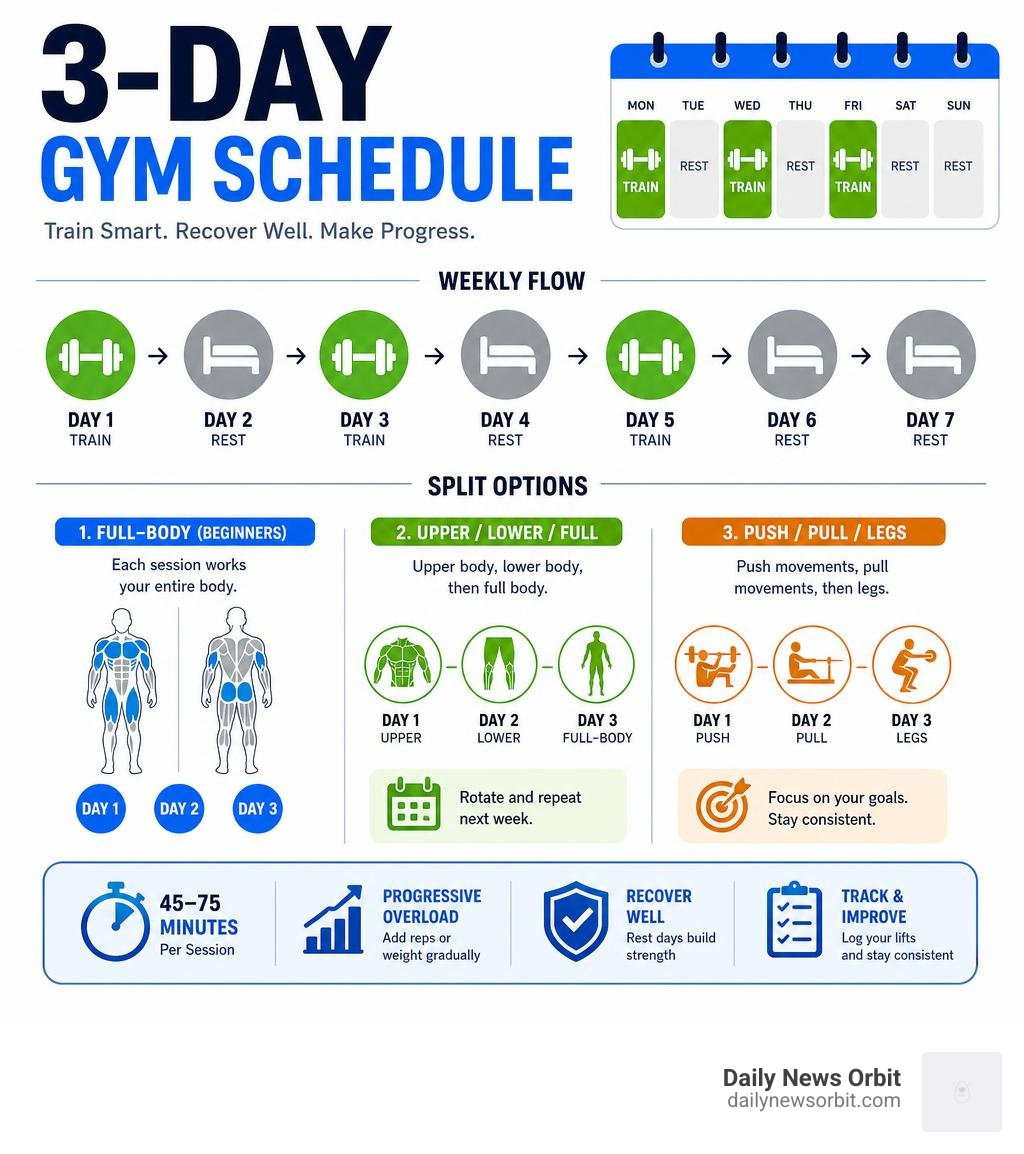
A 3 day gym schedule is a simple way to build strength, muscle, and fitness without spending most of your week in the gym. For most people, the best starting plan is to lift on three non-consecutive days, such as Monday, Wednesday, and Friday.
| Quick answer | What to do |
|---|---|
| Best schedule | Train three non-consecutive days each week |
| Best for beginners | Full-body workouts three times per week |
| Best for experienced lifters | Full body, a rotating upper/lower plan, or push/pull/legs based on goals |
| Workout length | About 45 to 75 focused minutes |
| Main priority | Use good form, track your lifts, and gradually add reps or weight |
Three sessions can be enough to make meaningful progress. The key is not cramming in endless exercises. It is training major movement patterns consistently, allowing recovery, and building up over time.
This guide will help you choose a plan that matches your experience, schedule, and goal – whether that is gaining muscle, getting stronger, losing fat, or simply making the gym a habit you can keep.
Why a 3 Day Gym Schedule Works for Muscle Growth and Fat Loss
Many people assume that doing more always leads to faster results. However, when it comes to strength training, maximum growth happens while resting rather than while lifting. A 3 day gym schedule balances intense training sessions with the exact window of physical recovery required for consistent gains.
Scientific research shows that training a muscle group 2 to 3 times per week is significantly more effective for strength gains than training it just once a week. In fact, individuals training three times per week in resistance studies improved their strength by 21.2% after 10 weeks and 28.4% after 18 weeks. When total weekly volume is matched, training frequency yields comparable hypertrophy outcomes, meaning three days of high quality lifting will get the job done just as well as five days of grinding.
Following a resistance workout, muscle protein synthesis remains elevated for roughly 24 to 48 hours. By spreading three workouts across the week—such as Monday, Wednesday, and Friday—you keep muscle building processes elevated while giving your central nervous system complete rest between sessions.
Whether your primary target is building mass or shedding body fat, this structure delivers. With proper nutrition, lifters on a three-day routine can expect to build roughly 1 to 2 pounds of lean muscle per month. If fat loss is your main objective, combining this routine with a slight caloric deficit supports a healthy fat loss rate of 1 to 2 pounds per week while preserving lean muscle. For even deeper insights into building foundational strength, check out our 3-Day Split Workout Research. If you are just embarking on your routine, exploring why a beginner 30-day workout challenge is the best way to start exercising can help kickstart long-term habits.
The 3 Most Effective 3-Day Workout Split Structures
Selecting the correct training split depends on your current experience level, total available time, and performance goals. Below is a structural comparison of the three most reliable setups:
| Split Type | Best For | Frequency per Muscle Group | Primary Advantage |
|---|---|---|---|
| Full-Body (x3) | Beginners to Intermediates | 3x per week | High movement frequency and schedule forgiveness |
| Push / Pull / Legs | Intermediates | 1x to 1.5x per week | Excellent muscle group isolation and targeted fatigue management |
| Upper / Lower Hybrid | Intermediate to Advanced | 1.5x per week (rotating) | High versatility for strength and athletic performance |
Full-Body 3 Day Gym Schedule for Beginners
For newcomers, a full-body routine performed three days a week is the absolute gold standard. The National Strength and Conditioning Association explicitly recommends 2 to 3 days per week with rest days in between for novice lifters.
By working the entire body each workout, beginners practice core compound lifts like squats, chest presses, and lat pull-downs three times per week. This accelerated repetition builds motor patterns and neural efficiency rapidly. Furthermore, full-body splits offer built-in schedule forgiveness; if life gets in the way and you miss a session, you haven’t skipped an entire muscle group for the whole week. Check out the SpotyFlex Full Body Guide to see sample full-body routines tailored for beginner lifters.
Push/Pull/Legs 3 Day Gym Schedule for Intermediate Lifters
Once you have built a foundation of strength over 8 to 12 weeks, transitioning to a Push/Pull/Legs (PPL) split provides greater exercise variation and isolation:
- Day 1 (Push): Chest, Shoulders, and Triceps
- Day 2 (Pull): Back, Biceps, and Rear Delts
- Day 3 (Legs & Core): Quads, Hamstrings, Glutes, and Calves
PPL isolates supporting muscle groups naturally. Pushing movements use the chest and shoulders while heavily engaging the triceps, whereas pulling movements combine back development with bicep activation. If you want to optimize your back and arm workouts, you can upgrade your pull day with cable back workouts for smoother joint tension and targeted isolation. Additional detailed routines can be reviewed in the comprehensive 3-Day Split Guide by LoadMuscle.
Upper/Lower Hybrid Split for Advanced Progression
For experienced lifters looking to maximize hypertrophy without adding a fourth gym day, an Upper/Lower hybrid split offers dynamic loading.
This model rotates workouts across weeks (e.g., Week 1: Upper / Lower / Upper; Week 2: Lower / Upper / Lower) or incorporates a third “Full Body” day at the end of the week. This setup gives extra emphasis to major compound lifts while preventing plateau fatigue. To build out a balanced strength program around multi-joint lifts, read our detailed guide on good workout plans for men: a practical roadmap to strength. Additional intermediate configurations can be found in Hypro’s 3-Day Workout Split Guide.
How to Program Your 3-Day Workouts: Sets, Progressive Overload, and Cardio

To build continuous strength and muscle mass, your programming must balance volume, intensity, and recovery.
For total weekly volume, aim for 10 to 15 hard sets per major muscle group per week. Across a three-day period, each training session should include roughly 5 to 7 total exercises, totaling 15 to 25 total sets per session. Keep individual workout sessions between 45 and 75 minutes to keep intensity high and avoid accumulating unnecessary “junk volume.”
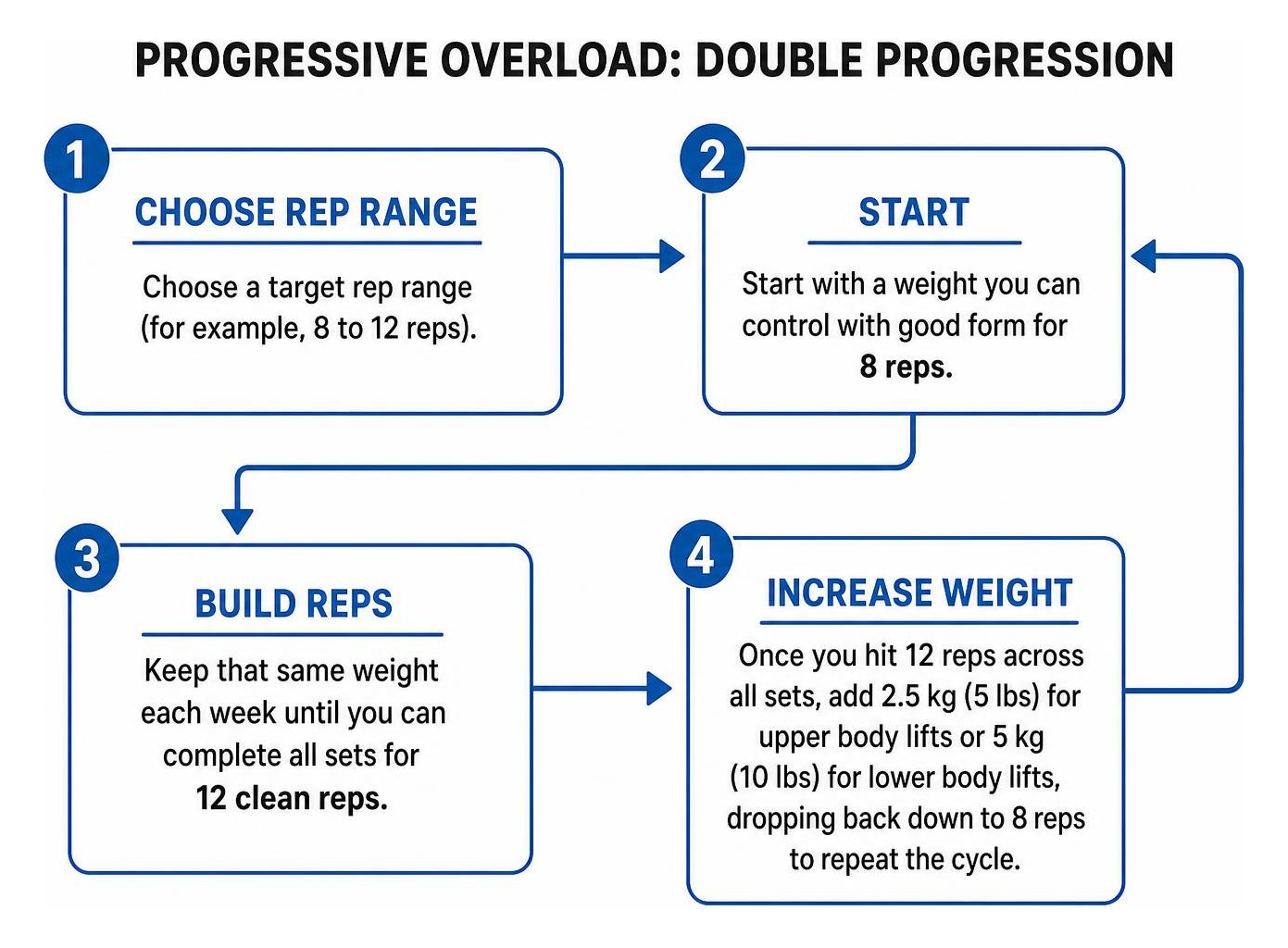
The primary key to success is applying progressive overload. You cannot lift the exact same weight for the exact same reps every week and expect your body to change. The easiest method to use is double progression:
- Choose a target rep range (for example, 8 to 12 reps).
- Start with a weight you can control with good form for 8 reps.
- Keep that same weight each week until you can complete all sets for 12 clean reps.
- Once you hit 12 reps across all sets, add 2.5 kg (5 lbs) for upper body lifts or 5 kg (10 lbs) for lower body lifts, dropping back down to 8 reps to repeat the cycle.
If you are short on time or want to combine conditioning with strength work on non-lifting days, you can easily stop making excuses and start these 15-minute workouts today. Alternatively, 20 to 30 minutes of low-intensity steady-state cardio (LISS) performed post-workout or on rest days will boost aerobic fitness without hurting your strength recovery. For step-by-step workout program designs and printable guides, check out The Fitness Phantom’s 3-Day Gym Workout Routine.
Common 3-Day Gym Schedule Mistakes and When to Transition

Even with a great routine, simple training errors can slow down your results. Here are the most common pitfalls to avoid:
- Ego Lifting: Piling on more weight than you can handle leads to poor form, reduced muscle activation, and potential joint injuries.
- Program Hopping: Changing your exercises every two weeks stops your nervous system from adapting. Stick to a routine for at least 8 to 12 weeks before switching.
- Skipping Recovery: Muscle building requires proper sleep (7 to 9 hours per night) and sufficient protein intake (1.6 to 2.2 grams per kilogram of body weight).
- Ignoring Deloads: Every 6 to 8 weeks, schedule a deload week where you drop your weights by 20% to 30% to clear fatigue.
Eventually, as you progress from intermediate to advanced status, you may notice your strength stalling despite strict nutrition and recovery. When you can no longer fit the volume required for growth into three sessions without workout quality dropping, it may be time to expand. If you find yourself hitting a plateau after 6 months of consistent training, you can build muscle faster using a weekly 5-day training split. Learn more about maximizing recovery strategies in VP Fitness’s 3-Day Muscle Building Routine.
Frequently Asked Questions About the 3-Day Gym Schedule
How should I schedule my 3 training days for maximum recovery?
The ideal format is scheduling workouts on non-consecutive days to allow 48 hours of recovery between sessions. Popular weekly options include:
- Monday / Wednesday / Friday
- Tuesday / Thursday / Saturday
- Wednesday / Friday / Sunday
If life gets busy and you have to train two days in a row, avoid repeating the same muscle groups back-to-back.
Can you perform cardio on a 3-day gym schedule without losing gains?
Yes, absolutely. Performing 20 to 30 minutes of low-to-moderate intensity cardio (walking, light cycling, or elliptical) on off-days or immediately following weight training enhances cardiovascular endurance and speeds up active recovery. Avoid doing intense HIIT workouts right before heavy leg sessions so your lifting performance stays high.
When should I move from a 3-day split to a 4-day split?
You should consider moving to a 4-day split when you have consistently followed a 3-day schedule for at least 3 to 6 months, can no longer progress using progressive overload, and need to increase your overall weekly training volume without stretching individual workouts past 75 minutes.
Conclusion
A 3 day gym schedule proves that you do not need to live in the weight room to build an impressive, healthy physique. By hitting your muscle groups with foundational compound lifts, prioritizing progressive overload, and honoring your rest days, three focused workouts a week are more than enough to deliver real, lasting fitness results.
Consistency will always beat short bursts of extreme effort. Pick a split that matches your experience, track your weights each session, and keep pushing forward week after week.
Ready to discover more structured plans tailored specifically to your fitness level? Explore optimal training programs with our ultimate gym guide to take your strength journey to the next level!