

A 2 Day Gym Workout Schedule Can Still Build Real Strength
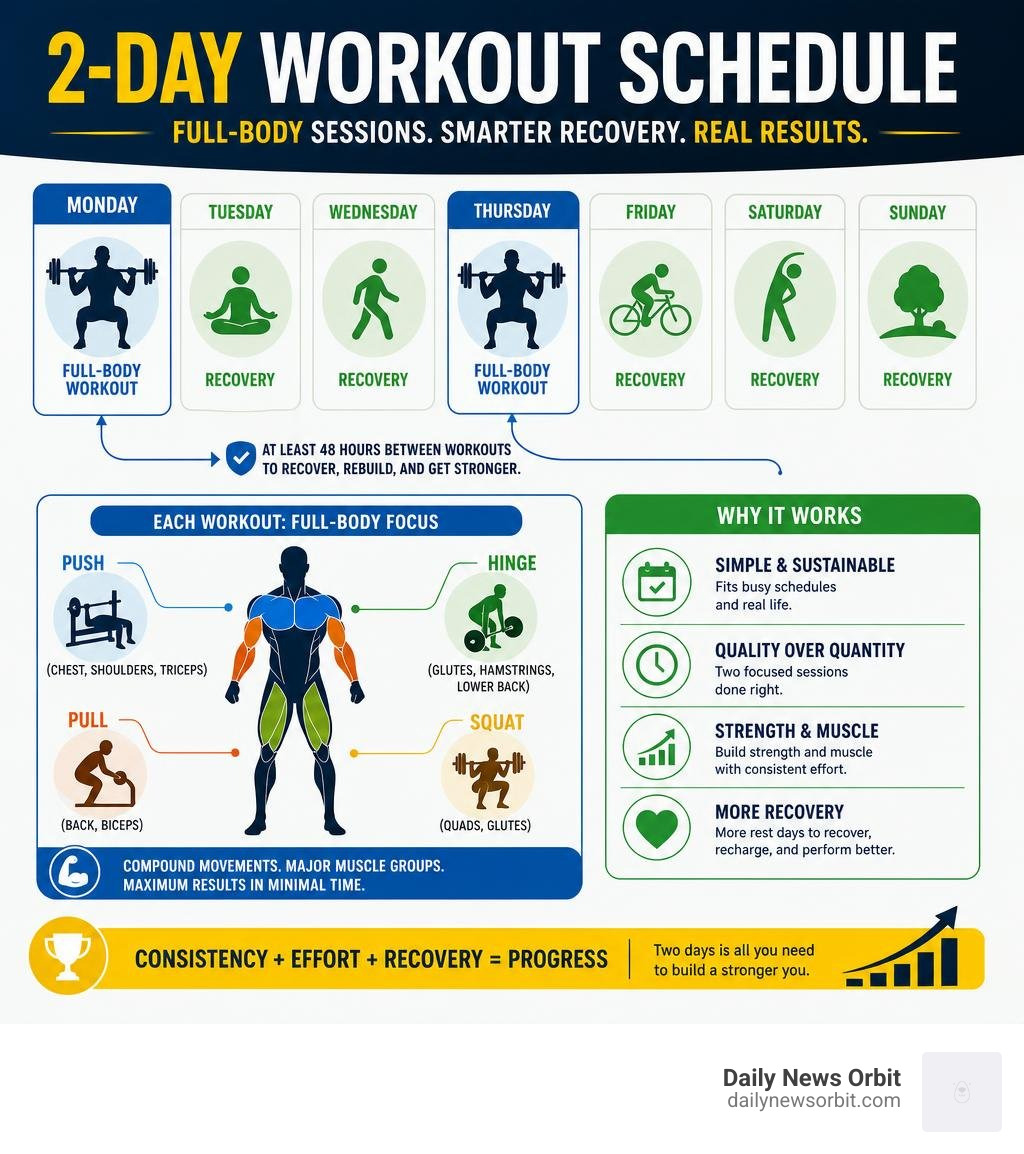
A 2 day gym workout schedule can build muscle and strength when the workouts are planned well, challenging, and repeated consistently. For most beginners, busy adults, and people returning to lifting, two full-body sessions on nonconsecutive days are the simplest place to start.
Quick answer: Train your major muscle groups in both sessions, prioritize compound lifts such as squats, presses, rows, and hinges, and leave at least 48 hours between workouts. Research reviews suggest that when total weekly training volume is matched, two full-body workouts can produce similar strength and muscle gains to higher-frequency split routines.
| Weekly schedule | Best fit | Main benefit |
|---|---|---|
| Monday and Thursday full body | Most people and beginners | Each muscle is trained twice weekly |
| Saturday and Sunday upper/lower | Weekend-only gym access | Avoids training the same muscles hard on back-to-back days |
| Two full-body workouts with limited equipment | Home or small-gym training | Efficient and flexible |
Two sessions a week are not a shortcut. They are a practical minimum that can fit around work, family, sport, and recovery. The key is not finding a perfect plan. It is choosing one you can follow for months.
This guide explains which two-day split fits your calendar, how to make limited gym time count, and when more training days may be worth adding.
Understanding the 2 Day Gym Workout Schedule and Who It Suits Best

A 2 day gym workout schedule is a structured resistance training plan where you hit the gym exactly twice per week. Rather than spreading individual muscle groups across five or six short visits, you consolidate your effort into two well-designed workouts. The remaining five days of the week are reserved for active recovery, work, family, and other physical pursuits.
We frequently see lifters burn out because they attempt high-frequency routines that simply do not fit their daily lives. A two-day schedule operates on the principle of the “minimum effective dose”—doing enough work to trigger noticeable strength gains and muscle hypertrophy without causing excessive mental or physical fatigue.
Who benefits most from training twice a week?
- Busy Professionals: Working 50+ hours a week leaves little room for daily gym trips. Two efficient workouts protect your calendar while keeping you physically fit.
- New Parents: When sleep and spare time are unpredictable, committing to two days ensures high consistency without overwhelming family duties.
- In-Season Athletes and Runners: Distance runners, soccer players, and martial artists need weight room work to build joint resiliency, but cannot compromise their primary sport practice.
- Fitness Beginners: If you are just getting started, diving into five days a week often leads to severe soreness and rapid dropout. Following beginner fitness roadmaps with a twice-weekly frequency builds strong movement habits safely.
- Lifters Returning from a Layoff: Two days serve as an ideal ramp-up phase to regain baseline conditioning before scaling volume.
By focusing on high effort during your two gym sessions, fatigue management becomes vastly easier. You enter every workout fully rested and ready to lift heavy weights with optimal form.
Full-Body vs Upper/Lower: Selecting Your Ideal Split

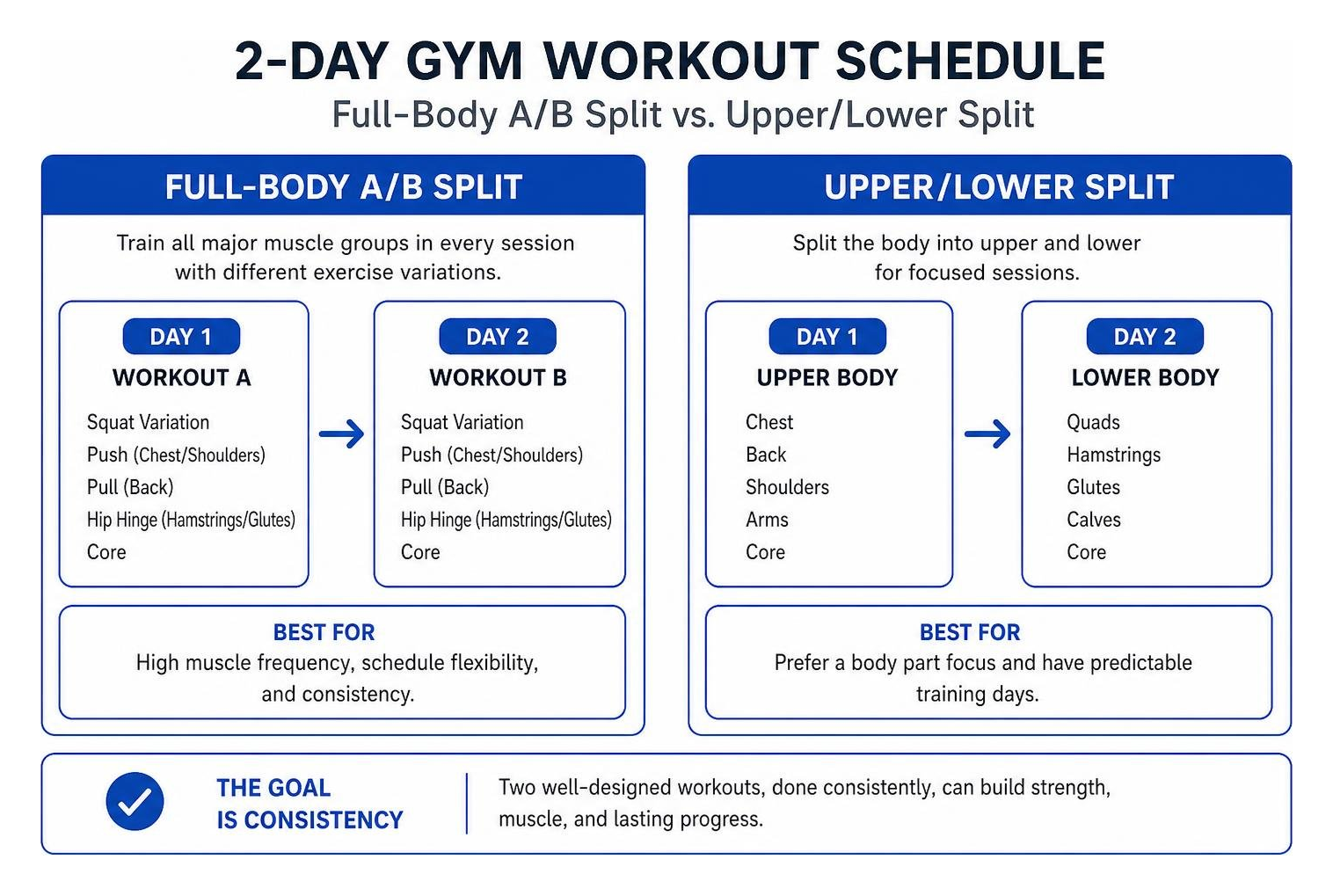
When designing a 2 day gym workout schedule, you must choose how to divide your exercises across the two days. The two primary approaches are a Full-Body A/B Split and an Upper/Lower Split. Selecting the right one depends entirely on your weekly calendar flexibility.
Structuring a Full-Body 2 Day Gym Workout Schedule for Maximum Gains
For the vast majority of people, a full-body routine is the gold standard when training twice a week. In a Full-Body A/B format, you hit all major muscle groups—quads, hamstrings, chest, back, shoulders, and core—during every session, using slightly different exercise variations in Workout A and Workout B.
The biggest advantage of a full-body setup is high muscle frequency. Research shows that stimulating muscle protein synthesis twice per week per muscle group is ideal for growth. Additionally, full-body programming offers built-in schedule redundancy. If life gets chaotic and you miss your Thursday session, you still trained every muscle group on Monday. Exploring comprehensive 2-day lifting split guides reinforces why multi-joint compound priority makes full-body days so effective.
When to Use an Upper/Lower 2 Day Gym Workout Schedule
While full-body training excels on non-consecutive days (like Tuesday and Friday), an Upper/Lower split shines for “weekend warriors” who can only lift on consecutive days (like Saturday and Sunday).
If you attempt heavy back squats and Romanian deadlifts on Saturday, attempting them again on Sunday will lead to poor performance and heightened injury risk. An upper/lower split divides your body geographically: Day 1 focuses on upper body pressing and pulling, while Day 2 focuses on quads, hamstrings, glutes, and calves. Reviewing an upper-lower vs full-body split analysis helps show that splitting by region prevents localized muscle exhaustion when rest days are limited. However, keep in mind that each muscle group is only trained once every seven days under this setup.
Can You Build Muscle and Strength Training Twice Weekly?
A common myth in fitness culture is that training twice a week is only good for light maintenance. The scientific literature proves otherwise.
A prominent 2024 systematic review confirmed that as long as total weekly training volume (number of hard sets performed per muscle group) is matched, two weekly full-body sessions generate the same strength gains and muscle hypertrophy as a four-day split. Similar research reviews examining strength progression found that training anywhere between 2 and 5 days per week provides identical results when overall work volume is equalized.
How is this possible? It comes down to recovery and intensity:
- The 48-Hour Recovery Window: Muscles typically require 48 hours to fully repair and grow after intense resistance training. A 2-day split gives your central nervous system and muscular tissue up to five full days of recovery each week.
- Effort Quality: Because you are in the gym less often, you can push your working sets closer to mechanical failure without risking overtraining.
- Volume Guidelines: To drive hypertrophy, aim for 6 to 12 hard working sets per major muscle group per week. On a 2-day full-body split, this equates to 3 to 6 hard sets per muscle group each workout session.
Applying progressive overload—gradually adding weight, reps, or improving form over time—is the primary engine of muscle growth. To explore how volume matching works across various training splits, read our insights on multi-day strength splits.
Sample Routines and Progressive Overload Protocols
To get maximum results in 45 to 75 minutes, build your routines around fundamental movement patterns. We structure every full-body workout around five core categories:
- Squat pattern: Barbell back squat, goblet squat, leg press
- Hinge pattern: Barbell deadlift, Romanian deadlift, dumbbell hip thrust
- Horizontal Press/Pull: Barbell bench press, bent-over row, dumbbell chest press
- Vertical Press/Pull: Overhead shoulder press, lat pulldown, pull-ups
- Core/Accessories: Planks, face pulls, bicep curls, triceps extensions
To save time without sacrificing volume, pair non-competing exercises into supersets (e.g., performing a set of bench press, resting 60 seconds, then performing a set of bent-over rows).
Below is a proven 2-day full-body schedule. You can alternate between Session A and Session B with 2 to 3 days of rest in between (e.g., Monday and Thursday).
| Session A (e.g., Monday) | Sets & Reps | Session B (e.g., Thursday) | Sets & Reps |
|---|---|---|---|
| Barbell Back Squat | 3 x 6–8 | Barbell or Trap Bar Deadlift | 3 x 5 |
| Dumbbell Flat Bench Press | 3 x 8–10 | Overhead Barbell Press | 3 x 6–8 |
| Lat Pulldown / Chin-ups | 3 x 8–10 | Seated Cable Row | 3 x 8–10 |
| Romanian Deadlift | 3 x 10–12 | Dumbbell Walking Lunges | 3 x 10 per leg |
| Incline Dumbbell Curl | 2 x 10–12 | Cable Triceps Pushdown | 2 x 10–12 |
| Hanging Leg Raise / Plank | 3 x Max / 60s | Cable Face Pulls | 3 x 12–15 |
For comprehensive workout options and downloadable templates, review complete 2-day workout routines with PDF. If you want to refine your pulling movements on Session B, check out these cable exercise upgrades for pull days.
The Double Progression Model: To progress safely, pick a rep range (such as 8–10 reps). Start with a weight you can handle for 3 sets of 8 reps with 1 to 2 Reps in Reserve (RIR). Keep using that same weight in future sessions until you can complete all 3 sets for 10 reps with clean form. Once achieved, increase the weight by 5 lbs for upper body or 10 lbs for lower body movements and reset to 8 reps.
Rest Days, Equipment Modifications, and Advanced Variations
The five non-lifting days in your weekly schedule are where the actual adaptation happens. However, “rest” does not mean sitting motionless on the couch.
Managing Rest Days and Active Recovery:
- Active Rest: Engage in low-intensity activities like 20 to 30 minutes of daily walking, light swimming, or gentle mobility yoga. This accelerates blood flow and helps flush out metabolic waste.
- Cardio Integration: Performing 15 to 20 minutes of moderate-intensity zone 2 cardio on non-lifting days keeps your heart healthy without hindering muscle recovery.
- Nutrition & Sleep: Aim for 7 to 9 hours of quality sleep nightly. To support muscle repair, consume 0.7 to 1.0 grams of protein per pound of body weight daily (1.6–2.2g per kg) and stay slightly above maintenance calories for muscle building.
Modifications for Limited Equipment or Home Gyms: If you train at home or in a basic facility, substitute commercial gym equipment with functional alternatives:
- Swap Barbell Squats for Heavy Goblet Squats or Bulgarian Split Squats.
- Swap Lat Pulldowns for Resistance Band Pull-downs or Inverted Rows under a sturdy table.
- Swap Barbell Bench Press for Weighted Push-Ups or Dumbbell Floor Presses.
When time is exceptionally tight, you can even rely on time-saving 15-minute workouts to keep momentum going during busy travel weeks.
Frequently Asked Questions About Training Twice a Week
Is a 2 day gym workout schedule enough for building muscle?
Yes! Research clearly shows that muscle hypertrophy depends primarily on total weekly training volume and set intensity rather than daily frequency. As long as you hit major muscle groups with 6 to 12 hard sets per week near muscular failure, two days provide plenty of stimulus for continuous growth.
How should I structure my rest days between 2-day workouts?
Allow at least 48 hours of recovery between full-body workouts. An ideal structure is training on Monday and Thursday, or Tuesday and Friday. This allows 2 to 3 days of complete recovery between sessions, keeping your energy levels peak for every lift.
Can advanced lifters or athletes benefit from a 2-day split?
Absolutely. While advanced bodybuilders may eventually need higher volume to maximize hypertrophy, advanced powerlifters and in-season sports athletes often utilize a 2-day split to maintain peak strength while giving their nervous system ample recovery time away from heavy spinal loading.
Conclusion
A 2 day gym workout schedule offers a practical, science-backed approach to building strength and muscle without taking over your life. By prioritizing heavy compound exercises, working hard on non-consecutive days, and maintaining consistent recovery habits, you can achieve long-term physical transformation on a realistic calendar.
Consistency beats perfection every single time. A simple two-day program you stick to for a year will deliver far greater results than an ambitious six-day split abandoned after three weeks.
We invite you to explore practical strength workout strategies across our website and dive into our broader fitness article category for actionable guides. Ready to take your lifting to the next level? Explore our ultimate beginner gym workout guide today to start building sustainable strength for life!