


Hit the Gym 4 Days a Week for Optimal Muscle Recovery
A Simple 4 Day Gym Schedule for Strength and Recovery
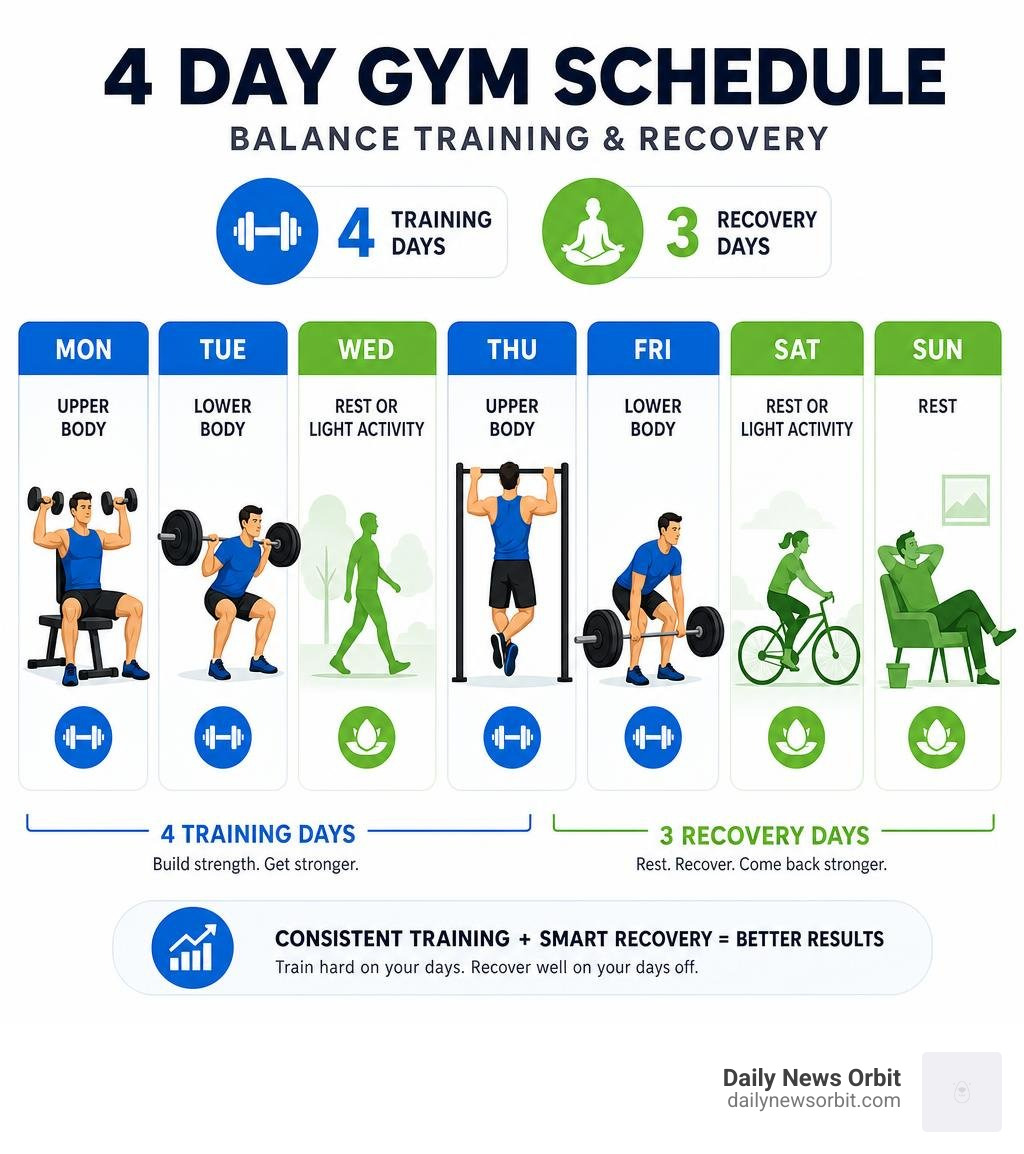
A 4 day gym schedule spreads your workouts across four lifting days and leaves three days for rest or light activity. For most people, the simplest setup is an upper/lower split: train upper body twice and lower body twice each week.
| Day | Workout focus |
|---|---|
| Monday | Upper body |
| Tuesday | Lower body |
| Wednesday | Rest or light activity |
| Thursday | Upper body |
| Friday | Lower body |
| Saturday | Rest or light activity |
| Sunday | Rest |
This structure gives each major muscle group regular work without asking you to train every day. It also creates room for recovery, which matters because muscles grow and adapt between workouts, not during them.
A four-day routine can work well for beginners who already know basic lifting form, as well as intermediate and advanced lifters who need more training volume. The key is not cramming in more exercises. It is choosing a workable split, progressing steadily, and letting fatigue stay manageable.
In this guide, you will learn how to choose a split, build each workout, plan rest days, and adapt the schedule for strength, muscle gain, or fat loss.
The Science Behind a 4 Day Gym Schedule
When we look at exercise physiology, training frequency plays a critical role in driving long-term adaptations. According to the NSCA Position Statement on Resistance Training, hitting a muscle group 2 to 3 times per week delivers superior hypertrophy and strength gains compared to training each muscle group only once weekly.
A 2019 meta-analysis published in the Journal of Strength and Conditioning Research reinforced this concept: muscle hypertrophy is significantly higher when we target muscle groups twice per week rather than once, even when total weekly volume is kept equal.

Every time we lift weights, we stimulate muscle protein synthesis—the biological process where our bodies rebuild damaged muscle tissue. This elevated state of protein synthesis lasts roughly 24 to 48 hours post-workout. By utilizing a 4 day gym schedule, we trigger this growth stimulus twice a week per muscle group without overloading our central nervous system (CNS).
Who Should Follow a 4 Day Gym Schedule?
While full-body routines are wonderful for true beginners during their first few months, intermediate lifters and busy professionals often find their sweet spot in a 4-day split. If you have anywhere from 6 to 24 months of consistent lifting experience, moving to four training sessions allows you to increase volume per muscle group without suffering from accumulated recovery debt.
It also provides excellent schedule flexibility. If work or life interrupts your routine on a Wednesday, having three built-in rest days means you can shift your workout without throwing off your entire week. For those exploring structured growth strategies, checking out Good Workout Plans for Men: A Practical Roadmap to Strength can provide even more tailored ideas.
How Recovery and Rest Days Optimize Hypertrophy
We often say in fitness that you do not build muscle in the gym—you break muscle down in the gym. True growth happens during sleep and rest. Without adequate downtime, micro-tears in muscle tissue remain in a state of chronic inflammation, leading to plateaued performance or overtraining syndrome.
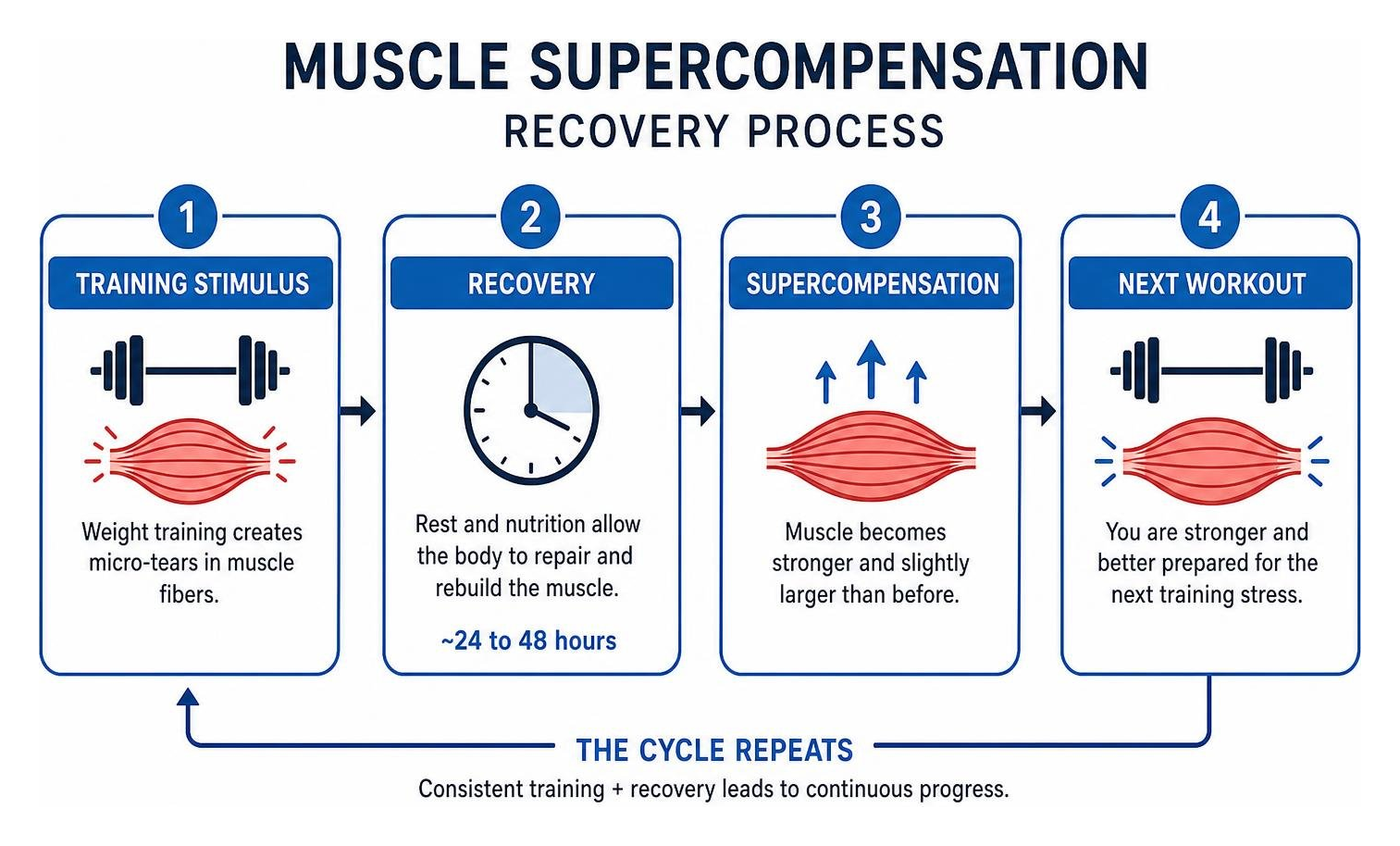
During off-days, our bodies undergo supercompensation, rebuilding muscle fibers slightly stronger and thicker than before to prepare for future stress. Incorporating active recovery—such as light walking, mobility drills, or gentle stretching—promotes blood flow to flush out metabolic waste without creating extra fatigue. If you are returning to fitness after a long break, reviewing Why a Beginner 30-Day Workout Challenge Is the Best Way to Start Exercising can help set baseline mobility habits.
Popular 4-Day Split Structures Compared
Choosing the right structure depends on your training age, goals, and personal preferences. Here are the four most common ways we arrange a 4-day routine:
- Upper/Lower Split: Alternates between upper body push/pull and lower body quad/hamstring work. Hits each muscle group twice weekly.
- PHUL (Power Hypertrophy Upper Lower): Combines two heavy strength days (3–6 reps) early in the week with two hypertrophy days (8–12 reps) later in the week.
- Push/Pull/Legs + Full Body (PPL + FB): Dedicates three days to individual movement patterns and finishes with a hybrid full-body session.
- Body Part Split (Bro Split): Focuses on single muscle groups per session (e.g., Chest, Back, Legs, Shoulders/Arms).
| Split Structure | Muscle Group Frequency | Primary Focus | Best For |
|---|---|---|---|
| Upper / Lower | 2x per week | Balanced size & strength | Intermediate lifters, overall hypertrophy |
| PHUL | 2x per week | Max strength & hypertrophy | Intermediate to advanced lifters |
| PPL + Full Body | 1–2x per week | Targeted volume + weak points | Lifters wanting movement variety |
| Bro Split (4-Day) | 1x per week | Direct muscle isolation | Pure hypertrophy / bodybuilders |
For an in-depth exploration of double-frequency splits, check out the comprehensive guide at Upper/Lower Split: Complete 4-Day Plan.
Sample 4 Day Gym Schedule Routine
Below is a practical Upper/Lower sample routine designed to balance heavy compound lifts with targeted accessories.
Day 1: Upper A (Strength & Heavy Compound Focus)
- Barbell Bench Press: 4 sets x 5-7 reps (2-3 min rest)
- Bent-Over Barbell Row: 4 sets x 6-8 reps (2 min rest)
- Standing Overhead Press: 3 sets x 6-8 reps (2 min rest)
- Lat Pulldown or Pull-Ups: 3 sets x 8-10 reps (90 sec rest)
- Cable Tricep Pushdowns: 3 sets x 10-12 reps (60 sec rest)
Day 2: Lower A (Squat & Posterior Chain Focus)
- Barbell Back Squat: 4 sets x 6-8 reps (2-3 min rest)
- Romanian Deadlift (RDL): 3 sets x 8-10 reps (2 min rest)
- Leg Press: 3 sets x 10-12 reps (90 sec rest)
- Lying Hamstring Curls: 3 sets x 10-12 reps (60 sec rest)
- Standing Calf Raises: 4 sets x 12-15 reps (60 sec rest)
Day 3: Upper B (Hypertrophy & Cable Focus)
- Incline Dumbbell Bench Press: 3 sets x 8-10 reps (90 sec rest)
- Seated Cable Rows: 3 sets x 10-12 reps (90 sec rest) — Learn more tips to Upgrade Your Pull Day with Cable Back Workouts
- Dumbbell Lateral Raises: 4 sets x 12-15 reps (60 sec rest)
- Face Pulls: 3 sets x 12-15 reps (60 sec rest)
- Dumbbell Incline Bicep Curls: 3 sets x 10-12 reps (60 sec rest)
Day 4: Lower B (Deadlift & Quad Accessory Focus)
- Conventional Deadlift: 3 sets x 5 reps (3 min rest)
- Bulgarian Split Squats: 3 sets x 8-10 reps per leg (90 sec rest)
- Walking Dumbbell Lunges: 3 sets x 10-12 steps per leg (90 sec rest)
- Hanging Leg Raises: 3 sets x 12-15 reps (60 sec rest)
You can also check trainer-approved modifications on 4-Day Workout Splits: A Sample Workout Schedule, From A Trainer.
Exercise Selection and Progression Strategies

Building a high-yield workout comes down to selecting movements with high mechanical tension and low fatigue penalties. We want to spend our main energy on compound exercises (squats, deadlifts, presses, and rows) when our nervous system is fresh, followed by isolation exercises to collect remaining volume.
Balancing Compound Lifts and Isolation Work
As a rule of thumb, large muscle groups (chest, back, quads) generally need 10 to 16 hard sets weekly, while smaller muscle groups (biceps, triceps, calves, side delts) flourish on 6 to 12 weekly sets.
Starting each workout with heavy free-weight compounds builds systemic foundation. Transitioning into machines and cable systems midway through the session allows us to push muscles near failure without straining joints or compromising lower back safety.
Progression Models and Double Progression
To avoid plateaus, we rely on progressive overload. The most reliable framework for intermediate lifters is the Double Progression System:
- Establish a set and rep window (e.g., 3 sets of 8 to 11 reps).
- Keep the weight constant until you can perform all 3 sets at the top end of the rep range (11 reps) with strict form.
- Once achieved, increase the weight by 2.5 to 5 lbs and drop back down to the bottom rep target (8 reps).
- Repeat the process.
To explore automated tools and progression frameworks, check out the resources provided in 4-Day Workout Planner for Muscle Gain (Beginner to Intermediate) | LoadMuscle and the 4-Day Workout Split Program: Complete Guide | IronLedger.
Adapting Your Split and Avoiding Common Mistakes
A 4 day gym schedule is inherently versatile, meaning we can adjust variables to fit specialized training goals.
Tailoring the Split for Strength, Mass, or Fat Loss
- For Maximum Strength: Prioritize 3 to 6 rep targets on main lifts, extend rest periods up to 3 minutes, and execute splits like PHUL.
- For Muscle Hypertrophy: Maintain a slight caloric surplus (200–400 kcal/day) and work primarily in the 6 to 12 rep range with 10–16 weekly sets per muscle group.
- For Fat Loss: Use training strictly to preserve muscle while relying on a modest 300–500 calorie deficit. Keep lifting heavy to signal to your body that muscle tissue is essential. For detailed fat-loss templates, see the 4-Day Gym Fat Loss Program – Macros Inc.
If you ever feel like expanding your volume down the road, you can compare this routine with our guide to Build Muscle Faster Using a Weekly 5-Day Training Split.
Program Longevity and Deload Protocols
A common mistake is rotating exercises every single week. To measure progress accurately, keep your core lifts identical for 6 to 12 weeks.
Additionally, every 6 to 8 weeks, plan a deload week. Reduce your total working sets by 40–50% or drop working weights by 20%. Deload weeks allow tendons, ligaments, and central nervous system fatigue to fully reset so you can break through your next strength phase cleanly.
Frequently Asked Questions about 4-Day Workout Splits
How long should each workout session last on a 4-day split?
Most sessions on a 4-day split should last 60 to 75 minutes. This provides plenty of time for a thorough 5-to-10-minute dynamic warm-up, heavy compound sets with appropriate rest, and targeted isolation work without running into severe physical burnout.
Can beginners start directly with a 4-day gym schedule?
Yes! As long as a beginner understands proper movement mechanics, a 4-day upper/lower split is very manageable. However, absolute beginners in their first 1 to 3 months may make faster skill progression on a 3-day full-body setup due to higher practice frequency per lift.
How long should I follow the same 4-day workout plan?
We recommend sticking with the same exercise selection and split structure for 8 to 12 weeks. This gives your neuromuscular system enough time to adapt, master the movement patterns, and push progressive overload predictably before you swap out accessory exercises.
Conclusion
At Daily News Orbit, we believe long-term strength and muscle growth depend on sustainability, consistency, and proper recovery management. Following a 4 day gym schedule strikes the ideal balance—it delivers ample weekly training volume to spark hypertrophy without forcing you to spend every single afternoon in the gym.
By committing to core compound movements, implementing a double progression model, and honoring your rest days, you set yourself up for continuous, plateau-free gains year after year. For even more exercise guides and training roadmaps, explore our curated Category: Fitness collection or read through The Ultimate Gym Workout Routines for Men for Beginners to take your strength to the next level!