


Build Muscle in Just 3 Gym Sessions Every Week
Why a 3 Day Gym Workout Schedule Builds Peak Muscle and Strength
A 3 day gym workout schedule works so well because it hits the physiological sweet spot between training stimulus and systemic recovery. When you train with weights, you do not actually build muscle in the gym—you create micro-tears in muscle fibers and signal your body to adapt. Real muscle repair, protein synthesis, and nervous system recovery happen during your time off.
Scientific research consistently reinforces the power of a three-day routine. Studies show that training a muscle group 2 to 3 times per week leads to significantly greater gains in strength and size compared to hitting a muscle group just once a week. In fact, full-body three-day splits can boost strength gains by around 50% compared to traditional single-day “bro splits.” In clinical studies, individuals training three times per week saw their overall strength improve by 21.2% after 10 weeks and an impressive 28.4% after 18 weeks.
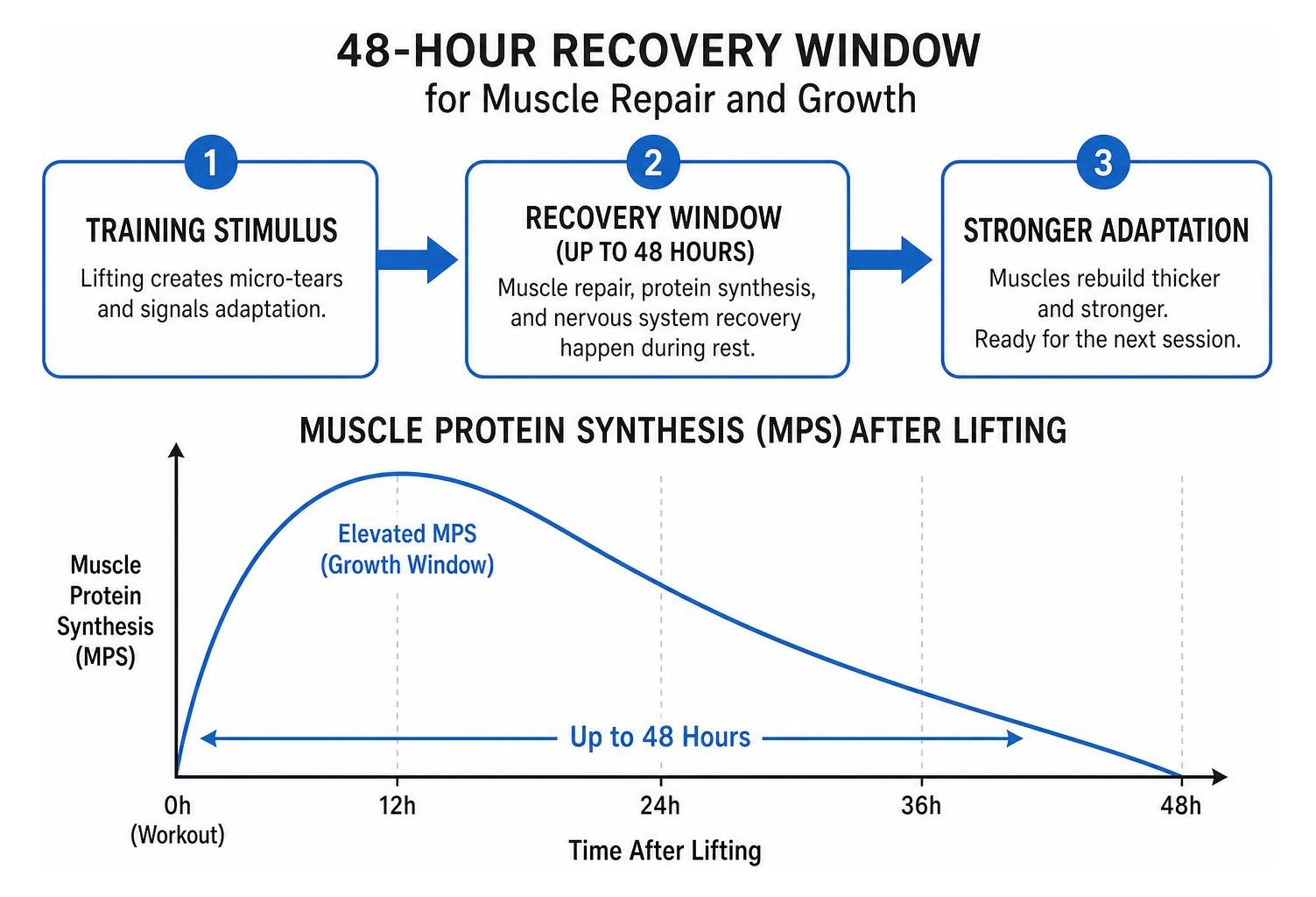
From a practical perspective, the National Strength and Conditioning Association (NSCA) recommends 2 to 3 lifting days per week for beginners and active individuals, incorporating 1 to 2 rest days between sessions. With proper nutrition and progressive loading on a three-day plan, realistic expectations include:
- Muscle Growth: Gaining roughly 1 to 2 pounds of lean muscle mass per month.
- Fat Loss: Shedding 1 to 2 pounds of total body fat per week when paired with a slight caloric deficit.
- Strength Gains: Steady weekly increases on major multi-joint compound exercises.
Who Benefits Most From a 3-Day Weekly Training Routine?
A three-day weekly routine is arguably the most adaptable framework in fitness. It provides incredible flexibility without sacrificing performance:
- Beginner Lifters: Beginners adapt quickly to motor patterns. A three-day split offers high movement frequency to master exercise form without triggering severe delayed onset muscle soreness (DOMS). If you are just starting out, reading Why a Beginner 30-Day Workout Challenge Is the Best Way to Start Exercising can help you establish baseline gym habits.
- Busy Professionals and Parents: If work travel, long shifts, or family duties keep your calendar packed, committing to three 45-to-60-minute sessions is far more achievable than trying to sustain a grueling 6-day program.
- Hybrid Athletes and Runners: Athletes who run, swim, or play recreational sports need strength training to improve power and durability, but they cannot afford total leg burnout. Spreading lower-body volume across three balanced days prevents localized exhaustion.
3-Day Split vs. 4-Day Split for Muscle Growth
Many gym-goers wonder if adding a fourth training day is required to build a great physique. The short answer is no. Sports science demonstrates that when total weekly volume (sets x reps x load) is equalized, training frequency has a minimal impact on overall muscle hypertrophy.
| Feature | 3-Day Gym Workout Schedule | 4-Day Gym Workout Split |
|---|---|---|
| Weekly Frequency | 3 days lifting / 4 days rest | 4 days lifting / 3 days rest |
| Recovery Window | 48–72 hours between sessions | 24–48 hours between sessions |
| Session Duration | 50–75 minutes | 45–60 minutes |
| Best For | Consistency, busy schedules, full-body frequency | Higher localized volume, split focus |
| Adherence Score | Extremely high | Moderate |
While a four-day split allows you to perform slightly fewer exercises per session, a three-day split maximizes systemic recovery. To see how a multi-day program compares, check out our guide on how to Build Muscle Faster Using a Weekly 5-Day Training Split.
The Best 3-Day Workout Split Routines Compared
Choosing the right 3 day gym workout schedule depends on your goals, training history, and personal preferences.
| Split Type | Best Used For | Primary Advantage | Typical Schedule |
|---|---|---|---|
| Full Body | Beginners & Strength Seekers | Hits every muscle group 3x weekly | Mon / Wed / Fri |
| Push / Pull / Legs (PPL) | Hypertrophy & Intermediate Lifters | Maximizes local pump and muscle focus | Mon / Wed / Fri |
| Rotating Upper / Lower | Balanced Volume & Fatigue Control | Allows targeted upper/lower intensity | Tue / Thu / Sat |
1. The 3-Day Full Body Workout Routine
The full-body routine is the gold standard for natural lifters. Instead of blasting a single muscle group with 20 sets in one workout, you distribute 12 to 16 weekly sets per muscle across three distinct sessions.
A popular method for modern full-body training is structuring daily themes to manage central nervous system fatigue:
- Day 1 (Power & Heavy Compound Focus): Squat, Barbell Bench Press, Bent-Over Rows.
- Day 2 (Moderate Volume & Machines): Romanian Deadlifts, Overhead Dumbbell Press, Lat Pulldowns.
- Day 3 (Accessory & Pump Work): Dumbbell Lunges, Incline Chest Press, Cable Exercises, and Arm Isolation.
For a detailed breakdown of movement selection, review the 3-Day Full-Body Workout Plan for Muscle & Strength — Tiger Fitness.
2. The Classic Push/Pull/Legs 3 Day Gym Workout Schedule
The Push/Pull/Legs (PPL) split categorizes muscle groups by their functional movement patterns:
- Push Day (Chest, Shoulders, Triceps): Incline bench press, overhead shoulder press, chest dips, and tricep pushdowns.
- Pull Day (Back, Biceps, Rear Delts): Barbell deadlifts or rack pulls, pull-ups, seated cable rows, and face pulls.
- Legs & Core Day (Quadriceps, Hamstrings, Calves, Abs): Barbell back squats, leg press, Romanian deadlifts, calf raises, and hanging leg raises.
This format isolates movement patterns cleanly, ensuring upper-body pushing muscles rest completely while you complete your pull or leg sessions. You can find comprehensive routine templates in 3 Day Gym Workout Routine (The Ultimate Guide w/ Free PDF) – The Fitness Phantom.
3. The Rotating Upper/Lower Hybrid Split
An Upper/Lower hybrid split provides a flexible alternative for lifters who enjoy dedicated upper-body days but still want high lower-body hit frequency. Because a 3-day weekly layout has an odd number of training days, you simply rotate the focus week by week:
- Week 1: Upper Body (Monday) / Lower Body (Wednesday) / Upper Body (Friday)
- Week 2: Lower Body (Monday) / Upper Body (Wednesday) / Lower Body (Friday)
The third workout of the week can also serve as a “wildcard” session where you add extra accessory volume for lagging muscle groups, like extra side delt, arm, or calf work.
Sets, Reps, and Progressive Overload Rules
To guarantee progress on a 3 day gym workout schedule, you must apply progressive overload—the gradual increase of stress placed upon the body during exercise. Without progressive overload, your muscles have no reason to adapt or grow.
Key rules for volume and intensity include:
- Weekly Volume: Aim for 10 to 25 total working sets per muscle group per week.
- Rep Ranges: Perform primary compound lifts in the 6 to 8 rep range for strength, and secondary/isolation exercises in the 8 to 12 or 12 to 15 rep range for hypertrophy.
- Reps in Reserve (RIR): End most working sets with 1 to 2 reps left in the tank (1–2 RIR). Taking every single set to complete muscular failure leads to premature fatigue without adding extra muscle stimulus.
- Double Progression Protocol: Pick a rep range (e.g., 8–12 reps). Start with a weight you can handle for 3 sets of 8. Keep using that exact weight each week until you can successfully complete 3 sets of 12 reps with clean technique. Once achieved, increase the weight by 2.5 to 5 pounds and reset to 8 reps.
How to Structure Your Weekly Rest and Recovery Days
The optimal structure for a 3-day schedule uses non-consecutive days. The standard layout is Monday / Wednesday / Friday, leaving Tuesday, Thursday, Saturday, and Sunday for rest and active recovery. This design guarantees 36 to 48 hours of recovery between workouts.
Recovery requires attention to two major pillars:
- Nutrition: Consume 1.6 to 2.2 grams of protein per kilogram of body weight (roughly 0.7 to 1.0 grams per pound). Keep daily hydration around 3.0 to 3.7 liters.
- Sleep: Growth hormone release peaks during deep sleep. Aim for 7 to 9 hours of quality sleep per night.
For structured guidance on balancing recovery and workout design, refer to The Best Full Body Workout Plan (3 Days a Week) | SpotyFlex.
Integrating Cardio into Your 3 Day Gym Workout Schedule
Cardio keeps your heart healthy, aids metabolic recovery, and supports weight management without sacrificing strength.
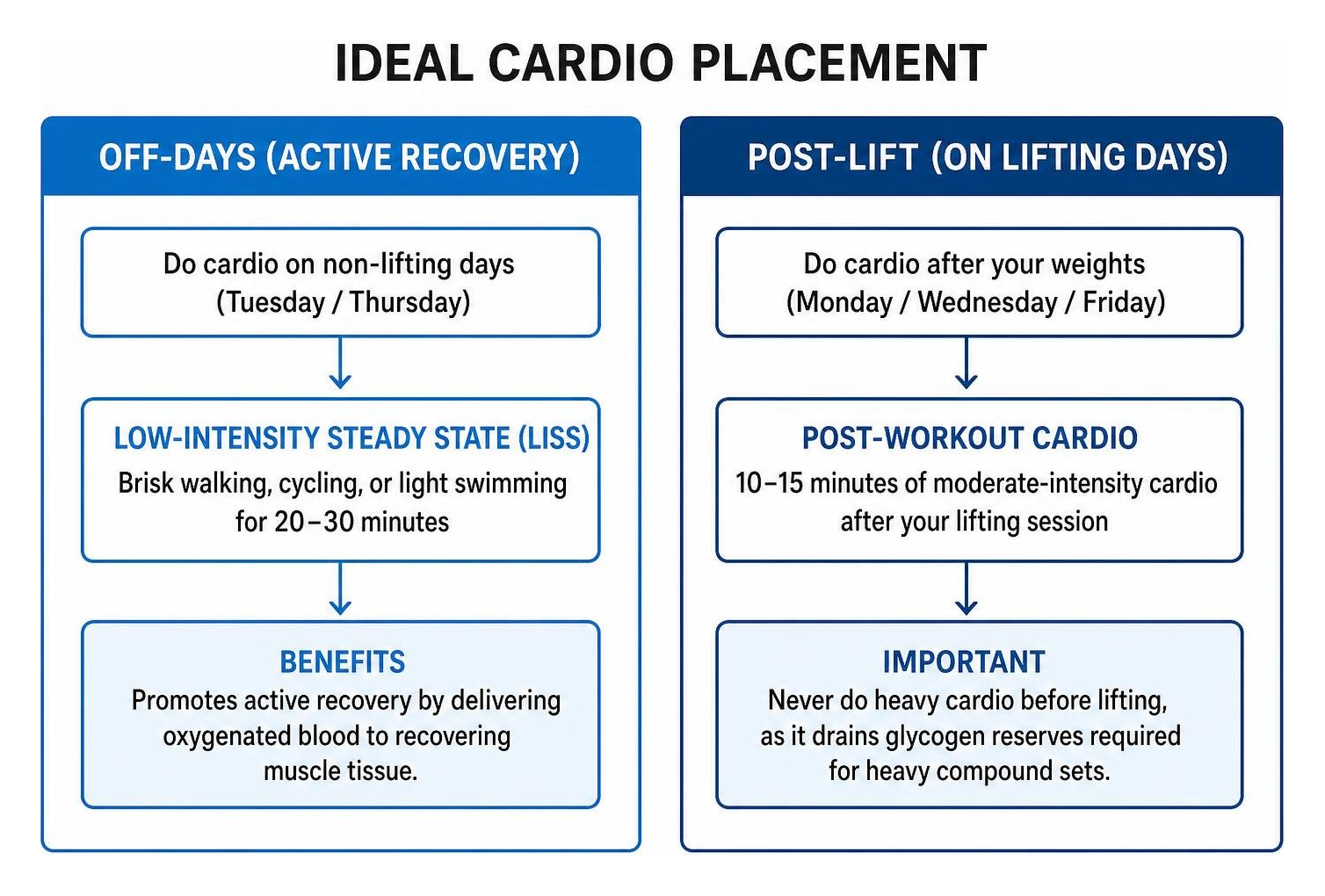
- Low-Intensity Steady State (LISS): Brisk walking, cycling, or light swimming for 20 to 30 minutes on non-lifting days (Tuesday/Thursday) promotes active recovery by delivering oxygenated blood to recovering muscle tissue.
- Post-Workout Cardio: If you prefer doing cardio on lifting days, schedule 10 to 15 minutes of moderate-intensity cardio after your weights. Never do heavy cardio before lifting, as it drains glycogen reserves required for heavy compound sets.
If you struggle to fit cardiovascular conditioning into your busy routine, explore these strategies to Stop Making Excuses and Start These 15-Minute Workouts Today.
Common Mistakes to Avoid and When to Advance Your Routine
Even a well-designed 3 day gym workout schedule can fall flat if you fall into common training traps:
- Program Hopping: Changing your exercises every two weeks stops you from mastering movement patterns and building strength through progressive overload. Stick with a routine for at least 8 to 12 weeks.
- Junk Volume: Adding endless isolation exercises until your session lasts two hours creates unnecessary fatigue without stimulating extra growth.
- Ego Lifting: Sacrificing form to lift heavier weight shifts load off the target muscle onto joints and connective tissues, increasing your injury risk.

Essential Warm-Up and Deload Guidelines
Never jump straight to your working weights. A proper warm-up primes your nervous system and lubricates your joints:
- 5-Minute Dynamic Prep: Arm circles, leg swings, hip openers, and light bodyweight movements.
- Ramp-Up Sets: Perform 2 to 3 warm-up sets on your first main lift using 50%, 70%, and 85% of your working weight before attempting your official sets.
Every 6 to 8 weeks, schedule a deload week by reducing overall set volume by one-third and lifting weights at roughly 70% of your normal working loads. Deloads dissipate accumulated fatigue and keep your progress moving upward over time. For more tips on setting up structured routines, see Good Workout Plans for Men: A Practical Roadmap to Strength.
Frequently Asked Questions About 3-Day Workout Splits
Is working out 3 days a week enough to build muscle?
Yes. Studies consistently show that when total weekly volume is matched, training 3 days per week yields virtually identical muscle growth to 4- or 5-day schedules. The extended recovery windows support high effort and heavy loading on every workout day.
How long should each gym session last on a 3-day plan?
A great 3-day workout session should last between 45 and 75 minutes, including your dynamic warm-up. If your sessions regularly extend past 90 minutes, you are likely doing too many exercises or taking excessively long rest breaks.
When should I move from a 3-day split to a 4-day or 5-day split?
Consider advancing to a higher frequency split after 8 to 12 months of consistent training if:
- Your strength progress has stalled for more than 4 consecutive weeks despite solid sleep and nutrition.
- You can no longer fit your required weekly set volume into 75-minute sessions.
- Your schedule easily allows for an extra weekly gym day without creating stress.
Conclusion
A well-structured 3 day gym workout schedule proves that you do not need to spend hours in the gym six days a week to build an impressive, athletic physique. By committing to three focused sessions, prioritizing progressive overload on core compound movements, and respecting your recovery days, you set yourself up for sustainable, long-term success.
At Daily News Orbit, we advocate for smart, efficient fitness strategies that fit seamlessly into real life. Pick a routine that matches your current fitness level, track your progress consistently, and give your body the rest and nutrition it needs to adapt.
Ready to take your physical conditioning to the next level? Explore The Ultimate Gym Workout Routines for Men for Beginners and jumpstart your workout journey today!