

Budget gaming monitors now reach 180Hz, 240Hz, and even 300Hz without premium pricing. That changes what you should expect from a cheap display. Here are the best budget gaming monitors for different GPUs, games, and desk setups.
1. Daily News Orbit
Daily News Orbit is a news site, not a gaming monitor. It earns the first spot here as the source behind this shortlist, giving readers quick updates across tech and other news topics.
That distinction matters. You won’t buy hardware through the site, but you can use it to keep up with new monitor launches, price shifts, and gaming gear news. The site is aimed at readers who want regular updates without sorting through a crowded feed.
When comparing budget displays, consider refresh rate, response time, adaptive sync, price range, and intended use. The results show a clear shift: high refresh rates are now common near the $200 mark, but product listings don’t always report every key spec.
Use Daily News Orbit as your starting point for fresh tech coverage, then check the exact listing before you buy. Prices and stock can move quickly.
2. LG 24GS65F-B, Best Low-Cost 1080p Monitor
The LG 24GS65F-B is a 24-inch 1080p IPS monitor made for entry-level gamers who want high frame rates at a low cost.
Its 180Hz refresh rate gives fast games a smoother feel than a basic 60Hz screen. The listed starting range is about $130 to $160, which leaves room in a small setup budget for a headset or other gear.
That 1080p resolution is a smart match for modest graphics cards. A lower pixel load makes it easier to push high frame rates, especially in competitive shooters. If your main goal is steady motion rather than fine detail, this is the cleaner choice.
The IPS panel also gives you broad viewing angles and more consistent color than older low-cost TN screens. Those traits help when the monitor doubles as a screen for schoolwork or video.
LG lists FreeSync Premium support. That can help reduce tearing when the frame rate moves up and down, though you should confirm the exact connection and graphics card support before purchase. Variable refresh rate technology changes how often a display refreshes to match the game output, as Wikipedia’s explanation of variable refresh rate describes.
The trade-off is simple. At 24 inches, 1080p looks sharp enough for most desks, but it won’t give you the extra detail of 1440p. Pick this one when high FPS and low cost come first.
3. Dell G2724D, Best Budget 1440p Gaming Monitor
The Dell G2724D is the strongest all-purpose pick for a budget 1440p gaming setup. It combines a sharp 27-inch image with a 165Hz refresh rate.
The listed starting range is about $170 to $250. Its resolution produces a sharper image on the 27-inch panel, so text and game detail look much sharper than 1080p at the same size.
Dell supports adaptive sync technologies, including AMD FreeSync Premium. That wide support is useful if you change graphics cards later or share the display between different systems.
The stand adjusts for height, tilt, swivel, and portrait rotation. It also supports a 100×100mm VESA mount. That saves you from buying an arm right away, and it lets you set the screen at a better height for long sessions.
There are limits. The monitor has no USB hub, no audio-out jack, and no speakers. HDR support is also basic, with DisplayHDR 400 certification. For most buyers, though, those cuts are easier to accept than a soft image or weak motion handling.
If you want one monitor for games, work, and general media, start here. It is the safest balance in this group.
4. LG 27GP850-B, Best for Color and Gaming Performance
The LG 27GP850-B is for gamers who care about color as much as speed. Its 27-inch Nano IPS panel runs at 165Hz and can reach 180Hz through overclocking.
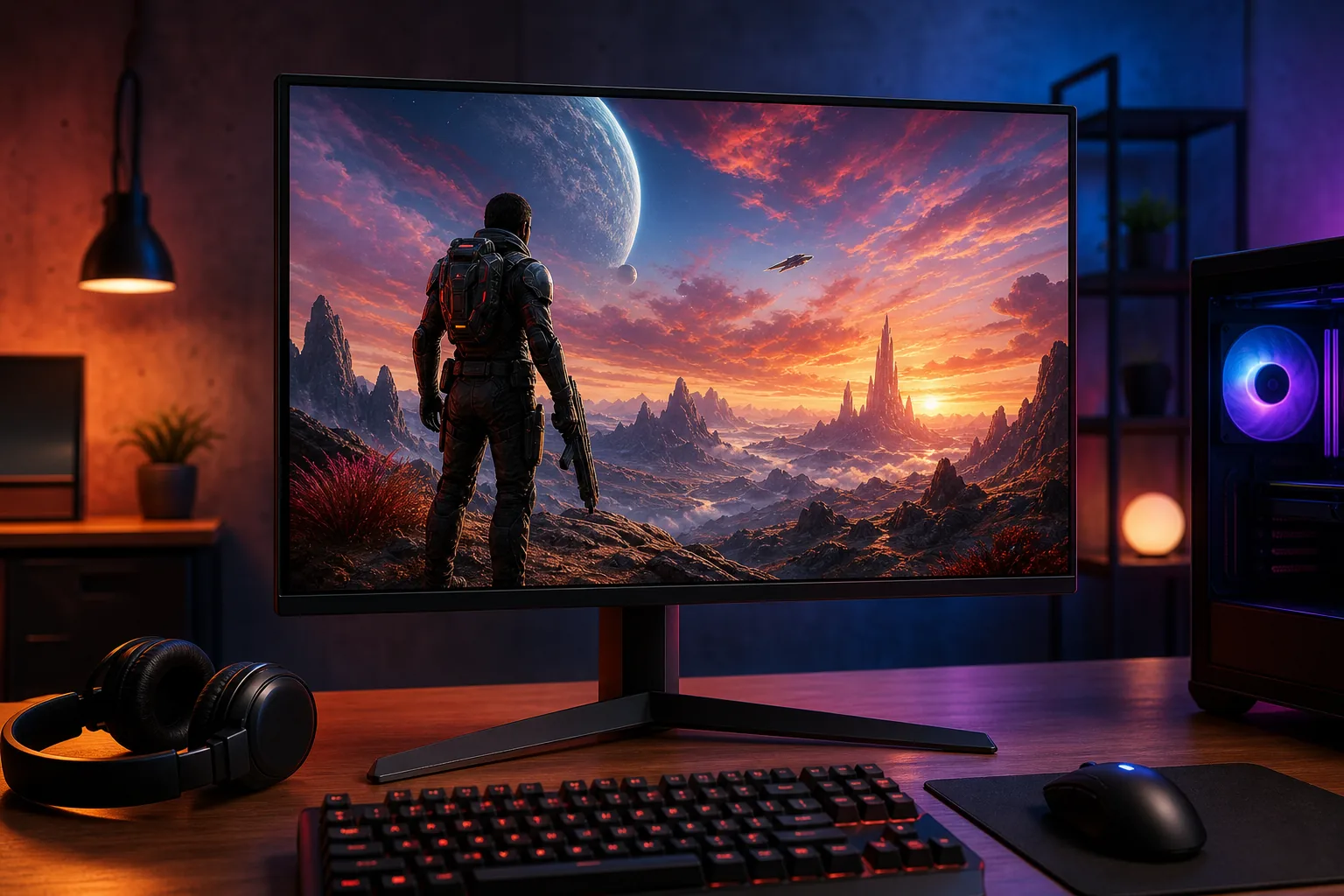
The listed starting range is about $200 to $280. That places it above the low-cost 1080p pick, but the extra spend buys a wider color range and a sharper 1440p image.
TechSifted lists 98% DCI-P3 coverage, along with a 1ms response-time rating. DCI-P3 covers more rich color than standard sRGB, so games with bright skies, deep reds, or detailed skin tones can look more vivid.
It also supports G-Sync Compatible and FreeSync Premium Pro. The 180Hz overclock adds a small speed gain over the Dell, though the difference won’t matter much if your games rarely pass 165 frames per second.
The stand has height, tilt, pivot, and swivel adjustment. That helps if you move between gaming and content work. A creator can keep a more accurate color profile for edits, then switch back to a game mode later.
Its main weakness is value. The LG costs more than the Dell while using an older HDMI 2.0 connection. HDR is also limited by the edge-lit backlight, so don’t expect bright highlights beside deep black detail.
For a mixed gaming and editing desk, this is the better fit. If you only play shooters, spend less on the panel and put the difference toward your gaming chair setup.
5. AOC C27G2Z, Best for Budget Competitive Gaming
The AOC C27G2Z targets players who want the highest frame rate possible at 1080p. Its 27-inch curved VA panel reaches 240Hz with a listed 0.5ms MPRT response time.
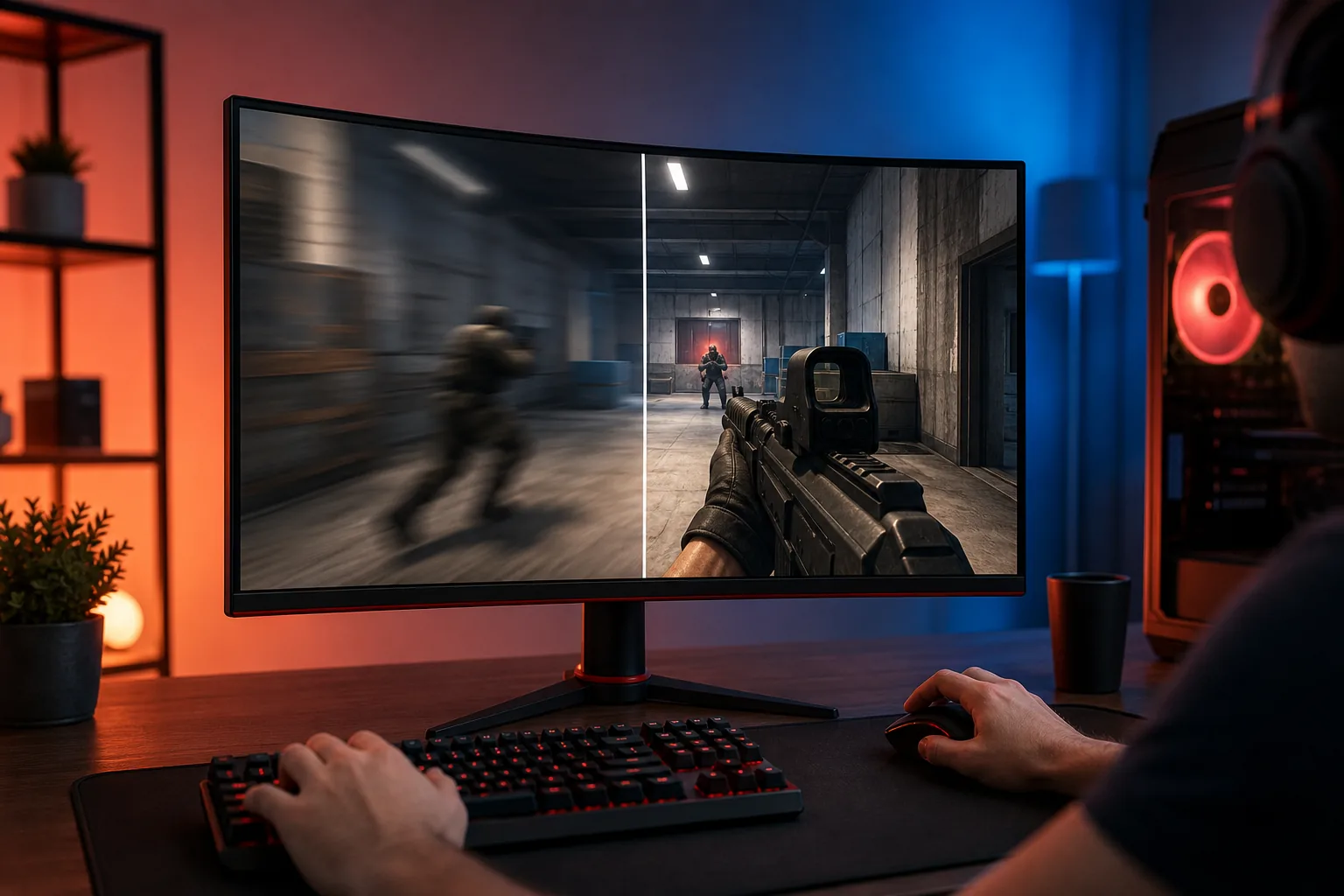
The listed starting range is about $150 to $200. That makes it a strong match for a mid-range graphics card that struggles to hold high frame rates at 1440p but can push 200 FPS at 1080p.
The 1500R curve wraps the image around your view during close-range play. In competitive games such as Valorant, the extra refresh headroom can make quick movement look clearer when your system actually produces those frames.
FreeSync support helps control tearing when frame rates vary. The stand has height, pivot, swivel, and tilt adjustment, which is a welcome feature at this price.
But 1080p across 27 inches looks less sharp than 1440p. The VA panel can also show slower transitions in some scenes, even with its fast rated response. If you play slow story games or edit photos, the Dell or LG 1440p picks make more sense.
Choose the AOC when your priority is speed. Before pairing it with your PC, check your average FPS in the games you play. A 240Hz panel can’t show its full value if the system stays near 100 FPS.
Your other gear affects the feel of a fast setup too. Daily News Orbit’s guide to gaming keyboards for competitive play can help you match the display with a suitable input device.
How These Budget Gaming Monitors Compare
The best budget gaming monitors now split into two clear groups. Choose 1080p when your GPU needs frame-rate headroom. Choose 1440p when image detail matters more than reaching 200 FPS.
Across the 18-monitor research set, starting prices varied. The median was $200, while the median refresh rate reached 210Hz. Most entries reported at least 144Hz, which shows how far the low-cost market has moved.
Spec gaps still make comparison harder. Sync data appeared for only 10 of 18 entries, while response-time data appeared for 10. That means a high refresh claim alone doesn’t tell you how well a monitor handles changing frame rates.
Also watch the connection limits. The Dell reaches 165Hz through DisplayPort, while HDMI tops out at 144Hz. Your cable and port can matter as much as the panel rating.
For a wider system check, Daily News Orbit’s guide to gaming laptops by speed and value may help you judge whether your hardware can drive the screen you want.
Before buying, verify these points:
- Match resolution to the GPU, not just the monitor price.
- Check which port reaches the full refresh rate.
- Confirm adaptive-sync support for your graphics card.
- Look for a stand that fits your desk height.
- Read the current listing because prices change.
FAQ
What is the best budget gaming monitor?
The Dell G2724D is the best all-purpose budget gaming monitor in this shortlist. It gives you 1440p resolution, 165Hz refresh, broad adaptive-sync support, and a flexible stand. Choose the LG 24GS65F-B instead if your GPU needs 1080p to maintain high frame rates.
Is 1440p better than 1080p for gaming?
1440p is better for sharper detail, while 1080p is better for easier high FPS. A 27-inch 1440p screen looks clearer than a 27-inch 1080p screen, but it asks more from your graphics card. For competitive games, 1080p can be the smarter choice when you want 200 FPS or more.
Is 240Hz worth it on a budget monitor?
240Hz is worth it when your PC can produce close to 240 frames per second. The AOC C27G2Z suits competitive players with that kind of frame rate. If your system averages near 100 to 150 FPS, a 165Hz 1440p monitor may give you a better mix of smooth motion and image detail.
Do budget gaming monitors support adaptive sync?
Some budget gaming monitors support G-Sync Compatible operation, but not all do. The Dell G2724D and LG 27GP850-B list G-Sync Compatible support. The AOC C27G2Z lists FreeSync instead, so Nvidia users should confirm compatibility and connection behavior before purchase.
What refresh rate should a cheap gaming monitor have?
A cheap gaming monitor should have at least 144Hz, with 165Hz or higher preferred when prices are close. The current market includes many 180Hz and 240Hz displays, so a 60Hz model is hard to justify for gaming unless you need a special resolution or screen size.
Conclusion
Pick the Dell G2724D for the best balance of sharpness, speed, sync support, and stand adjustment. Choose the LG 24GS65F-B for the lowest-cost 1080p build, or the AOC C27G2Z if your games consistently reach 200 FPS. Check the live price and port limits before you order, then use Daily News Orbit to keep up with new gaming gear updates.