

Focus on the Best Compound Workouts for Maximum Efficiency
Science and Benefits Behind Multi-Joint Strength Training
When we dive into the physiology of multi-joint movements, the efficiency of the best compound workouts becomes crystal clear. Multi-joint strength training relies on motor unit recruitment. Instead of isolating a single target, movements like heavy deadlifts or squats call upon thousands of muscle fibers across multiple muscle groups to stabilize, lift, and lower the weight.
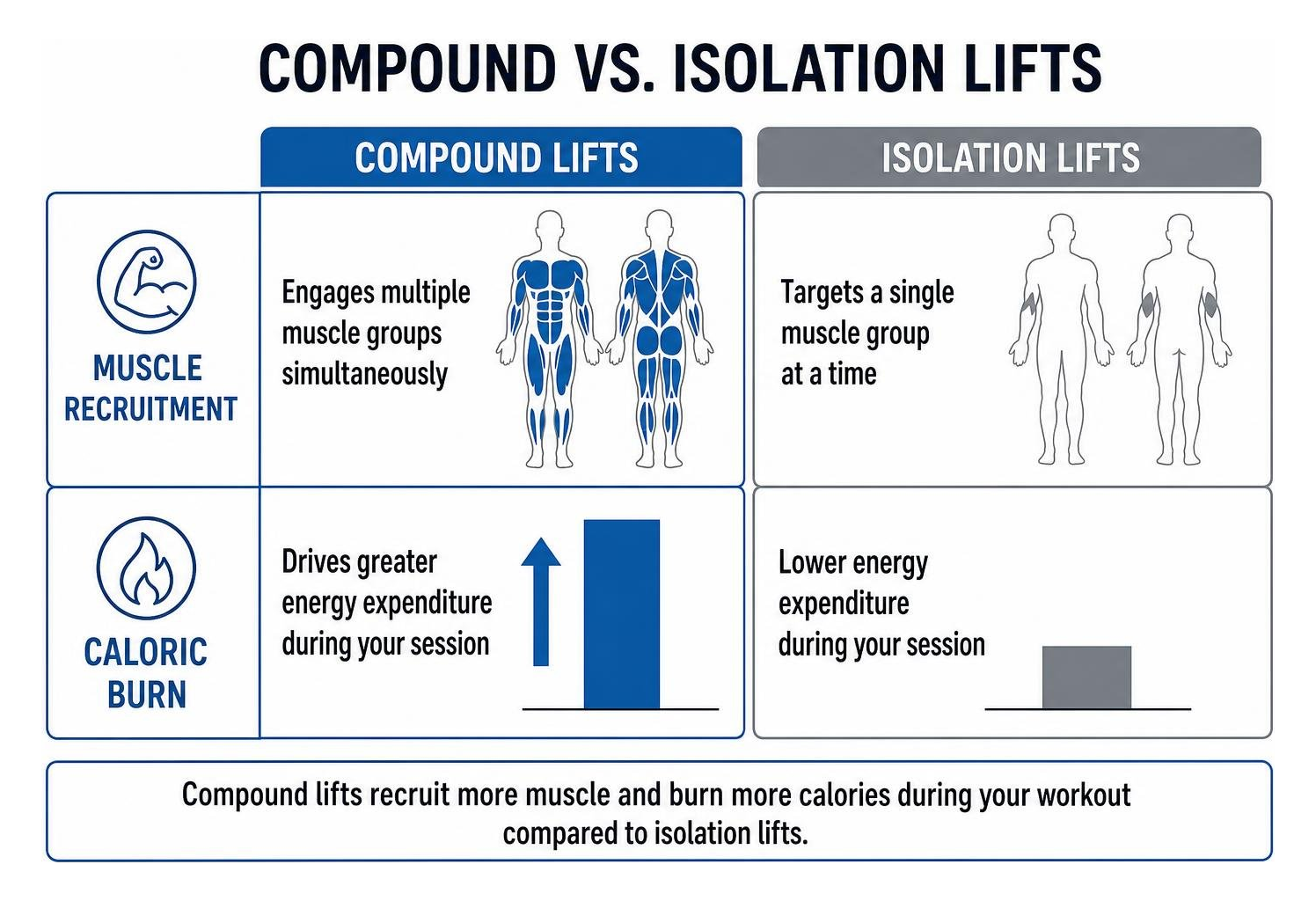
This systemic demand places a high stimulus on the central nervous system (CNS). By engaging massive muscle groups simultaneously, compound training drives greater energy expenditure during your session while boosting your resting metabolism long after you leave the gym. Building and preserving lean muscle mass requires energy, and maintaining that active tissue is a great way to manage body composition naturally. To maintain this metabolic rate during weight loss, experts recommend targeting a safe daily caloric reduction of around 600 calories alongside regular resistance training.
The cardiovascular and functional payoffs are equally impressive. Research highlights that compound exercise groups achieve up to 2.5 times higher VO2 max improvements than isolation-only lifters. Furthermore, because multi-joint movements force major muscle groups to work in harmony, they deliver 1.5 to 2 times faster strength transfer to real-world sports and daily physical tasks compared to single-joint isolation routines. To explore how to balance these lifts inside a broader training schedule, check out our guide on Good Workout Plans for Men: A Practical Roadmap to Strength.
Key Exercises for Building a Powerful Full-Body Routine
To get the most out of your gym sessions, your routine should focus on key multi-joint lifts. Mastering these foundational patterns ensures maximum muscle recruitment while protecting your joints.
The Barbell Squat
Often referred to as the king of exercise, the barbell back squat challenges the quads, glutes, hamstrings, calves, and entire spine-stabilizing core. Focus on keeping your feet firmly planted on the floor with your weight distributed evenly. As you lower your hips, ensure your knees track in line with your toes rather than caving inward. Sink down until your thighs are parallel to the floor (or as deep as your ankle and hip mobility comfortably permits) before driving back up through your heel and mid-foot.
The Conventional Deadlift
The conventional deadlift is the primary posterior-chain builder, working everything from your hamstrings and glutes to your traps and grip strength. The foundation of a safe deadlift is a sound hip hinge. Stand with the barbell over your mid-foot, brace your core tightly, pull your shoulder blades back to engage your lats, and maintain a neutral spine from head to pelvis. Lift by pushing the floor away with your legs rather than yanking with your lower back, keeping the bar close to your shins throughout the ascent.
The Bench Press and Overhead Press
Upper body pushing power centers around the flat bench press and the standing overhead press. When setting up for a barbell bench press, plant your feet flat, squeeze your shoulder blades together on the bench, and keep your elbows angled at roughly 45 degrees relative to your torso. This 45-degree angle reduces stress on your rotator cuffs while optimizing chest and tricep recruitment.
For the standing overhead press, brace your glutes and core to avoid excessive lower back leaning. Press the bar upward in a straight line, allowing your head to slip slightly forward once the bar clears your forehead.
Upper Body Pulls: Rows and Pull-Ups
Balanced upper body development requires heavy pulling. The barbell bent-over row forces your back and core to stabilize your entire body as your arms pull the load to your upper stomach. Pull-ups and underhand chin-ups target your latissimus dorsi, rhomboids, and biceps. While an overhand grip puts more focus on the lats, using an underhand chin-up grip increases bicep engagement, letting you work three major muscle groups in one movement. To enhance your pulling sessions further, consider combining free weights with cable variations by exploring how to Upgrade Your Pull Day with Cable Back Workouts.
Structuring the Best Compound Workouts for Your Weekly Routine
Selecting the right training split depends on your schedule, recovery capabilities, and training background. Balancing volume and central nervous system recovery is crucial to avoid burnout.

| Split Structure | Recommended Frequency | Primary Focus | Best Suited For |
|---|---|---|---|
| 3-Day Full Body | 3 days per week (e.g., Mon/Wed/Fri) | Full-body compound strength & functional capacity | Beginners, busy schedules, weight loss focus |
| 4-Day Upper / Lower | 4 days per week (e.g., Mon/Tue/Thu/Fri) | Balanced muscle hypertrophy & heavy load progression | Intermediate lifters, bodybuilders |
| 5-Day Full Body Split | 5 days per week (Daily movement rotation) | High frequency, alternating power, strength, hypertrophy, dynamic finishes | Advanced trainees, high athletic capacity |
Designing the Best Compound Workouts for Beginners
If you are new to structured resistance training, keeping things simple will deliver the fastest results. Beginners should start with bodyweight or light dumbbell progressions—such as goblet squats, elevated push-ups, and hip hinges—to build solid movement habits.
Always begin workouts with an 8 to 10-minute dynamic warm-up involving light cardio and joint mobility to prepare your body for heavy work. Place your heaviest multi-joint exercises right after your warm-up when your central nervous system is freshest. For a simple step-by-step roadmap to building exercise habits, see Why a Beginner 30-Day Workout Challenge Is the Best Way to Start Exercising.
Advanced Split Variations for the Best Compound Workouts
Experienced trainees looking to push past plateaus can transition to high-frequency splits or explosive complex patterns. Following a structured multi-day plan allows you to train different movement variations daily without overtaxing specific joints.
You can also incorporate advanced training formats such as functional conditioning complexes or 16-minute EMOMs (Every Minute On the Minute), where you cycle through deadlifts, cleans, pull-ups, and front squats under strict time caps. To learn how high-frequency structures build athletic mass, read our guide to Build Muscle Faster Using a Weekly 5-Day Training Split.
Programming Guidelines: Sets, Reps, and Progressive Overload

No workout routine yields continuous muscle growth without the application of progressive overload. Progressive overload means gradually increasing the total stress placed on your muscular system over time. While adding weight to the bar is the most common approach, you can also progress by adding reps, improving your technical range of motion, or decreasing rest periods.
Target Rep Schemes for Hypertrophy vs Max Strength
Your rep ranges should reflect your specific performance targets:
- Maximum Strength Focus: 3 to 5 sets of 3 to 5 reps. Using heavy loads sparks muscle growth through high mechanical tension, requiring longer rest intervals of 2 to 3 minutes.
- Hypertrophy (Muscle Building) Focus: 3 to 4 sets of 8 to 12 reps. This rep scheme keeps muscles under tension for longer while allowing enough total volume for muscle growth, using rest periods of 60 to 90 seconds.
- Endurance & Weight Loss Focus: 2 to 3 sets of 12 to 16 reps. Utilizing lighter loads with 2 to 3-minute rest periods helps build muscular endurance and keeps your heart rate elevated.
Do You Need Isolation Exercises Alongside Compounds?
Can you build a strong body using only the best compound workouts? Absolutely. For most trainees, multi-joint lifts provide plenty of stimulus for major muscle groups, including the arms and shoulders. However, relying entirely on compound lifts can sometimes leave specific weak points behind or create muscular imbalances over time. Adding isolation exercises—like tricep pushdowns, lateral raises, or calf raises—at the end of your session helps address lagging areas without draining the energy needed for your main lifts.
You can also use compound sets (pairing two exercises for the exact same muscle group back-to-back without rest) to trigger extra muscle growth.
Common Execution Mistakes and Injury Prevention

Because compound lifts allow you to handle heavy weights, performing them with bad form significantly increases your risk of injury. The single most common mistake is sacrificing form for heavy weight, leading to lower back rounding during deadlifts and squats.
To prevent lower back strain:
- Keep your back neutral and your core braced tightly during heavy lifts.
- Keep the bar close to your body during hinges and rows to protect your spine.
- Avoid forcing your knees inward during deep squats.
- Avoid over-arching your lower back when overhead pressing.
It is equally important to avoid overtraining. Studies indicate that 30% to 40% of lifters suffer from overtraining when they skip rest days, which can double their overall injury risk. Schedule dedicated rest days, aim for 7 to 9 hours of quality sleep each night, and plan a light deload week every 6 to 8 weeks to give your joints and central nervous system time to recover. If you are ever short on time and need to keep your momentum going, try these simple 15-minute workouts to keep moving without overfatiguing your joints.
Frequently Asked Questions About Compound Workouts
Can you build muscle using only compound exercises?
Yes, you can build impressive total-body muscle using only compound exercises. Multi-joint movements create high mechanical tension and engage large amounts of muscle mass across every rep. Adding isolation work is simply an optional tool to refine smaller muscle groups or address specific aesthetic weak points.
How often should you perform heavy compound lifts per week?
Most lifters perform heavy compound movements 3 to 4 days per week. Because heavy multi-joint lifts place high demands on your central nervous system, training 3 to 4 days per week gives your muscles and nervous system enough time to recover and grow between sessions.
How do compound exercises assist with body fat loss?
Compound exercises burn more calories per minute than isolation moves because they engage multiple large muscle groups simultaneously. Combined with a balanced diet, lifting heavy compound loads helps protect your hard-earned lean muscle tissue while operating in a caloric deficit, ensuring that the weight you lose comes from body fat rather than muscle mass.
Conclusion
At Daily News Orbit, we believe smart, efficient training beats overly complicated routines every single time. Centering your training around the best compound workouts allows you to build functional strength, spur muscle growth, and boost your metabolism without wasting hours on endless single-joint machines. Prioritize your technique, keep your lifting numbers tracked in a training log, and apply progressive overload week after week.
Ready to build your foundational strength routine right now? Take the next step by exploring The Ultimate Gym Workout Routines for Men for Beginners and start building a stronger, healthier body today!