


Good Workout Routine for Men: A Simple Weekly Blueprint
A Good Workout Routine for Men Starts With a Plan You Can Repeat
A good workout routine for men is one that fits your real schedule, matches your goal, and helps you get stronger over time without burning out. There is no single routine that works best for every man.
For a quick starting point:
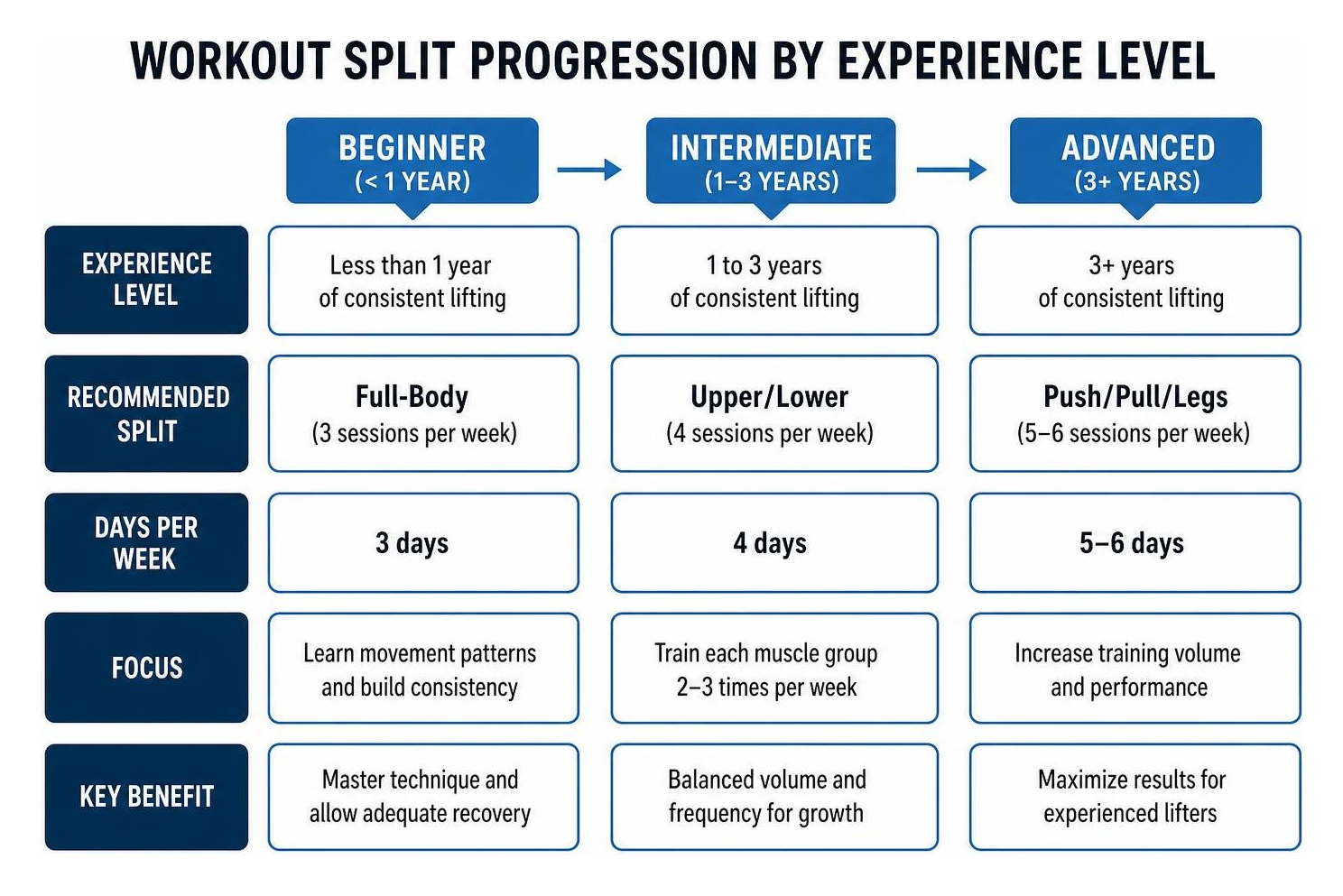
| Experience level | Best weekly starting structure | Main focus |
|---|---|---|
| Beginner | 3 full-body workouts | Learn form and build consistency |
| Intermediate | 4-day upper/lower split | Add training volume and strength |
| Advanced | 5-6 day push/pull/legs split | Build muscle with more focused volume |
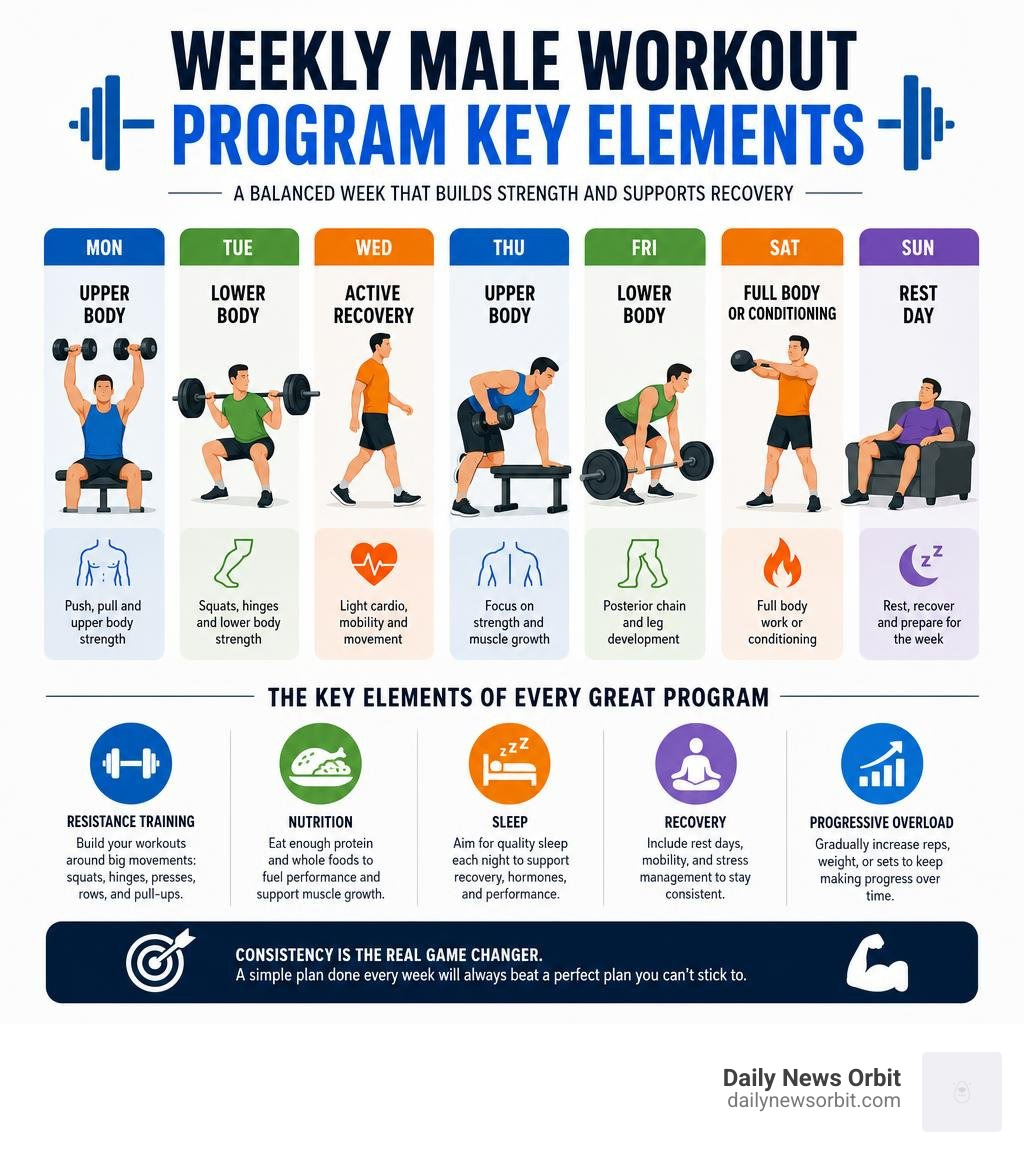
Resistance training should sit at the center of the plan. Build sessions around big movements such as squats, hinges, presses, rows, and pull-ups. Then support them with enough protein, sleep, recovery days, and progressive overload – gradually adding reps, weight, or sets as you improve.
The best-looking plan on paper is not always the best plan for you. A simple routine done consistently for months will beat an intense six-day split you quit after two weeks.
What Makes a Good Workout Routine for Men?
When we design or choose a training routine, we often look for secret exercises or complex rep schemes. However, evidence shows that resistance training provides massive health and aesthetic benefits—ranging from enhanced metabolic rate to increased bone density—regardless of how flashy the routine looks. What truly makes a good workout routine for men is structure, sustainability, and alignment with your lifestyle.
To pick the right strategy, we must understand how different workout splits distribute weekly training volume and muscle recovery:
| Training Split | Weekly Frequency | Pros | Best For |
|---|---|---|---|
| Full-Body | 3 Days / Week | High muscle hit frequency, low time commitment | Beginners, busy schedules |
| Upper / Lower | 4 Days / Week | Great balance of heavy volume and recovery | Intermediates, strength building |
| Push / Pull / Legs (PPL) | 5–6 Days / Week | Maximum volume per muscle group per session | Advanced lifters, maximum hypertrophy |
The core goal of any split is to give your muscles enough stimulus to adapt while granting at least 48 hours of recovery before hitting the same muscle group heavily again. To explore detailed program designs, read our guide on Good Workout Plans for Men: A Practical Roadmap to Strength.
Choosing the Right Training Frequency for Your Goals
How many days a week should you train? We always tell lifters to look at their schedule before looking at a barbell. If you have a demanding job or family commitments, committing to six gym days a week often leads to skipped sessions and frustration.
- For Fat Loss: A 3-to-4-day resistance split combined with daily walking or light conditioning works wonders by preserving lean muscle mass while keeping energy expenditure high.
- For Muscle Growth (Hypertrophy): Muscle groups generally respond best when targeted 2 to 3 times per week. Beginners can easily hit this target with a 3-day full-body schedule, while intermediate lifters often thrive on a 4-day upper/lower split.
If you are just building the habit of exercising daily, starting with a structured timeline can build momentum. Check out Why a Beginner 30-Day Workout Challenge Is the Best Way to Start Exercising to jumpstart your consistency.
Building a Good Workout Routine for Men: Key Exercises
Every strong routine hinges on multi-joint compound exercises. These movements recruit large amounts of muscle mass, burn more calories, and trigger greater functional strength gains than isolated exercises like bicep curls alone.

We recommend building every program around these core movement patterns:
- Squat (Quadriceps & Glutes): Barbell back squats, goblet squats, or leg presses.
- Hip Hinge (Hamstrings & Posterior Chain): Conventional deadlifts, Romanian deadlifts (RDLs), or kettlebell swings.
- Horizontal Push (Chest, Shoulders, Triceps): Flat or incline bench presses and dumbbell presses.
- Horizontal Pull (Upper Back & Lats): Barbell bent-over rows, dumbbell rows, or cable rows.
- Vertical Push (Deltoids & Triceps): Overhead barbell or dumbbell presses.
- Vertical Pull (Lats & Biceps): Pull-ups, chin-ups, or lat pulldowns.
For a focused deep dive into essential lifts, check out These 6 Exercises Are All You Need for a Truly Effective Full-Body Workout.
Sample Good Workout Routine for Men by Experience Level
To help you put these principles into action, we have structured three distinct training blueprints tailored to your gym age and physical capacity.
Beginner Blueprint: 3-Day Full-Body Routine
If you have less than a year of consistent lifting experience, a 3-day full-body schedule allows you to master exercise technique while giving your neuromuscular system adequate rest between sessions. Perform this routine on non-consecutive days (e.g., Monday, Wednesday, Friday).
- Squat Variation (Goblet or Barbell Squat): 3 sets × 8–10 reps (Rest 90-120 sec)
- Incline Dumbbell Bench Press: 3 sets × 10–12 reps (Rest 90 sec)
- Lat Pulldown or Assisted Pull-Up: 3 sets × 10–12 reps (Rest 90 sec)
- Romanian Deadlift (RDL): 3 sets × 10–12 reps (Rest 90 sec)
- Standing Dumbbell Overhead Press: 3 sets × 10–12 reps (Rest 60-90 sec)
- Plank Hold: 3 sets × 30–45 seconds
Many lifters find high success starting with structured, simple templates such as those outlined in the Best Fitness Routine for Men: 4-Week Starter Plan | NaturalHealthX or reading through the Beginner Muscle Building Routine For Men: Full-Body Plan.
Intermediate Blueprint: 4-Day Upper/Lower Split
For men with 1 to 2 years of continuous training, an Upper/Lower split provides the extra volume required to keep breaking through plateaus.

- Monday (Upper A – Push Emphasis):
- Barbell Bench Press: 4 sets × 6–8 reps
- Bent-Over Barbell Row: 4 sets × 8–10 reps
- Standing Overhead Press: 3 sets × 8–10 reps
- Dumbbell Incline Flyes: 3 sets × 10–12 reps
- Tuesday (Lower A – Squat Emphasis):
- Barbell Back Squat: 4 sets × 6–8 reps
- Romanian Deadlift: 3 sets × 8–10 reps
- Walking Lunges: 3 sets × 10 steps per leg
- Standing Calf Raises: 4 sets × 12–15 reps
- Thursday (Upper B – Pull Emphasis):
- Pull-Ups or Heavy Cable Pulldowns: 4 sets × 6–8 reps
- Incline Dumbbell Bench Press: 4 sets × 8–10 reps
- Seated Cable Rows: 3 sets × 10–12 reps (Explore options in Upgrade Your Pull Day with Cable Back Workouts)
- Dumbbell Lateral Raises: 4 sets × 12–15 reps
- Friday (Lower B – Hinge Emphasis):
- Conventional Deadlift: 3 sets × 5 reps
- Leg Press or Bulgarian Split Squat: 3 sets × 10–12 reps
- Hamstring Leg Curls: 3 sets × 12–15 reps
- Hanging Leg Raises: 3 sets × 12–15 reps
If you want to evaluate alternative high-frequency options, read Build Muscle Faster Using a Weekly 5-Day Training Split.
Advanced Blueprint: 5-to-6-Day Push/Pull/Legs Split
For experienced lifters (2+ years of consistent progress), a Push/Pull/Legs (PPL) split allows high overall volume per muscle group while isolating target areas for maximum muscle growth.
- Push Days: Chest, Shoulders, and Triceps
- Pull Days: Back, Rear Delts, and Biceps
- Leg Days: Quadriceps, Hamstrings, Calves, and Core
Advanced trainees can repeat the cycle twice per week (PPL-Rest-PPL) or complete a 5-day variation. You can review full detailed programming guides like the Workout Routine for Men: 3 Plans by Experience Level to tune your specific isolation volume.
Essential Factors to Maximize Workout Results
A gym routine only creates the signal for muscle growth—recovery is where actual growth happens.
To get full value from your workouts, keep these non-negotiable recovery pillars in mind:
- Progressive Overload: Track your workouts. Aim to increase the load by 2.5–5 lbs or add 1 extra rep every 1–2 weeks on primary compound movements.
- Protein Intake: Consume approximately 0.7 to 1.0 grams of protein per pound of target body weight daily (1.6 to 2.2g per kg) to support tissue repair.
- Caloric Balance: Eat in a minor surplus (200–300 calories over maintenance) to build muscle efficiently, or a mild calorie deficit (200–300 calories below maintenance) to shed fat.
- Sleep: Aim for 7 to 9 hours of quality sleep nightly, as key recovery processes occur primarily during deep sleep stages.
Key Adjustments for Lifters Over 40
As we age, our joints and recovery capacities change. Men over 40 can absolutely build impressive physique and strength levels, but smart exercise selection becomes critical to prevent cumulative joint strain.
- Swap Barbell Back Squats for Goblet Squats or Trap Bar Deadlifts: These reduce axial loading on the spine while still heavily working the lower body.
- Extend Warm-Ups: Spend 5–10 minutes performing dynamic mobility work to lubricate shoulder, hip, and ankle joints before lifting.
- Listen to Soreness: If joint pain (not muscle soreness) persists, substitute exercises immediately (e.g., swapping flat barbell bench presses for neutral-grip dumbbell presses).
Managing Short Time Windows with High-Efficiency Workouts
When time is tight, we don’t have to sacrifice our physical fitness. You can maintain—and even build—muscle using time-efficient intensity techniques:
- Supersets: Pair non-competing exercises together (e.g., doing a set of overhead presses, resting 30 seconds, then doing a set of pull-ups).
- Rest-Pause Sets: Take a heavy working load to near failure, rest 15–30 seconds, and immediately execute another mini-set of 3–5 reps.
For science-backed time-saving routines, review The 3-Day Full-Body Workout Routine for Maximum Gains – Men’s Journal or read our guide on how to Stop Making Excuses and Start These 15-Minute Workouts Today.
Frequently Asked Questions About Men’s Workout Routines
Does a single best workout routine exist for all men?
No. There is no universally superior routine. The “best” plan depends entirely on your current experience level, daily schedule consistency, personal joint health, and structural goals. A simple 3-day routine you stick to for a year is infinitely better than an advanced 6-day split you drop after three weeks.
How many days per week should a man workout to build muscle?
Most men build optimal strength and muscle training 3 to 5 days per week. Beginners adapt rapidly to 3 full-body sessions, whereas intermediate and advanced lifters benefit from spreading total workload across 4 to 5 training days.
Can men over 40 still build muscle safely?
Yes! Resistance training is one of the most effective tools for counteracting age-related muscle mass loss. By emphasizing joint-friendly movements, controlling rep speed, extending rest periods, and prioritizing nutrition, men over 40 can continue to build muscle and increase strength safely.
Conclusion
Building an impressive, healthy physique does not require endless hours of confusion in the gym. By anchoring your schedule around compound exercises, matching your split to your actual availability, and applying progressive overload, you create a sustainable foundation for long-term health and strength.
Ready to take your initial steps or revamp your current program? Dive into our comprehensive guide on The Ultimate Gym Workout Routines for Men for Beginners and explore our latest training updates in the Daily News Orbit Fitness Category. Consistency beats complexity every single time—pick your schedule, hit your workouts, and let time work for you!