

Build Muscle Faster Using a Weekly 5-Day Training Split
Why a 5-Day Gym Workout Schedule Can Build Muscle Faster
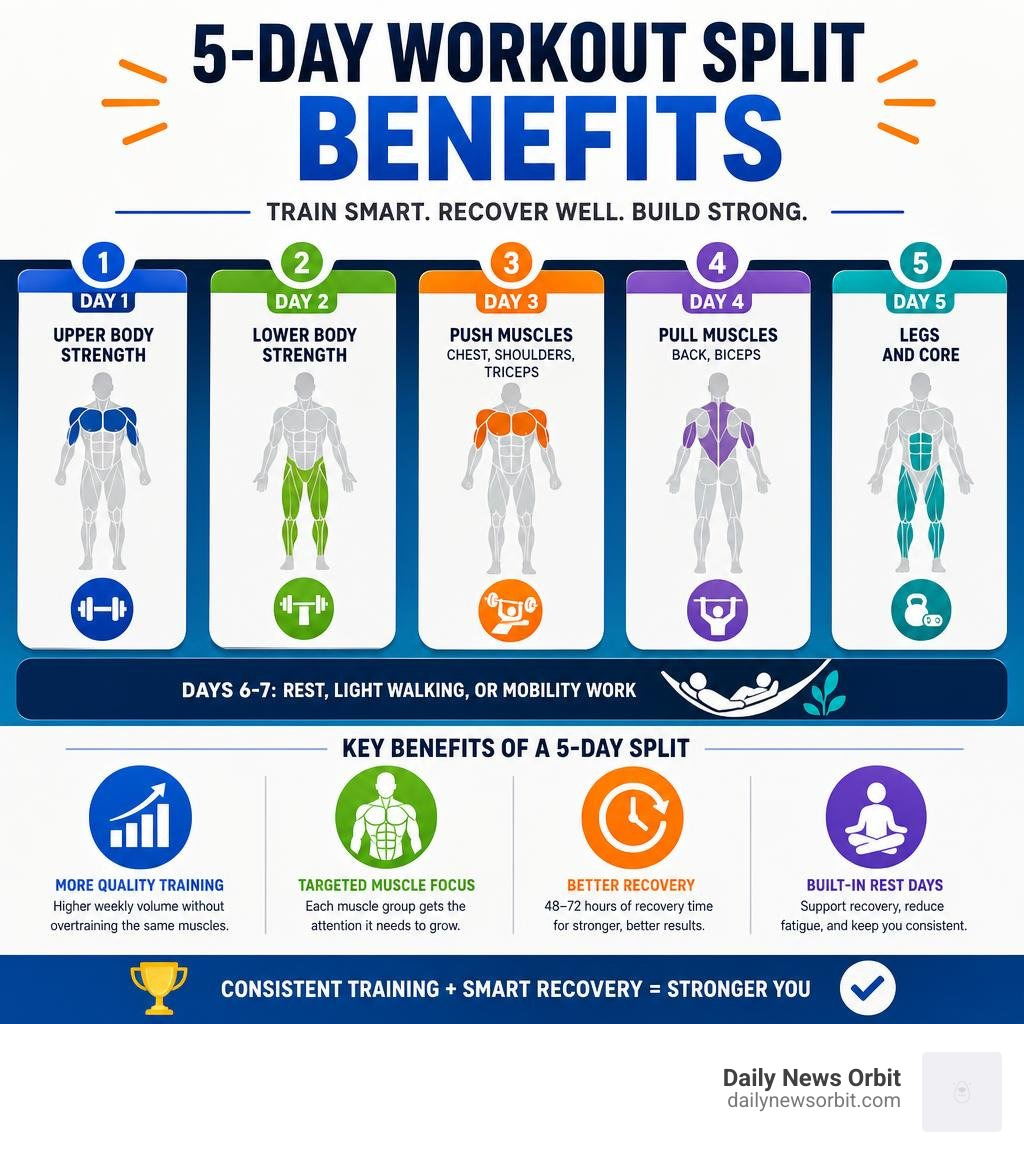
A 5 day gym workout schedule spreads resistance training across five weekly sessions so you can train with enough volume for muscle and strength gains while giving worked muscles time to recover.
A quick example looks like this:
| Day | Training focus |
|---|---|
| Day 1 | Upper body strength |
| Day 2 | Lower body strength |
| Day 3 | Push muscles: chest, shoulders, triceps |
| Day 4 | Pull muscles: back, biceps |
| Day 5 | Legs and core |
| Days 6-7 | Rest, light walking, or mobility work |
The appeal is simple: you can do more quality work than in a 2- or 3-day plan without hammering the same muscles every day. Most muscles need roughly 48 to 72 hours before another hard session. A well-planned split creates that space.
This schedule is often best for intermediate and experienced lifters, or committed beginners who can keep the weights manageable and put form first. It can support muscle gain, strength, or fat loss depending largely on training effort, food intake, sleep, and consistency.
Understanding the 5-Day Workout Split and Who It Is For
When we talk about a workout split, we are referring to dividing our weekly fitness routine by specific body parts, movement patterns, or training intensities. Rather than trying to hit every muscle group in a single taxing full-body workout, a 5 day gym workout schedule allows us to isolate specific muscle groups per session.
By spreading out our sets across five distinct days, we achieve a high overall training volume without accumulating mid-workout exhaustion. High weekly volume is one of the primary drivers of muscle hypertrophy. Furthermore, elevated muscle protein synthesis—the process where our bodies repair and build new tissue—stays continuously stimulated across the entire workweek.
According to scientific research on 5-day hypertrophy splits, training major muscle groups twice weekly yields far better hypertrophy compared to hitting them only once, provided total weekly volume is matched.
Evaluating Suitability for Beginners vs Advanced Lifters
Is a 5-day training schedule suitable for everyone? The quick answer depends on your training age, baseline strength, and ability to recover.

- Intermediate to Advanced Lifters: Lifters who have spent 12 to 18 months consistently strength training are prime candidates. Their muscles require a higher dose of total sets per week (typically 15–20 sets per major muscle group) to trigger fresh growth. Spreading this demand over five days avoids physical burnout.
- Committed Beginners: Beginners can utilize a 5-day split, provided they keep weights light, stay away from absolute failure, and prioritize movement technique. However, brand-new lifters usually grow rapidly on 3-day full-body schedules because their recovery capacity and baseline strength are still adapting.
Most Common Types of 5-Day Gym Workout Routines
Selecting the right arrangement for your 5 day gym workout schedule ensures you stick with your training without accumulating joint wear or extreme fatigue. Here are three leading split structures:
| Split Style | Best For | Primary Advantage | Typical Muscle Hit Frequency |
|---|---|---|---|
| ULPPL (Upper/Lower/Push/Pull/Legs) | Muscle Hypertrophy | Ideal mix of heavy strength and volume | 2x per week |
| Upper/Lower Plus | Strength & Weak Point Focus | High customization for lagging muscles | 2x per week + weak points |
| Classic Bro Split | Isolation & Pump Focus | Maximum focus on single muscle group | 1x per week |
The ULPPL (Upper/Lower/Push/Pull/Legs) Hybrid
The ULPPL framework is widely considered the gold standard for natural lifters. It combines two upper/lower strength days with a traditional 3-day push/pull/legs block.
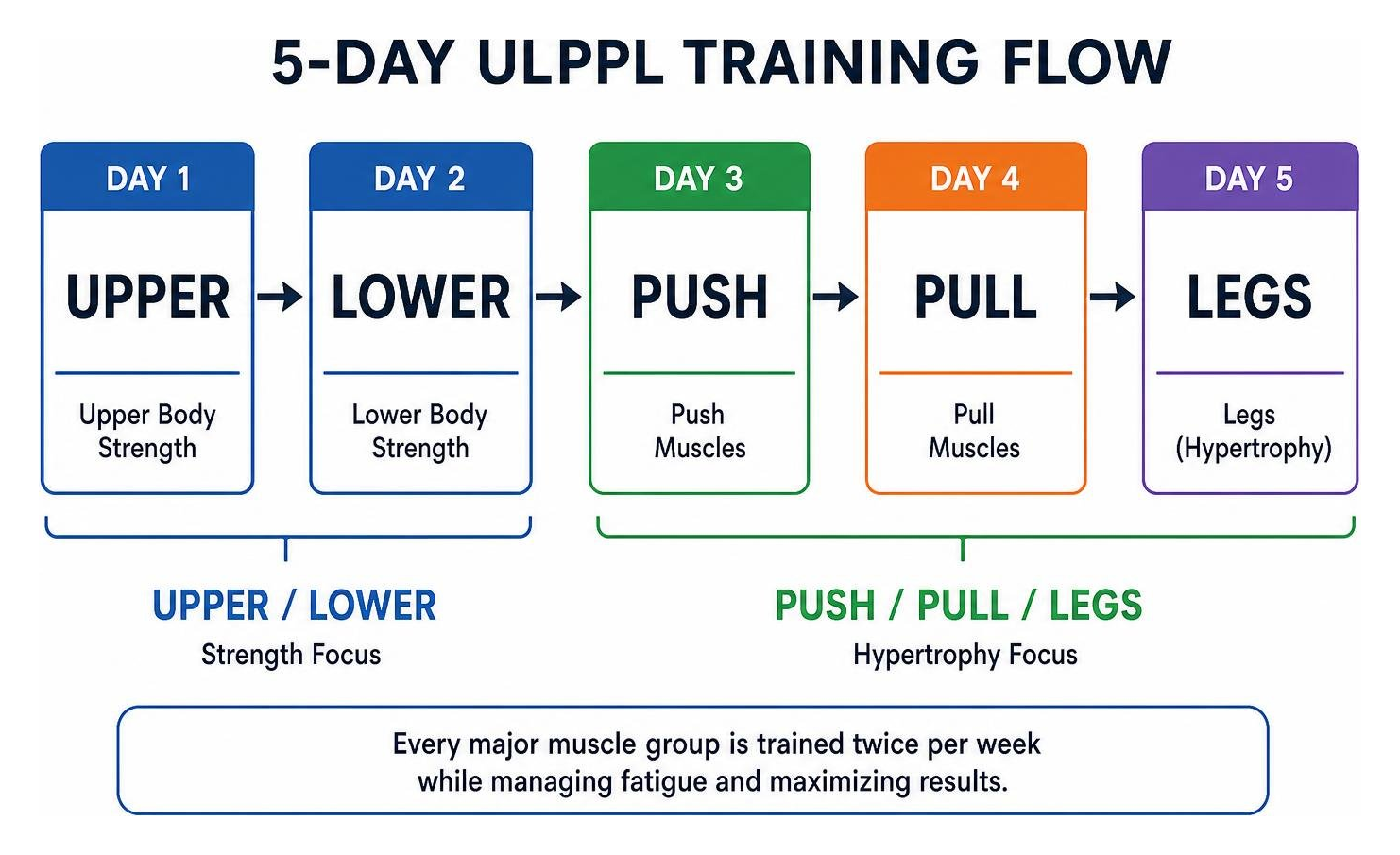
This structure ensures every major group gets stimulated twice per week while managing central nervous system fatigue cleanly.
The Upper/Lower Plus Specialization Routine
If you want to bring up specific weak points—such as shoulders, chest, arms, or glutes—an Upper/Lower Plus template works wonders. You execute heavy Upper and Lower days on Monday and Tuesday, take Wednesday off, run moderate Hypertrophy Upper and Lower days on Thursday and Friday, and reserve Saturday for a targeted specialization session. Our guide to 5-day splits for intermediate lifters details how allocating an extra day to weak points can spark renewed progress.
Designing the Ultimate 5 Day Gym Workout Schedule
To get the most out of your hours in the gym, every session should combine heavy compound movements (like squats, bench presses, and deadlifts) with targeted isolation exercises (such as lateral raises or bicep curls).

Keep workout session durations tightly focused between 45 and 75 minutes. Leaving plenty in the tank ensures you recover properly for the next day’s split.
Sample 5 Day Gym Workout Schedule for Muscle Hypertrophy
Below is a detailed, real-world schedule designed to build both absolute strength and muscle size. For a complete strength-building blueprint, review this detailed 5-day strength routine.
- Day 1: Upper Body Strength
- Barbell Bench Press: 4 sets x 6–8 reps (2–3 mins rest)
- Bent-Over Barbell Row: 4 sets x 6–8 reps (2 mins rest)
- Overhead Dumbbell Press: 3 sets x 8–10 reps (90 secs rest)
- Lat Pulldown: 3 sets x 8–10 reps (90 secs rest)
- Day 2: Lower Body Strength
- Barbell Back Squat: 4 sets x 6–8 reps (2–3 mins rest)
- Romanian Deadlift: 3 sets x 8–10 reps (2 mins rest)
- Leg Press: 3 sets x 10–12 reps (90 secs rest)
- Standing Calf Raises: 4 sets x 12–15 reps (60 secs rest)
- Day 3: Push (Chest, Shoulders, Triceps)
- Incline Dumbbell Press: 3 sets x 8–12 reps (90 secs rest)
- Cable Chest Flyes: 3 sets x 12–15 reps (60 secs rest)
- Dumbbell Lateral Raises: 4 sets x 12–15 reps (60 secs rest)
- Rope Tricep Pushdowns: 3 sets x 10–12 reps (60 secs rest)
- Day 4: Pull (Back, Rear Delts, Biceps)
- Seated Cable Row: 3 sets x 8–12 reps (90 secs rest)
- Single-Arm Dumbbell Row: 3 sets x 10–12 reps (90 secs rest)
- Face Pulls: 4 sets x 12–15 reps (60 secs rest)
- Incline Dumbbell Bicep Curls: 3 sets x 10–12 reps (60 secs rest)
- Day 5: Legs & Core
- Dumbbell Walking Lunges: 3 sets x 10 reps per leg (90 secs rest)
- Lying Hamstring Curls: 3 sets x 12–15 reps (60 secs rest)
- Cable Woodchoppers & Hanging Leg Raises: 3 sets x 15 reps (60 secs rest)
Essential Exercises for Each Major Muscle Group
- Chest: Barbell bench press, incline dumbbell press, dips, cable flyes.
- Back: Pull-ups, lat pulldowns, barbell rows, seated cable rows.
- Legs (Quads & Hamstrings): Barbell back squats, Bulgarian split squats, Romanian deadlifts, leg curls.
- Shoulders: Overhead barbell press, dumbbell shoulder press, lateral raises, face pulls.
- Arms (Biceps & Triceps): Dumbbell curls, preacher curls, tricep dips, overhead cable extensions.
Progressive Overload, Recovery, and Nutrition Principles
The finest 5 day gym workout schedule won’t produce results without progressive overload. This means gradually increasing the total resistance, repetition count, or work volume over time.
To support this workload, give every muscle group a mandatory 48-to-72-hour recovery window before training it hard again.
Nutrition, Protein Targets, and Deload Strategies
Muscle hypertrophy happens outside the gym when your body repairs microscopic muscle tears during sleep and rest.
- Protein Intake: Target 1.6 to 2.2 grams of protein per kilogram of body weight daily (roughly 0.7 to 1.0g per pound).
- Caloric Intake: Eat at a slight caloric surplus (200 to 400 calories above maintenance) for optimal hypertrophy.
- Sleep Quality: Prioritize 7 to 9 hours of quality sleep every night.
- Deload Weeks: Every 6 to 8 weeks, schedule a deload week by cutting your total training sets or working weights by 40–50% to flush out accumulated fatigue.
How to Adapt Your 5 Day Gym Workout Schedule for Fat Loss
A 5-day split is also exceptionally effective during a cutting phase. Preserving lean body mass while shedding body fat requires keeping resistance training intensity high while creating a slight caloric deficit (300 to 500 calories below maintenance).
According to this 5-day fat loss training program, maintaining a regular strength training frequency helps preserve muscle mass so that dropped weight comes strictly from fat stores. Keep lifting heavy, add 20 to 30 minutes of light cardio after workouts or on rest days, and step up your daily non-exercise physical activity (such as walking). You can also explore flexible sample 5-day split workout plans for muscle gain to keep your workouts engaging throughout a fat-loss block.
Recommended Gym Equipment for a 5-Day Split
To get the most out of your 5-day training schedule, we recommend utilizing a well-equipped commercial gym or setting up a versatile home gym space containing:
- Barbells and Bumper Plates: Crucial for heavy compound foundation lifts.
- Power Rack with Safety Arms: Allows you to perform heavy squats and bench presses safely without needing a spotter.
- Adjustable Dumbbells & Benches: Essential for unilateral work, chest pressing, and shoulder flyes.
- Cable Machines: Perfect for continuous tension on isolation exercises like tricep pushdowns and face pulls.
- TRX Suspension Trainers: Excellent for functional bodyweight conditioning, abdominal work, and joint preparation; consult this TRX strength training guide for creative integration ideas.
Frequently Asked Questions About 5-Day Workout Splits
Is a 5-day split suitable for absolute beginners?
While absolute beginners can follow a 5-day split if intensity is carefully controlled, a 3-day full-body or 4-day upper/lower split is generally recommended for the first 3 to 6 months. This allows novice lifters to master exercise execution without overwhelming their recovery capacity.
How long should each gym session take on a 5-day split?
An optimal session lasts between 45 and 75 minutes. This provides plenty of time for a thorough 5-to-10-minute dynamic warm-up, heavy compound lifting with adequate rest intervals (2–3 minutes), and isolation work with shorter rest periods (60–90 seconds).
Can I train 5 days in a row without rest days?
While training Monday through Friday and taking the weekend off is possible, inserting a mid-week rest day (such as resting on Wednesday and Sunday) is generally superior. Spreading out your rest days helps reduce central nervous system fatigue and prevents fatigue accumulation before your heaviest lower-body days.
Conclusion
A structured 5 day gym workout schedule offers an ideal balance of training volume, workout variety, and recovery time. By distributing your training across five focused sessions, you can push harder on individual movement patterns while giving worked muscle groups 48 to 72 hours to repair and grow.
To turn effort into visible results, focus on clean technique, track your progress consistently, consume adequate daily protein, and prioritize rest. If you are looking to build a strong foundation, discover the ultimate beginner gym workout routines published by Daily News Orbit to kickstart your strength journey today!