


Upgrade Your Pull Day with Cable Back Workouts
Why Cable Back Workouts Superiorly Target Muscle Growth
When building a powerful V-taper, many lifters gravitate toward standard barbells and dumbbells. While free weights are great, relying solely on gravity creates mechanical “dead zones.” For instance, during a bent-over dumbbell row, tension peaks at the top of the pull but drops off at the bottom. Cable machines solve this limitation by delivering continuous tension throughout both the eccentric (lowering) and concentric (lifting) phases of every rep.
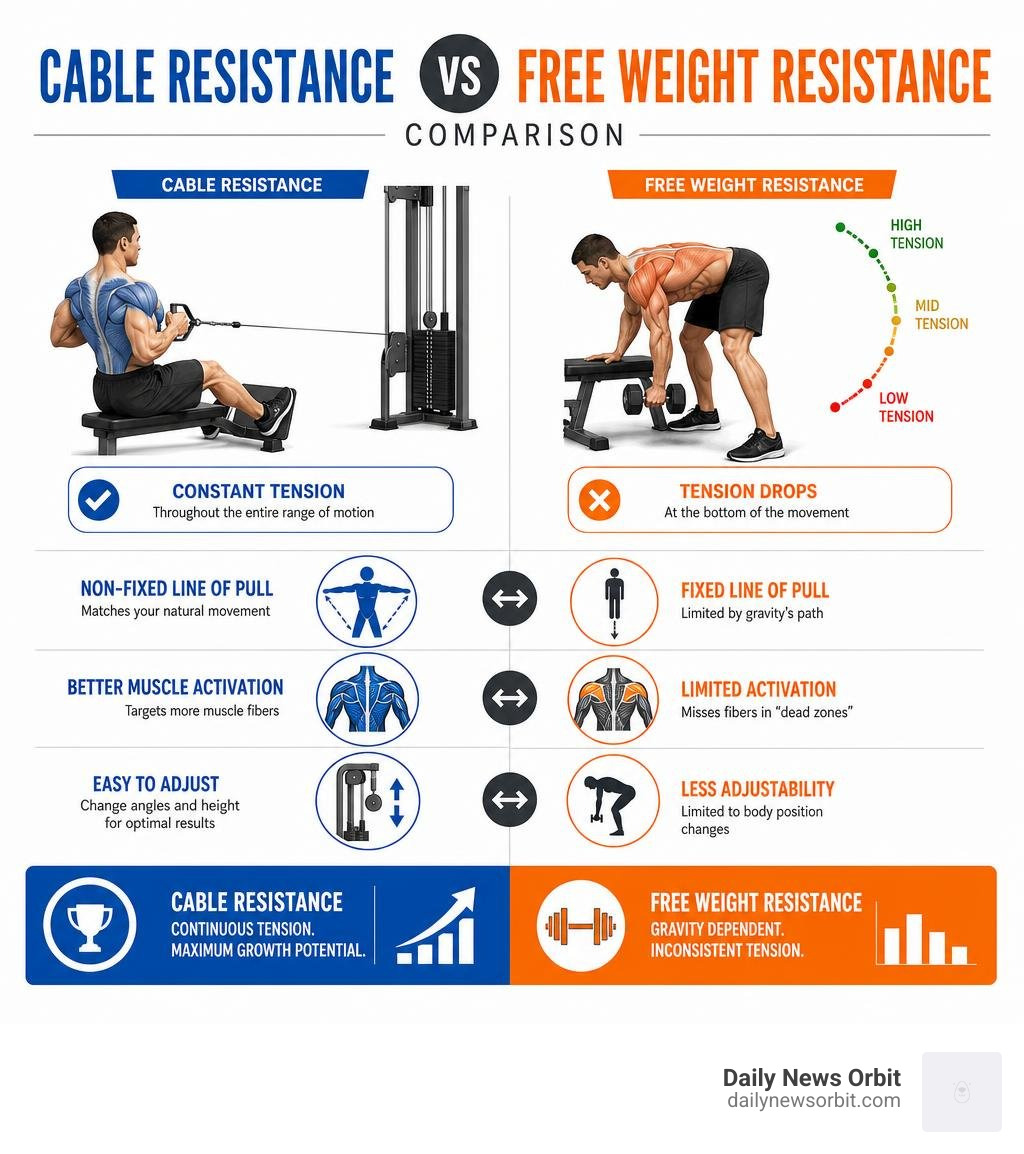
Cables do not rely directly on gravity. Instead, they provide a customizable, non-fixed line of pull that aligns precisely with your individual anatomical structure. This setup allows you to move your arms along natural paths rather than being forced into fixed tracks. By adjusting pulley heights, you can hit diagonal muscle fibers in your back that standard free weights often miss.
Beyond muscle isolation, continuous cable tension provides key biomechanical advantages for joint safety and long-term strength:

- Customized Angles: Adjusting the pulley position allows you to direct resistance inline with muscle fiber alignment.
- Reduced Joint Stress: Cables minimize peak joint shearing forces, keeping constant mechanical strain on target tissues instead of stressing elbows or shoulders.
- Cleaner Execution: The smooth resistance curve discourages excessive momentum and swinging, promoting better execution and muscle isolation.
To explore more fitness guides, check out our Fitness Category page. Learn more about the scientific advantages of continuous tension in this Cable Back Workouts Benefits article.
Anatomy of the Back: Target Muscles in Cable Exercises
To maximize hypertrophy, we need to understand the complex network of muscles that form the human back. Cables allow us to manipulate lines of pull to target specific upper body regions effectively:
- Latissimus Dorsi (Lats): The largest muscle group in the back, spanning from the mid-to-lower spine up to the upper arm. The lats drive shoulder extension and adduction, creating upper-body width.
- Trapezius (Traps): Divided into three functional zones:
- Upper Traps: Elevate the shoulder girdle (targeted via cable shrugs).
- Middle Traps: Retract the scapulae to add mid-back thickness (targeted via chest-supported rows).
- Lower Traps: Depress the shoulder blades, stabilizing the shoulders during overhead pulls.
- Rhomboids (Major and Minor): Situated beneath the mid-traps, these muscles pull the shoulder blades together, providing structural density across the mid-back.
- Teres Major: Positioned high on the outer back, this muscle works as the “little helper” to the lats, contributing directly to upper frame width.
- Posterior Deltoids & Rotator Cuff: The rear shoulders, infraspinatus, and teres minor handle shoulder external rotation and horizontal abduction, promoting shoulder health and joint stability.
- Erector Spinae: Vertical muscle columns running along the spine that maintain posture and stabilize your torso during heavy pulling movements.
Top Exercises for High-Impact Back Workouts Cable Routines
Data from popular workout tracking apps shows millions of logged sets for cable exercises, confirming their widespread use in modern training programs:
- Lat Pulldowns: Over 8.1 million sets logged (Strength Score: 100)
- Seated Cable Rows: Over 6.1 million sets logged (Strength Score: 98)
- Wide-Grip Lat Pulldowns: Over 1.3 million sets logged (Strength Score: 86)
- Shotgun Rows: Over 1.3 million sets logged (Strength Score: 92)
- Straight-Arm Pulldowns: Over 1.1 million sets logged (Strength Score: 72)
Master Vertical Pulling for Lat Width with Back Workouts Cable Methods
Vertical pulling exercises target the latissimus dorsi to broaden your upper frame.
- Standard Lat Pulldown: Secure your thighs firmly under the leg pads. Grab the bar with a grip slightly wider than shoulder-width. Lean back slightly, pull your shoulder blades down, and drive your elbows toward your hips. Avoid leaning back excessively to keep tension on the lats.
- V-Bar Pulldown: Using a neutral V-bar grip places your shoulders in a friendly position, shifting emphasis onto the lower lats while allowing heavy loading.
- Wide-Grip Lat Pulldown: Spreads the grip out to emphasize the upper outer lats and teres major, maximizing upper back width.
- Reverse-Grip Pulldown: Using an underhand supinated grip increases biceps assistance and allows a deeper lower-lat stretch at the top of the movement.
- Single-Arm Lat Pulldown: Attaching a single D-handle lets you pull unilaterally, fixing strength imbalances while expanding your functional range of motion.
For detailed step-by-step guidance on pulldown variations, review this Comprehensive Lat Pulldown Guide.
Build Mid-Back Thickness with Horizontal Rows and Cable Back Workouts
Horizontal pulling exercises add density to the mid-back, targeting the rhomboids, middle traps, and lats.
- Seated Cable Row: Sit upright with your feet planted securely. Retract your shoulder blades first, then pull the handle toward your navel while driving your elbows behind your torso.
- Shotgun / Half-Kneeling Row: Performed from a standing or half-kneeling position, this unilateral movement requires core control to stabilize your body against twisting forces.
- Chest-Supported Cable Row: Leaning your chest against an incline bench eliminates momentum entirely, allowing you to isolate the mid-back without stressing your lower spine.
- Cuff Attachments for Lat Isolation: Using wrist cuffs on low cable rows eliminates forearm grip limitations, placing direct tension onto the lats.
Check out Eric Janicki’s Cable Routines to see how pro lifters isolate muscle groups using cuff setups.
Isolation and Upper Back Finisher Movements
Finished with your main compound pulls? Incorporate targeted isolation work to refine smaller muscle groups and support long-term shoulder durability:
- Cable Face Pulls: Set the pulley to eye level with a rope attachment. Pull the center of the rope toward your nose while splitting the ends wide, rotating your hands backward. This movement strengthens the upper traps, rear delts, and rotator cuff.
- Straight-Arm Pulldowns: Standing tall at a high pulley, keep your arms nearly straight and pull the bar down in an arc to your thighs. This exercise isolates the lats without heavy biceps assistance.
- Cable Shrugs: Attach a low pulley bar or handles to perform smooth, continuous shrugs that isolate the upper trapezius without gravity dead spots.
- Incline Cable Pullovers: Lie back on a 45-degree incline bench facing away from a low pulley. Pull the handle overhead in a wide arc to achieve a strong stretch on the lats.
How to Structure an Effective Cable Back Routine
To design an effective back workouts cable program, optimize your acute training variables based on proven hypertrophy science:

- Volume & Frequency: Aim for 10 to 20 total working sets per week spread across 2 separate sessions.
- Intensity: Select weights between 60% and 80% of your 1RM, leaving 1 to 2 reps in reserve (RIR) on most working sets.
- Rest Periods: Rest 60 to 90 seconds between isolation sets, and up to 2 minutes for heavy compound pulls.
- Tempo Cadence: Use a controlled 2-0-2 tempo (2 seconds pulling down/back, 0 pause, 2 seconds lowering under control).
Here is a balanced 4-exercise cable routine designed for complete back mass and definition:
Track your progress and structure your split with this Cable Back Workout Routine resource.
Form Execution and Injury Prevention Tips
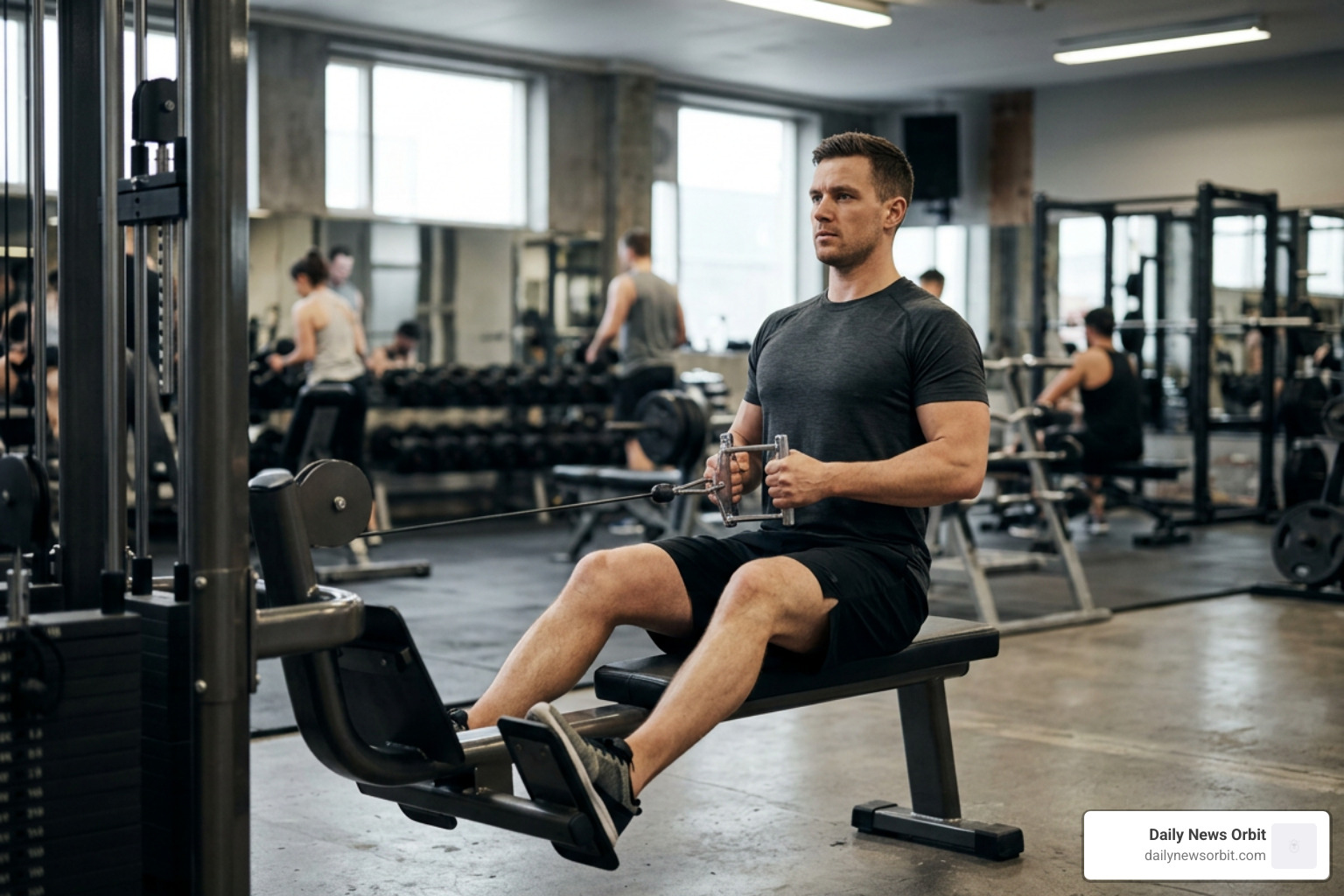
To build muscle safely while protecting your joints, keep these key form cues in mind during your sessions:
- Lead with Your Elbows: Do not pull primarily with your hands and biceps. Instead, imagine your hands as simple hooks and focus on driving your elbows backward or down toward your hip pockets.
- Maintain Scapular Control: Initiate every row or pulldown by depressing and retracting your shoulder blades before flexing your arms.
- Control Your Momentum: Avoid swaying your torso violently to lift heavy weights. Keep your spine in a neutral position and let your target back muscles handle the load.
- Manage Progressive Overload: Keep a simple logbook. Gradually increase the cable stack weight, add extra reps, or improve your control over time to maintain steady progress.
Frequently Asked Questions About Cable Back Training
Can you build a big back using only cables?
Yes! Cable machines maintain continuous mechanical tension throughout both full stretches and peak contractions. By combining vertical pulldowns, horizontal rows, and single-arm movements, you can build a strong, well-developed back using cables alone.
What cable exercises target the lower lats?
Reverse-grip pulldowns, single-arm low rows, and neutral V-bar pulldowns effectively target the lower lat attachment points. Focusing on driving your elbows close to your hip pockets maximizes muscle activation in these areas.
How often should you train your back with cables per week?
Training your back 2 to 3 times per week is ideal for most lifters. Splitting your weekly volume across multiple sessions keeps your work high-quality while giving your muscles time to recover between workouts.
Conclusion
At Daily News Orbit, we believe smart, consistent strength training is the clearest path to long-term fitness. Adding structured cable back workouts to your program offers continuous tension, adaptable movement paths, and targeted muscle growth while keeping joint strain low.
Focus on controlled execution, track your progressive overload, and combine vertical and horizontal pulling variations to build a strong, defined upper body. If you are ready to construct a complete, long-term training plan, review our guide to The Ultimate Gym Workout Routines for Men for Beginners!