

You know that moment when you’re standing in front of an old piece of furniture, a box of vintage records, or a piece of jewelry you inherited, and you think to yourself, “How much is it worth?” It’s one of those questions that seems simple on the surface but can quickly send you down a rabbit hole of confusion.
Whether you’re thinking about selling something, insuring it, or just satisfying your own curiosity, figuring out the value of your belongings doesn’t have to be overwhelming. The good news is that in 2026, there are more tools, resources, and methods available than ever before to help everyday people like you get accurate answers.
In this guide, we’re breaking everything down into simple, easy-to-follow steps. You’ll learn how to research values on your own, when to call in a professional, and which free online tools actually work. No confusing jargon, no complicated formulas, just straightforward advice that anyone can use. By the end, you’ll feel completely confident tackling that mystery item sitting in your attic.
Why the Answer Is Always ‘It Depends’
Here’s the thing: when someone asks “how much is it worth?”, the honest answer really is it depends. That’s not a cop-out. It’s because the word “worth” actually means several different things, and mixing them up leads to real mistakes.
Market value is what a buyer would pay you today in an open, fair transaction. Resale value is what you’d actually pocket selling through a secondhand platform. Replacement value is what it costs to buy the same item brand new right now, which is the number your insurance company usually cares about (you can dig into the difference between market value and replacement cost to see why these numbers often look surprisingly different). Then there’s sentimental value, which carries zero dollar sign but still shapes real decisions during estate splits or insurance claims.
The channel you sell through matters just as much as the item itself. A vintage jacket might bring $15 at a garage sale, $85 on a resale app, and $200 at a curated consignment boutique. Same jacket, three completely different numbers.
The single most important rule to take into this guide: always use sold-price data, not active listing prices. Listings reflect what sellers hope to get. Sold prices reflect what buyers actually paid. Understanding the gap between market value and actual cash value helps make this distinction click. Skipping this step leads to overpricing items, undervaluing assets, and making keep-or-sell calls you’ll regret.
Everyday Items and Collectibles: The 60-Second Method
If you’ve ever found yourself photographing a dusty vase at a garage sale and wondering whether it’s a hidden treasure or just a dusty vase, 2026 has genuinely good news for you. AI photo valuation tools can now return a directional estimate on everyday items and collectibles in under 60 seconds from a single photo. That’s a real shift from the old routine of booking antique dealer appointments weeks out or posting blurry photos to Reddit and hoping an expert happened to scroll by.
The Workflow That Actually Works
The process is straightforward enough for anyone to follow. Start by photographing your item from multiple angles, and make sure you capture any maker’s marks, hallmarks, serial numbers, or labels clearly. Those details are often what separates a confident estimate from a vague guess. Then run your photos through a photo-based AI valuation tool. Platforms like Underpriced.app are trusted by thousands of active resellers and walk you through a structured valuation process that goes well beyond a simple number.
Once you have an AI estimate, cross-reference it against sold listings on eBay, Whatnot, or Mercari, not active listings. Active listings show what sellers are asking; sold listings show what buyers actually paid. That distinction matters more than most beginners expect. Dealer asking prices can sit unsold for months and tell you almost nothing about real market demand.
Condition Is Everything
Before you anchor on any number, be brutally honest about your item’s condition. In the collectibles world, grading can swing value dramatically. A comic book graded 9.8 versus a 7.0 copy of the same issue can represent a difference of ten times the price or more. Wear, completeness, and provenance all factor in, and overestimating condition is the single most common mistake first-time valuers make.
For items like jewelry, pottery, vintage toys, and signed memorabilia, free AI tools give you a solid directional signal to work from. However, if that signal points to anything above a few hundred dollars in value, it’s worth pursuing authentication and a formal appraisal. Authentication can be the make-or-break variable, especially for items where convincing fakes or variants exist in the market.
Gaming Gear, Tech, and Electronics: Depreciation Is Brutal
If you’ve got a gaming console, a smartphone, or a laptop you’re thinking about selling, here’s the hard truth: the clock has been working against you since the day you bought it. Flagship phones and current-gen consoles can lose 30 to 50% of their retail value within the first 12 to 18 months. Most laptops follow a nearly identical curve regardless of specs or brand. The moment a new generation drops, the previous one takes a price hit almost overnight.
This makes knowing where to sell just as important as knowing what your item is worth.
Trade-In Offers Are a Starting Point, Not a Goal
Retailer buyback programs and carrier trade-ins are convenient, but convenience has a price. What GameStop or a phone carrier quotes you is almost always well below what a real buyer will pay on a peer-to-peer platform. Think of trade-in quotes as your floor, the absolute minimum you should accept, not a fair target. Selling directly on eBay or Facebook Marketplace (where local cash sales mean zero fees and no shipping headaches) will typically get you meaningfully more.
Retro Gaming Plays by Different Rules
Not all gaming gear depreciates. The retro market is a genuine exception. Sealed first-edition cartridges, limited-run titles, and original hardware in complete packaging have been appreciating in 2026, not losing value. The key is condition and completeness. A loose cartridge and a complete-in-box copy of the same game can have wildly different values.
The Best Free Pricing Tools Right Now
For games and consoles, PriceCharting.com aggregates eBay sold data across dozens of platforms including NES, SNES, N64, Switch, and even regional PAL variants. It’s a great starting point, but cross-reference it. Community collectors note that PriceCharting can skew high on rare or low-volume titles because thin sales data distorts the averages. Always verify against recent eBay sold listings for the most accurate read. For limited-edition hardware and collectible tech, StockX is your best benchmark.
Fees Eat Into Your Final Number
Before you get excited about a $200 sold comp you spotted online, do the math. eBay takes roughly 13% in fees; StockX takes 9 to 10%. Add shipping costs and packaging materials, and that $200 sale might net you closer to $165 or less. Factor this in before deciding whether a trade-in offer is actually worse than selling independently.
Fashion and Streetwear: Brand, Condition, and the Hype Premium
Fashion resale is one of the most volatile corners of the “what is it worth” question, and it catches a lot of sellers off guard. Unlike electronics, which depreciate on a predictable curve, fashion value can spike, crash, or hold steady depending on three things: brand recognition, physical condition, and where the item sits in the cultural hype cycle right now.
That last one is the tricky part. A sneaker riding peak buzz from a limited collab drop might command $400 on a Tuesday. Six months later, once the hype cycle has moved on to the next release, that same pair could sit at $180 with no takers. This isn’t a fluke; it’s how streetwear economics work, especially for brands like Supreme, Off-White, and BAPE, where collab pieces and limited drops drive value, not general-release inventory.
Condition matters just as much as brand. Platforms across the board enforce grading standards, and the terminology is fairly consistent: New With Tags (NWT), Excellent Used Condition, Good, and Fair. NWT items sell faster and at a meaningfully higher price point. Misrepresenting condition leads to returns, negative feedback, and account penalties on every major platform, so honesty here is both ethical and practical.
Where you sell is also a real variable. Different platforms serve very different buyers, and the same item can fetch a noticeably different price depending on the audience. StockX and GOAT attract authenticated-sneaker buyers willing to pay a premium for verified goods. Depop skews younger and trend-focused, making it great for fast-moving streetwear but less effective for high-end luxury pieces. The RealReal caters to buyers expecting curated, luxury-tier authentication and pricing.
For luxury fashion, designer handbags and high-end outerwear add another layer of complexity. Resale value and insurance replacement value are not the same number. A handbag that resells for $1,800 today might cost $3,500 to replace new, because luxury brands have raised retail prices significantly in recent years. If you’re insuring these pieces, get a current replacement appraisal rather than relying on what you paid or what resale comps show.
Before you price anything, check sold listings across at least two platforms. Active listings tell you what sellers hope to get; sold comps tell you what buyers actually paid. That gap is where most beginner sellers leave money on the table or price themselves out of a sale entirely.
Your Home: Why Zillow Is a Starting Point, Not an Answer
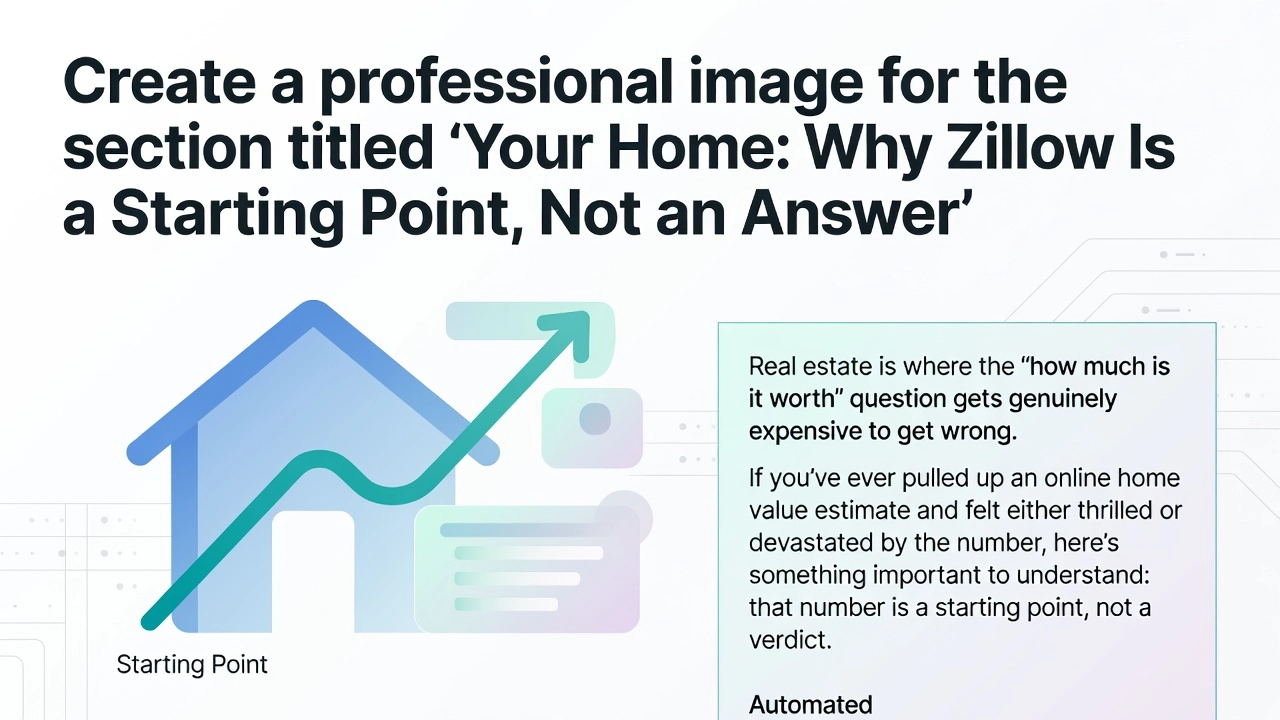
Real estate is where the “how much is it worth” question gets genuinely expensive to get wrong. If you’ve ever pulled up an online home value estimate and felt either thrilled or devastated by the number, here’s something important to understand: that number is a starting point, not a verdict.
Automated valuation models, or AVMs, work by pulling together public tax records, recent comparable sales, and listing data, then running it through an algorithm. Zillow’s Zestimate is the most widely used example in the U.S., covering roughly 125 million homes nationwide. For homes actively listed on the market, the median error rate sits around 1.78 to 1.9 percent, which on a $400,000 home is a manageable gap. For off-market homes, though, that error rate jumps to around 7 percent, which translates to a $35,000-plus swing on a $500,000 property. That is not a rounding error. That is a real financial miscalculation. And critically, no AVM can walk through your front door. It cannot see your renovated kitchen, your leaking roof, your proximity to a noisy arterial road, or the specific buyer demand on your particular street.
True home value is determined through comparable sales, commonly called comps. A licensed appraiser or real estate agent looks at recent sales of similar homes within roughly a half-mile radius, then adjusts for square footage, condition, lot size, age, and upgrades. This is what produces a Comparative Market Analysis or a formal appraisal report. These are the documents that lenders, buyers, and courts actually rely on. A CMA from a local agent is typically provided free as part of a pre-listing consultation, making it an easy first step.
Home prices are broadly projected to rise across most U.S. markets in 2026, and national data sources like the FHFA House Price Index and NAR median sale price figures give useful directional context. But national trends are background noise for your specific situation. What actually matters is what similar homes on your street sold for in the last 90 days.
For a formal appraisal report that satisfies lender, legal, or estate requirements, a licensed appraiser typically charges in the low-to-mid hundreds of dollars, with regional variation. For luxury properties, standard comp-based methods often undervalue the home significantly. Waterfront access, architectural exclusivity, land scarcity, and custom features carry weight that requires specialist appraisers who focus specifically on high-end properties and understand those distinct market dynamics.
A Small Business: Three Methods and When You Need a Pro
Figuring out what a small business is worth feels intimidating, but it really comes down to three core questions that professionals have been asking for decades.
The Three Methods in Plain English
The income approach asks: what future profits is this business expected to generate? It converts anticipated earnings into a present-day value, accounting for the risk involved in actually achieving those numbers. Businesses with strong recurring revenue, like subscription services or retainer-based agencies, tend to score well here because predictable cash flow lowers perceived risk.
The market approach asks: what have similar businesses sold for recently? Think of it like pulling comps on a house. You match your business to recent arm’s-length sales in the same industry and size range. For most small business buy/sell decisions, this approach drives the final number. The typical benchmark is a multiple of Seller’s Discretionary Earnings (SDE), and across all industries, the average SDE multiple has hovered around 2.57x, though that number shifts meaningfully depending on your sector.
The asset approach asks: what are the tangible and intangible assets worth, minus liabilities? This is most useful for asset-heavy businesses or companies being wound down. For operating businesses, it generally represents a floor value since it does not capture goodwill or earning power.
What Pushes Value Up (and When You Need a Pro)
Buyers in 2026 pay premiums for businesses that transfer cleanly. That means documented systems and processes that allow operations to run without the owner, clean financials going back at least three years, diversified customer bases, and modern technology infrastructure.
Knowing your industry’s typical multiple range is essential before entering any negotiation. Brokers like Sunbelt Atlanta publish sector-specific valuation trend data that gives you a realistic anchor point.
On the professional side, businesses under roughly $750,000 in annual revenue can usually rely on a simpler broker opinion of value for buy/sell planning. However, IRS submissions, SBA loan applications, litigation, and partner disputes all require a certified business valuation report. That level of report costs considerably more than an informal estimate, reflecting the appraiser’s credentials, analytical depth, and the defensibility of the conclusion in a formal proceeding. If there is any legal or regulatory component to your situation, skipping the certified report is a risk not worth taking.
Free Tools vs. Paid Appraisers: Which Do You Actually Need?
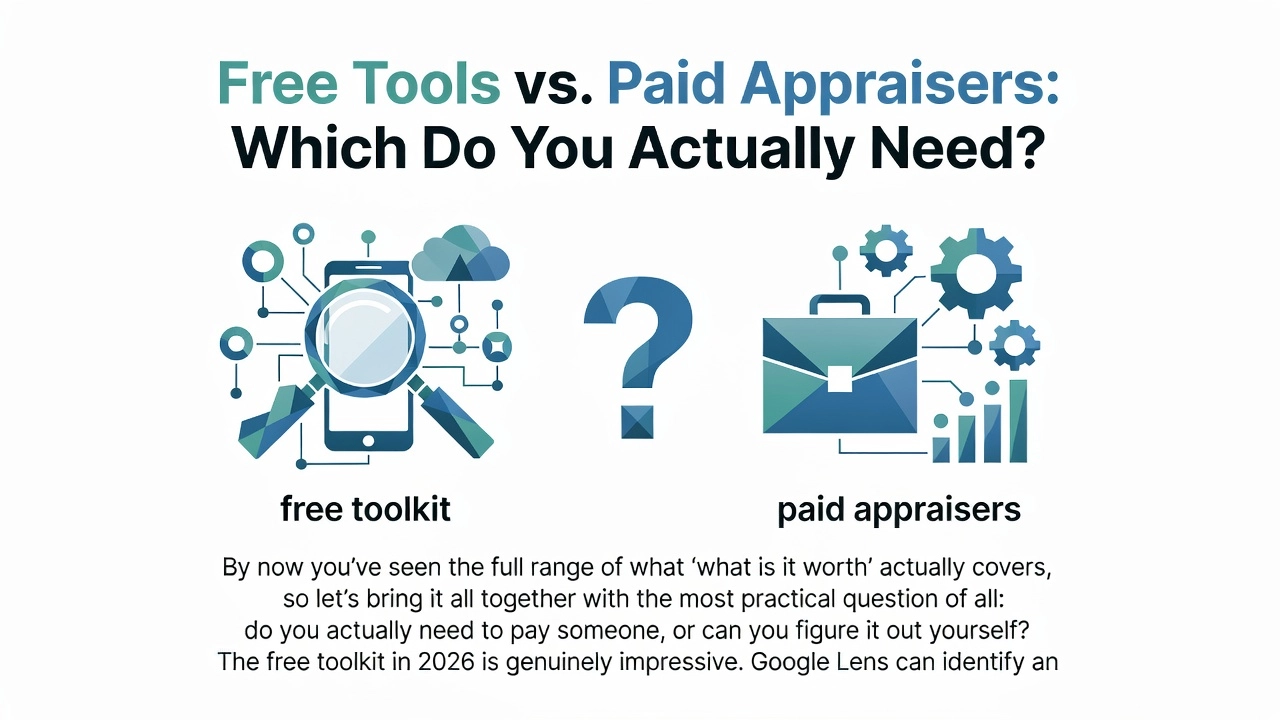
By now you’ve seen the full range of what “what is it worth” actually covers, so let’s bring it all together with the most practical question of all: do you actually need to pay someone, or can you figure it out yourself?
The free toolkit in 2026 is genuinely impressive. Google Lens can identify an item and surface similar listings in seconds. eBay’s sold filter shows you real transaction prices, not wishful asking prices. PriceCharting tracks gaming and collectibles with obsessive accuracy. Zillow and Redfin give you a residential ballpark without a single phone call. AI photo tools like Underpriced AI can deliver a valuation in under 60 seconds from one photograph. For low-stakes decisions, this toolkit is more than enough.
Paid appraisals exist for a different category of situation entirely. Licensed real estate appraisers produce legally defensible reports that lenders, courts, and tax authorities will actually accept. Certified business appraisers handle valuations for IRS submissions, partnership disputes, and business sales. Specialist auction houses provide appraisals for fine art, jewelry, and rare collectibles where the margin for error is significant. A standard paid home appraisal typically runs between $300 and $425, which sounds like a lot until you consider what’s at stake.
Here is the practical decision rule: use free tools when the stakes are low. Pricing a jacket for resale, figuring out what your old gaming console is worth, getting a rough sense of your home’s value before chatting with a realtor, all of these are perfect free-tool situations. The moment legal standing, taxes, an estate, or a divorce settlement enters the picture, you need a professional report.
The smartest approach is actually a combination. Use free tools first to build your baseline and understand your range. Then bring that research to a professional consultation. You arrive informed, the appraiser spends less time on basics, and the engagement is often shorter and less expensive as a result.
Now That You Know the Number: Keep It or Sell It?
Getting a valuation number feels like crossing the finish line, but it’s actually the starting line for a whole separate decision. Most guides hand you the number and walk away, leaving you to figure out what to do with it on your own. That second layer, whether to sell, hold, insure, or donate, is where the real thinking happens.
Once you have an estimate in hand, run through these four questions before doing anything else:
- Will this appreciate or depreciate from here? A collectible at peak hype, a home in a rising market, or a business with recurring revenue all have different trajectories than their stagnant equivalents.
- What are the net proceeds after fees, taxes, and effort? A home valued at $400,000 looks different after agent commissions, closing costs, and capital gains tax. The gross number and the money you actually pocket can be surprisingly far apart.
- What would I do with the money? According to Zillow’s Sellers and Housing Trends Report, 78% of home sellers said a major life event drove their decision to move. Use-of-proceeds planning is a primary driver, not an afterthought.
- Does the sentimental or functional value to me outweigh the market value to someone else? A practical test: would you pay today’s market price to re-acquire this item if you sold it? If yes, that’s a strong signal to keep it.
Timing is arithmetic, not speculation. Selling a gaming item during peak hype, a streetwear piece while the trend is still hot, or a home during a seller’s market will produce meaningfully better outcomes than waiting until demand cools. The window matters as much as the number.
For business owners, the valuation figure unlocks planning options beyond an immediate sale. You can use it to anchor a buy-sell agreement with a partner, benchmark your position ahead of a capital raise, or identify exactly which operational improvements, like reducing owner-dependency or building recurring revenue, would raise your multiple before going to market.
Finally, there is one scenario most guides miss entirely: when an item’s resale value is low but its replacement cost is high. Specialty tools, vintage electronics in working condition, and niche hobby equipment often fall into this category. Selling might net you very little, while replacing the item later could cost significantly more. In that case, keeping the item and insuring it at replacement cost value, not depreciated actual cash value, is often the smarter financial move.
The Bottom Line on Figuring Out What Something Is Worth
Every category covered in this guide comes down to five rules you can apply starting today. Always anchor to sold prices, not asking prices or automated estimates, whether you’re pricing a vintage jacket, a collectible, or a piece of real estate. Asking prices tell you what sellers hope to get; sold prices tell you what buyers actually paid, and that gap is often significant.
Match the tool to the stakes. Free AI photo tools and platform search work perfectly well for everyday items. Anything with legal, tax, insurance, or financial consequences deserves a licensed professional.
Know which type of value you need before you start, because market value, resale value, replacement value, and assessed value each point you toward a different tool and a different number.
Turn your number into a decision. Valuation without action is just trivia. Run the keep-vs-sell thinking once you have a figure.
Finally, revisit your valuations periodically. Markets shift, trends move, and an item worth $200 today could be worth considerably more or less in 12 months. Set a reminder and check again.