

Remember when “the network” just meant a bunch of computers plugged into the same wall? Those days are long gone, and if you’re running a business today, the way your technology connects and communicates has changed in some pretty dramatic ways.
Digital network architecture, which is basically the blueprint for how your business’s technology infrastructure is designed and organized, has gone through some massive transformations over the past few years. And honestly, you don’t need to be a tech wizard to understand why these changes matter to you and your bottom line.
Whether you’re a small business owner trying to make sense of all the buzzwords your IT person keeps throwing around, or an entrepreneur looking to scale up your operations, knowing what’s shifting in the world of networking can save you time, money, and a whole lot of headaches.
In this post, we’re breaking down 8 major shifts in digital network architecture that every business owner should have on their radar. No confusing jargon, no overwhelming technical deep dives. Just straightforward, practical insights that help you make smarter decisions for your business. Let’s get into it.
What Is Digital Network Architecture, Really?
Think of digital network architecture as the master blueprint for how everything connects in a digital environment. It determines how your devices, data centers, cloud services, and everyday users communicate with each other, whether that’s within a single company or across the entire internet. It’s not one piece of software or a single router sitting in a closet. It’s a layered system of hardware, software, protocols, and design decisions that work together as one cohesive whole.
A helpful way to picture it: imagine the road and highway system of a busy city. The architecture decides how many lanes are on each road, what the speed limits are, where the traffic signals go, and what detour routes kick in when an accident blocks the main highway. A well-designed city keeps traffic flowing smoothly even during rush hour. A poorly designed one creates gridlock at the worst possible moments. Digital network architecture works exactly the same way, just with data instead of cars.
Here’s why this matters even if you’ve never worked in IT a single day of your life. Every time an app opens instantly, a video streams without that spinning buffer wheel, or your credit card payment goes through without a hiccup, network architecture is the invisible system running quietly in the background making it all happen. It’s the reason some digital experiences feel effortless and others feel frustratingly slow.
And right now, 2026 marks a real turning point. Enterprise networks are no longer described as passive data pipelines. Analysts are calling them intelligent platforms designed to adapt, secure, and optimize themselves in real time. According to current data center industry trends, the push is toward networks that actively improve user experience rather than simply carrying traffic from point A to point B.
The scale of investment signals just how critical this infrastructure has become. The data center networking market is on a steep growth trajectory, with one analysis from Precedence Research projecting the market to surpass USD 126.80 billion by 2035. This is a space where billions of dollars are being poured in because businesses now understand that strong network architecture is not optional; it’s the foundation everything else is built on.
Trend 1: AI-Native Networks Replace the Old ‘Bolt-On’ Approach
Here is something worth understanding right away: not all AI in networking is created equal. There is a big difference between a network that has AI tools added on top of it versus a network that was built with AI at its core from the very beginning. The older approach, often called “bolt-on AI,” is a bit like taping a smart speaker onto an old radio and calling it modern. The underlying system was never designed for AI, so performance bottlenecks, instability, and costly workarounds tend to pile up over time. According to research comparing AI-native and bolt-on architectures, an estimated 80% of bolted-on AI implementations fail to deliver their promised results in enterprise environments.
AI-native networks flip this completely. As explained by Stackpoint’s breakdown of AI-native vs. bolt-on products, these systems are “built from the ground up with AI as the core foundation,” meaning every layer, from data collection to policy enforcement, is designed to support real-time inference and continuous learning. Telemetry is baked in from the start, learning loops improve decisions automatically over time, and the network can enforce policies without waiting for a human IT team to file a ticket.
A helpful way to picture this: think about a smart home versus a regular one. In a smart home, the thermostat adjusts before you feel cold, the lights dim when you settle in for a movie, and the security system recognizes familiar faces automatically. A regular home requires you to manually flip every switch. AI-native networks work the same way. Instead of just alerting someone that traffic is slow, the network identifies why it is slow, predicts whether the problem will get worse, and reroutes traffic automatically.
Small business owners, this matters to you too. Even if you run a five-person team using cloud software like QuickBooks or Google Workspace, you are already relying on AI-native network infrastructure. Your cloud providers have built these intelligent backbones into their platforms, which is why your apps load quickly and stay reliable. Fluent AI’s comparison of AI-native vs. bolt-on solutions puts it well: the best AI-native systems handle complexity so seamlessly that users simply experience reliability, without seeing the work happening underneath.
Finally, this shift is changing who companies are hiring. Demand for professionals skilled in AI, cloud, and security networking is reshaping enterprise IT teams heading into 2026, as organizations recognize that running intelligent networks requires a new kind of expertise.
Trend 2: Networks Are Now Being Built Around Generative AI Workloads
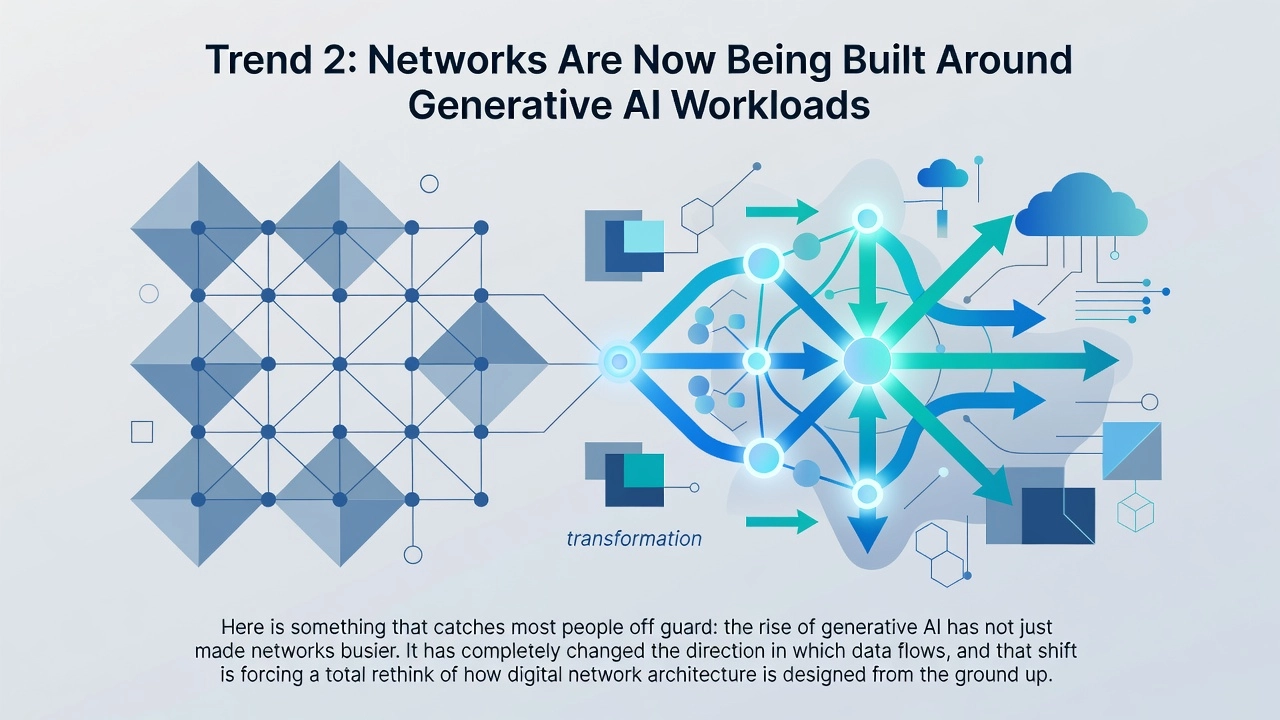
Here is something that catches most people off guard: the rise of generative AI has not just made networks busier. It has completely changed the direction in which data flows, and that shift is forcing a total rethink of how digital network architecture is designed from the ground up.
The Difference Between North-South and East-West Traffic
Traditional networks were built around what engineers call north-south traffic. Picture a customer walking into a retail store, picking up an item, paying, and leaving. That is essentially what traditional data movement looks like: a user sends a request, a server responds, and the data travels back. Clean, simple, and directional. Most business networks for the past few decades were optimized entirely around this pattern.
Generative AI breaks that model completely. When an AI is training or running inference, it does not just need to talk to one server and back. It needs thousands of compute nodes, GPU clusters, storage systems, and cloud resources to talk to each other, constantly, simultaneously, and at enormous speed. This is east-west traffic, and the volume is staggering.
The warehouse analogy makes this click instantly. North-south traffic is like customers walking in and out through the front door of a store. East-west traffic is like every single forklift inside a massive warehouse moving inventory between shelves, loading docks, storage rooms, and packing stations all at the same time, nonstop, without pause. The internal activity dwarfs anything happening at the entrance.
Why This Demands Purpose-Built Infrastructure
This shift carries serious infrastructure consequences. AI model training requires thousands of GPUs to exchange data with each other in near-real time. Any bottleneck, even a tiny one, slows down the entire training run and can make AI tools noticeably sluggish. General-purpose business networks simply cannot handle this kind of workload without significant rebuilding.
To keep up, Ethernet speeds inside AI data centers are now scaling to 200G, 400G, and even 800G, a dramatic leap from the 10G or 25G connections that powered most data centers just a few years ago. Upgrading AI data centers from 400G to 800G is already underway across the industry, with 1.6T speeds emerging as the next frontier on the horizon.
What This Means for Your Business
Here is the part that directly affects you as a business owner or everyday user of AI tools. Every ChatGPT integration, AI-powered marketing platform, or automated customer service bot your business relies on runs on data centers whose underlying networks are being rebuilt around exactly these east-west, high-throughput demands. As AI training and GPU clusters scale, growing east-west traffic is accelerating the urgency of these upgrades industry-wide. The speed and reliability you experience when using those tools is directly tied to whether the network underneath them can move data fast enough across hundreds of nodes at once. The billions being invested in faster Ethernet, denser fiber, and purpose-built AI switching is, at its core, the infrastructure investment that makes your AI tools faster and more dependable every single day.
Trend 3: The Death of the Perimeter and the Rise of Zero Trust Security
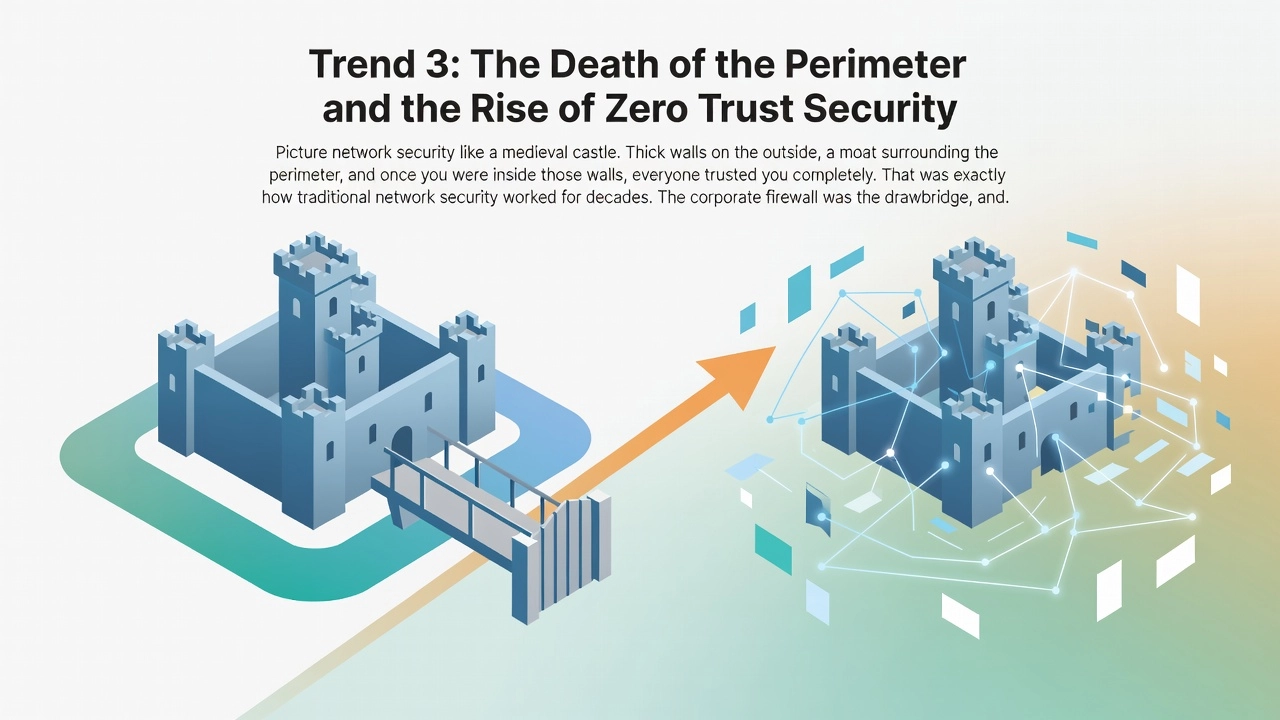
Picture network security like a medieval castle. Thick walls on the outside, a moat surrounding the perimeter, and once you were inside those walls, everyone trusted you completely. That was exactly how traditional network security worked for decades. The corporate firewall was the drawbridge, and if you were inside the office network, you were considered safe. Everything outside was blocked; everything inside was free to roam.
The problem? That model was designed for a world where everyone worked in the same building and all the important data lived on servers down the hall. The moment employees started working from home, using personal laptops, and storing files in cloud apps like Google Workspace or Microsoft 365, the walls of the castle basically dissolved. There is no single perimeter to defend anymore. Attackers who figure out one set of login credentials can walk right in and move freely, because the old model never questioned anyone already “inside.”
Enter SASE and Zero Trust: A Smarter Way to Think About Security
This is where two important ideas come into play. The first is SASE (Secure Access Service Edge), which is essentially a framework that bundles network security and connectivity into a single cloud-delivered service so security travels with the user, not just the office building. Instead of traffic funneling back through a central corporate firewall, SASE enforces security policies wherever the user happens to be. You can learn more about how this approach works in practice through Microsoft’s guidance on securing networks with SASE, Zero Trust, and AI.
The second idea is ZTNA (Zero Trust Network Access). The core principle is simple: trust nobody automatically, not even users already inside the network. Every single access request gets verified every time, based on identity, device health, and context. No free passes, no assumptions.
AI Is Now Running Security in Real Time
What makes modern Zero Trust frameworks genuinely powerful is the AI layer underneath them. AI-driven security models continuously scan behavior patterns across the entire network, flagging unusual activity the moment it appears. According to 2026 security trend reporting from Open Systems, the industry is moving decisively from fragmented tool stacks toward AI-powered, consolidated platforms. Human security teams simply cannot review millions of data points per second manually; AI can, and it responds to threats far faster than any manual process allows.
HPE’s analysis of SASE trends for 2026 confirms that market leaders are leaning heavily on AI to keep pace with increasingly sophisticated threats, extending protections even to unmanaged devices connecting to corporate resources.
Why This Matters Even If You Run a Small Business
Here is the part that surprises most small business owners: if your team uses remote workers, subscribes to SaaS tools, or stores data in the cloud, you are already operating inside SASE and Zero Trust frameworks. Your cloud providers have quietly built these protections into the services you pay for every month. Gartner estimates that over 60% of enterprises will have adopted SASE architecture by 2026, and small businesses are increasingly included in that shift through their vendor relationships.
Understanding these concepts will not make you a security engineer overnight, but it will help you ask smarter questions. When evaluating an IT vendor or managed service provider, asking “do you support Zero Trust policies?” or “is your security SASE-based?” signals that you understand the landscape, and that matters when choosing partners who will protect your business as it grows.
Trend 4: Post-Quantum Cryptography Is Closer Than You Think
Let’s talk about something that sounds like science fiction but is very much a present-day planning concern for anyone building or managing network infrastructure in 2026.
Here is the simplest way to understand the threat. The encryption protecting your passwords, your online banking, and your private messages works because today’s computers would take millions of years to crack it through brute force. Quantum computers operate on completely different physics, and when they reach full power, they will be able to break that same encryption in hours or even minutes. This is not a distant hypothetical. Researchers warn that adversaries are already running what are called “harvest now, decrypt later” attacks, capturing encrypted data today and storing it with the plan to decrypt it once quantum computing matures. If your business sent sensitive contracts or customer records over the internet in the last few years, that data could already be sitting in someone’s archive waiting for that moment.
What Post-Quantum Cryptography Actually Means
Post-quantum cryptography, often shortened to PQC, refers to a new generation of encryption algorithms built to withstand quantum-powered attacks. The U.S. National Institute of Standards and Technology spent years running a global competition to identify and finalize these algorithms, and those post-quantum cryptography standards are now published and available for use today. Network architects are not waiting around anymore; they are actively designing systems with PQC compatibility baked in from the start. In 2026, a White House executive order elevated PQC readiness from a voluntary best practice to a government-mandated priority for federal systems, creating ripple effects across any organization that works with or supplies the government.
Why This Is a Political Issue, Not Just a Technical One
The NCCoE migration guidance makes one thing very clear: this is as much about digital sovereignty as it is about encryption. Different governments are mandating different algorithms. China requires its own SM-series standards for critical infrastructure and will not accept NIST-approved options. The EU is building independent requirements through its own cybersecurity agency. This means multinational organizations cannot rely on a single encryption strategy; their network architecture needs what experts call “crypto-agility,” the ability to swap cryptographic approaches by region without rebuilding entire systems from scratch.
For business owners, the takeaway is practical and immediate. If your business handles customer payment data, medical records, legal documents, or any proprietary information, your hosting provider and network infrastructure partners need to have a clear answer when you ask about their PQC roadmap. Asking your vendors “what is your post-quantum readiness plan?” is a completely reasonable evaluation question heading into 2026 and beyond. The security architects’ guide from QSECDEF confirms that organizations across banking, defence, and healthcare are already making this part of their vendor selection criteria. You should too.
Trend 5: High-Speed Ethernet Is Rewiring the Data Centers Behind Your Apps
Think of Ethernet as the digital equivalent of a highway system running inside every data center. You probably recognize the concept already: it is the same basic technology as the cable you might plug into the back of your home router to get a wired internet connection. Inside a data center, however, that same fundamental idea scales up to connect thousands of servers, storage systems, and networking devices all talking to each other at once. The cable in your living room and the Ethernet fabric inside a major data center share a family resemblance, but comparing them is a little like comparing a garden hose to a municipal water main.
The Speed Numbers Are Hard to Wrap Your Head Around
Here is where things get genuinely impressive. Most home internet users celebrate hitting 1 gigabit per second speeds. Network engineers deploying infrastructure inside enterprise data centers in 2026 are working with Ethernet connections running at 200G, 400G, and even 800G. That is not a small step forward; it is hundreds of times faster than what most people consider a blazing home connection. This dramatic speed jump is being driven almost entirely by AI workloads, specifically the enormous data demands of training and running large language models. According to a comprehensive market insight into 800G switches, 800G is rapidly becoming the benchmark tier for modern AI data center networks, with 1.6 terabit Ethernet already visible on the horizon as the next step beyond that.
Why This Has Nothing to Do With Being Technical
You do not need to understand fiber optics or switching architecture to care about this trend. When you open a cloud-based application, ask an AI tool to generate something, or jump on a video call, every one of those actions depends on data moving quickly between servers inside a data center. If that internal network is slow or congested, you feel it directly as lag, slow load times, or dropped connections. Fast internal Ethernet is the foundation beneath every real-time digital experience you rely on.
The data center network infrastructure market is projected to reach USD 252.83 billion (verify the exact figure and timeline at source before publishing), which tells you something important: an enormous amount of capital is flowing into exactly these kinds of upgrades right now.
What Small Businesses Should Actually Take Away
If you run a small business and you are comparing hosting providers or cloud platforms, you are making a choice that goes deeper than price or storage limits. You are indirectly selecting the network infrastructure that will back your website, your customer-facing tools, and your business applications. A provider that has invested in modern high-speed Ethernet fabric will consistently outperform one running on older, slower internal connections, especially as AI-powered features become standard across business software. Asking about infrastructure specs or checking whether a provider has made recent network investments is a reasonable and worthwhile step before committing to a platform.
Trend 6: Wi-Fi 7 Is the New Enterprise Wireless Standard
If the previous trends felt more abstract, this one is refreshingly tangible. You have almost certainly connected to Wi-Fi today, and Wi-Fi 7 is the latest and most capable version of that familiar technology. Formally known as IEEE 802.11be, it succeeds Wi-Fi 6 and Wi-Fi 6E and is built specifically to handle the kind of crowded, high-demand environments that older wireless standards were never designed for. Think busy hospital floors, warehouse operations with dozens of scanners and robots running simultaneously, retail stores packed with point-of-sale systems, and hybrid offices where half the team is on video calls at any given moment.
The Highway Analogy That Actually Makes Sense
The biggest technical leap in Wi-Fi 7 is something called Multi-Link Operation, or MLO. Previous Wi-Fi generations could only use one frequency band at a time, even if multiple bands were available. Wi-Fi 7 lets a device send and receive data across multiple frequency bands simultaneously, covering 2.4 GHz, 5 GHz, and 6 GHz all at once. Using the highway analogy from earlier in this post, older Wi-Fi just increased the speed limit on a single lane. Wi-Fi 7 adds several express lanes running in parallel at the same time. The result is not just faster speeds but more consistent performance, which is exactly what real-time applications like wireless medical devices, inventory robots, and video conferencing actually need. According to IDC, Wi-Fi 7 already captured 44% of enterprise wireless access point revenue in Q1 2026, confirming this is well past the early-adopter stage.
Who Is Using It and Why It Matters for You
Healthcare organizations are deploying Wi-Fi 7 to support wireless patient monitoring equipment. Retailers are using it to keep point-of-sale systems running without lag during peak hours. Logistics companies rely on it for real-time warehouse tracking. And hybrid offices are adopting it so that large video calls and cloud application access stay smooth regardless of how many people are connected.
If you run a small office or home-based business and are shopping for new routers or access points right now, Wi-Fi 7 compatibility is worth prioritizing as a future-proofing decision. The hardware is commercially available in 2026 at increasingly accessible price points, and buying Wi-Fi 7 ready equipment today means your network stays relevant as your device count grows.
It is also worth noting that Wi-Fi 7 does not exist in isolation. It is part of the same larger story this entire post has been building toward: wireless and wired infrastructure being redesigned together to support AI workloads, cloud connectivity, and dense device environments all at once.
Trend 7: Open Networking Platforms Are Breaking Vendor Lock-In
Here is a trend that speaks directly to one of the most frustrating realities in enterprise IT: once you commit to one vendor’s ecosystem, getting out feels nearly impossible. Open networking is changing that, and it is doing so in a way that benefits organizations of almost every size.
Open networking, in the simplest terms, is a movement toward separating the software that runs a network from the physical hardware it runs on. Traditionally, when a company bought networking equipment, the hardware and the operating system came bundled together as one locked package. Open networking breaks that bundle apart, allowing IT teams to source hardware from one provider and run software from an entirely different one, including open-source options from community-driven projects.
The most prominent example of this shift is SONiC, which stands for Software for Open Networking in the Cloud. It is an open-source network operating system originally built by Microsoft for its Azure data centers and later contributed to the Linux Foundation in 2022. Today, SONiC has grown into a massive community project with over 4,250 contributors across more than 520 organizations, growing at roughly 20% year over year. Some experts have described it as the potential “Linux of networking,” which is a meaningful comparison given how Linux transformed server computing.
Think of it this way. Choosing open networking over a proprietary system is a lot like choosing a smartphone where you can install any app from any developer, versus a locked device where only the manufacturer controls every piece of software you can use. One gives you freedom and flexibility; the other keeps you dependent on a single company’s decisions, pricing, and release schedule.
The business benefits here are real and practical. Open networking platforms reduce total cost of ownership, give IT teams genuine control over their infrastructure choices, and make scaling much easier as AI and cloud demands grow. In 2026, with enterprise networks increasingly expected to support AI workloads and rapid change, that flexibility is not just convenient; it is strategically essential. SONiC’s expanding enterprise adoption signals that even large organizations are choosing adaptability over the comfort of all-in-one proprietary solutions.
Trend 8: Private Cloud Growth and the Coming 5G/6G Convergence
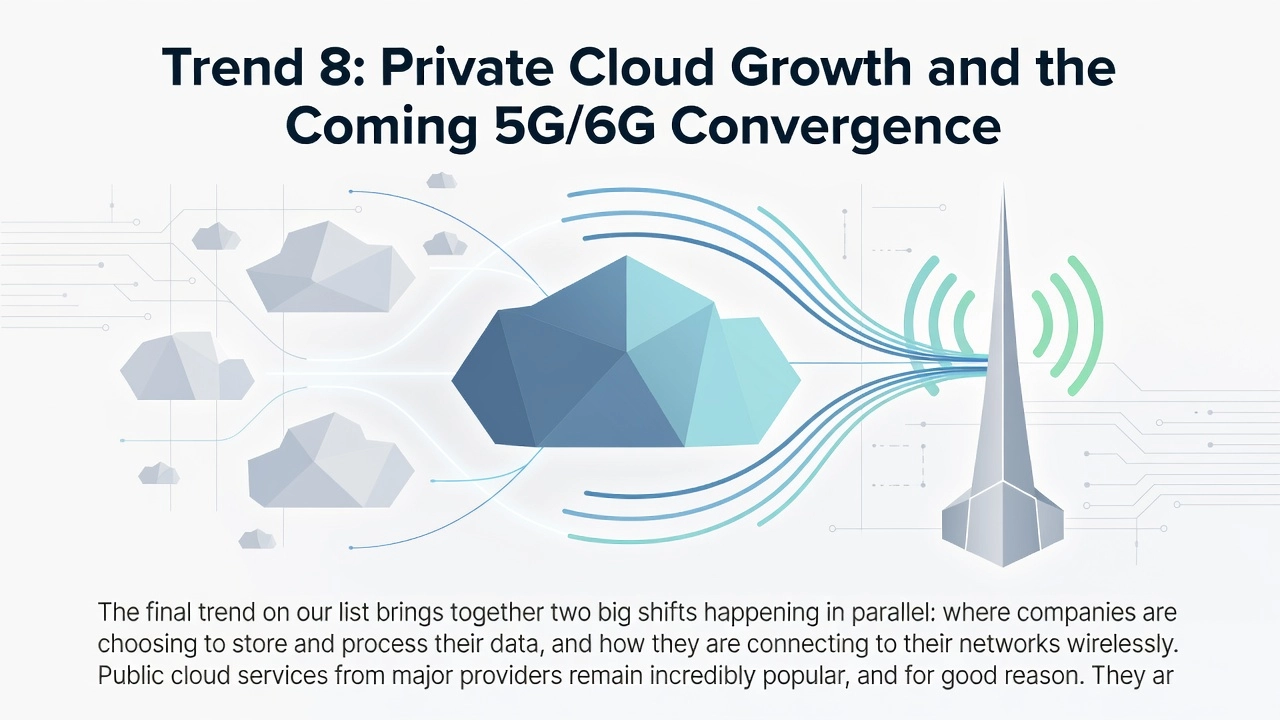
The final trend on our list brings together two big shifts happening in parallel: where companies are choosing to store and process their data, and how they are connecting to their networks wirelessly.
The Hybrid Cloud Reality Nobody Talks About
Public cloud services from major providers remain incredibly popular, and for good reason. They are flexible, relatively affordable to start with, and easy to scale up quickly. But here is what is changing in 2026: more enterprises are also spinning up private cloud infrastructure alongside those public services rather than relying on public cloud alone.
Think of it this way. Public cloud is like renting a desk in a shared coworking space. It is convenient and cost-effective, but you share the building with other tenants and have limited say over how things run. Private cloud is like owning your own office. You handle the upkeep and the upfront costs, but you control everything inside, from the layout to who gets a key. Enterprises handling sensitive data under regulations like GDPR or HIPAA often find that owning their own space is simply non-negotiable. Hybrid cloud, which blends both models, has quietly become the standard strategy for larger organizations in 2026.
5G Is Already Transforming Enterprise Connectivity
On the wireless side, enterprise networking and mobile network technology are converging fast. Private 5G networks are no longer just a telecom concept; they are becoming a real infrastructure layer for factories, warehouses, remote job sites, and field operations. The 5G Enterprise Private Network market was valued at USD 4.10 billion in 2025 and is projected to reach USD 5.71 billion in 2026, with forecasts pointing toward USD 155.89 billion by 2036, reflecting a 39.2% compound annual growth rate. That is not gradual growth; that is a signal that enterprises are treating 5G as a serious replacement for wired connections in many environments.
6G Is Already on the Planning Radar
While 5G is actively rolling out, 6G is already shaping how architects think about future infrastructure. At MWC Barcelona 2026, leading executives were openly discussing 6G alongside 5G-Advanced and AI-driven radio access networks. Commercial 6G is generally expected in the early-to-mid 2030s, but smart infrastructure teams are building with that horizon in mind today rather than scrambling to retrofit later.
For small businesses, the practical takeaway is straightforward. Better 5G-powered options are arriving for remote teams and pop-up operations that previously depended on unreliable wired setups. And when evaluating cloud hosting vendors, do not just accept the cheapest public cloud plan by default. Ask specifically about data residency guarantees and performance SLAs, because in 2026, those details matter more than ever.
What These Network Changes Mean for Your Website and Small Business
All eight trends covered in this guide are not just happening inside corporate data centers. They are actively shaping the experience your website visitors have right now, and understanding that connection puts you ahead of most small business owners.
Your Hosting Provider Is Riding These Trends Whether You Know It or Not
The infrastructure powering your website sits inside a data center somewhere, connected to networks that are increasingly built around AI-native architecture, high-speed connectivity, and Zero Trust security principles. When your hosting provider runs on modern infrastructure, you benefit from faster server response times, more reliable uptime, and security systems that detect and block threats automatically. A 1-second delay in page load time can reduce conversions by 7%, and 53% of mobile users abandon sites that take longer than 3 seconds to load. Those numbers are directly tied to what is happening at the infrastructure level, not just your website design.
CDN Quality Comes Down to Network Architecture
A content delivery network distributes copies of your website files across servers in different geographic locations, so visitors load your site from a nearby server rather than one located far away. Here is the part most people miss: the quality of the backbone network connecting all those CDN nodes determines how fast your content actually reaches visitors. A CDN built on top of outdated, low-bandwidth infrastructure will underperform compared to one running on modern high-speed connectivity, even if the server count looks impressive on paper. In 2026, the best CDN setups also come with built-in DDoS protection and real-time threat response baked into the same network layer.
What WordPress Site Owners Should Be Asking Right Now
WordPress powers over 43.5% of all websites as of 2026, making it the most common foundation for small business sites by a wide margin. Choosing the right hosting partner for a WordPress site is no longer just about storage and bandwidth. It is about whether that provider’s underlying infrastructure includes fast server-to-server data paths, AI-driven security monitoring (meaning automated threat detection, real-time malware scanning, and anomalous traffic flagging), and CDN integration at the infrastructure level rather than as a paid add-on.
Three Questions to Ask Any Hosting or IT Vendor
You do not need a technical background to evaluate your current setup. Ask these three questions and pay attention to how confidently a vendor answers them.
- “What data center infrastructure do you run on?” A strong answer includes specifics about data center tier levels, redundancy, and network connectivity speeds. Vague or single-region answers are a flag.
- “How do you handle security threats in real time?” Look for mentions of AI-driven monitoring, automated DDoS mitigation, and Zero Trust access controls. Zero Trust simply means no user or device is automatically trusted; every access request gets verified every single time, which is far more secure than older perimeter-based models.
- “Where is my data physically stored and who controls it?” This matters for regulatory compliance, especially if you serve customers in regions covered by laws like GDPR. A good answer is specific about data residency locations and clearly states who has access.
Businesses working with a web development or managed hosting partner should apply these same questions during the evaluation process. The infrastructure decisions made at that stage will shape your site’s performance, security, and scalability for years ahead.
Staying Ahead Without Being a Network Engineer
Here is the honest takeaway from everything covered in this guide: digital network architecture in 2026 is not something you need a technical degree to care about. It is the foundation underneath every app you open, every cloud tool your business relies on, every website your customers visit, and every AI feature your software vendor is promoting. Its rapid evolution affects anyone connected to the internet, whether you manage a small business or simply use one.
The good news is that staying ahead does not require you to become a network engineer. It requires a few practical habits. Where your setup allows it, upgrading wireless hardware to Wi-Fi 7 is a meaningful and accessible improvement. When evaluating hosting providers or cloud platforms, ask direct questions about AI-driven security and where your data physically lives. When choosing digital tools, pay attention to the infrastructure specs behind them, because performance and reliability are built at that level, not just at the surface.
The intelligence shift happening across modern networks is also working in your favor. As networks become self-optimizing and self-healing, businesses that simply choose the right infrastructure partners benefit from stronger performance and security automatically, without managing it themselves.
Finally, if your business runs a website or is planning one, the network supporting that site matters just as much as the design on it. That is worth a real conversation with a web development partner who understands both sides.
Conclusion
The digital networking landscape is evolving fast, and staying informed is no longer optional for business owners who want to remain competitive. Here are the key takeaways to keep in mind: modern networks are built for flexibility and cloud integration, security is now embedded into the architecture itself rather than bolted on as an afterthought, and scalability is something you can plan for from day one.
These shifts are not just technical upgrades. They directly impact your costs, your team’s productivity, and your ability to serve customers reliably.
Ready to take the next step? Start by having an honest conversation with your IT team or technology partner about where your current infrastructure stands. Ask which of these shifts your business has already embraced and which ones need attention.
The businesses that thrive tomorrow are the ones making smart network decisions today. Don’t wait to get started.